
On this pageTable of contents+

What happens if training data acquires a price?
What happens if access to content moves from default crawling to negotiated permission?
How long can existing SEO strategies, content budgets and brand-visibility plans continue unchanged?
In July 2025, Cloudflare introduced a new variable for AI crawlers. The source article interpreted it not merely as a product update, but as an early sign of change in the rules governing access.
The announcement was quiet, but potentially important.
It affected three questions: who may read your content, whether AI systems can understand it, and whether it may appear in generated answers.
Key Points
- Cloudflare introduced a private-beta mechanism that lets participating sites charge selected AI crawlers per successful retrieval, using HTTP 402 responses and payment headers to manage access and pricing.
- The article presented this as an early attempt to turn crawler access into a structured commercial transaction rather than an assumed entitlement.
- Traditional SEO ranking systems did not change immediately, but crawler access became another strategic control point.
- The article argued that GEO visibility may depend partly on whether a system can access content for training or retrieval, rather than only on whether a search engine can find it in real time.
- Content strategy therefore starts to include who may access a page and whether automated systems can interpret and cite it, not only how the page is published.
- In the article's view, content owners were beginning to regain some control over distribution in the AI era.
1. The Traffic Problem Created by AI Crawlers Is Becoming Visible
Over the preceding years, AI systems had crawled large volumes of website content while sending relatively little referral traffic.
That weakened the old exchange in which publishers made content available and received visits in return.
Cloudflare reported that GPTBot alone had reached more than 40 percent of websites on its network.
Yet those sites received little corresponding referral traffic.
The source cites Cloudflare ratios of roughly 1,500 crawls per referral for GPTBot and 60,000 to one for ClaudeBot, while Google's ratio reportedly moved from six to one to 18 to one. These figures describe Cloudflare's source-era network data, not a universal current benchmark.
The content was retrieved, but the users did not arrive.
The clearest effects were felt by sites that depended on organic discovery, including:
Content-led independent sites; high-value brand sites such as DTC businesses; and advertising-funded platforms and publishers.
For these sites, lost visits affected revenue, not merely ranking positions.
At the same time, many site owners had little visibility into AI crawler activity and even less ability to control or price it.
Cloudflare intervened at this point with a technical mechanism intended to reshape the relationship between AI crawlers and content owners.
2. What Did Pay Per Crawl Change?
This section gives only a high-level explanation of Pay Per Crawl. Readers who need implementation details should use Cloudflare's current documentation because the product remains subject to change.
Pay Per Crawl did not create a new internet protocol or redesign the structure of the web.
It added a payment-control layer to an existing crawling process.
When an eligible AI crawler requests a protected page without an acceptable payment intent, the service can return HTTP 402 Payment Required and disclose the configured crawl price.
If the crawler accepts the price and sends the required authenticated payment headers, a successful request can return the normal content.
If it does not accept or satisfy the requirement, access is not granted through the paid route.
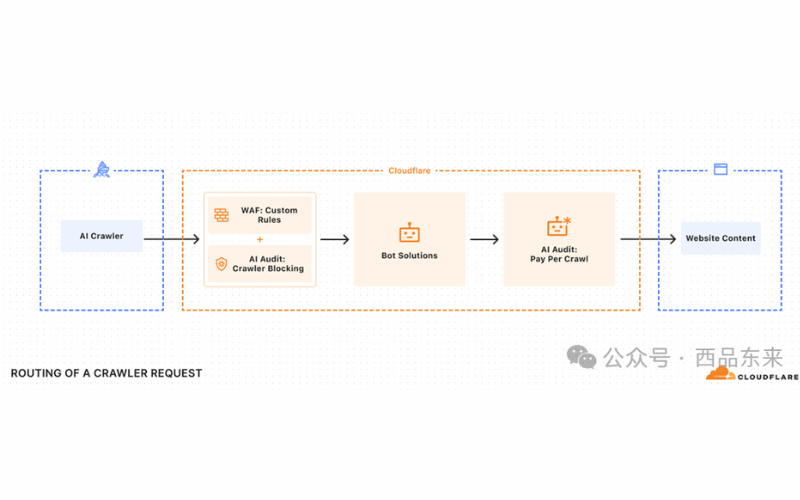
The participating site can choose how selected crawlers are handled:
Allow, charge or block.
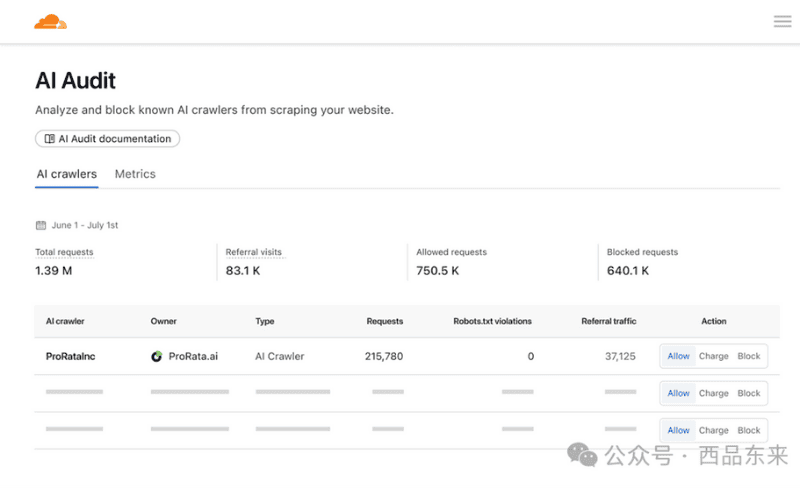
Cloudflare supplies the underlying mechanism, while the content owner configures the policy.
Two parts of this shift mattered most to the source article.
First, it challenged the default.
Previously, a capable crawler could often read publicly available pages unless the site had deliberately created a restriction.
The new mechanism gave participating sites a practical way to attach a price to some crawler access.
Second, it lowered the operational barrier.
Previously, charging an automated system required technical infrastructure, a negotiation channel and custom interfaces that few publishers could build.
Cloudflare is a major content-delivery and security provider with visibility into bot traffic across a large share of the web, placing it directly in the request path for participating sites.
For the first time at this scale, a content owner could set conditions and establish a price reference without rebuilding the underlying website.
Whether a site should charge is a separate decision. The important change was that a charging mechanism now existed, initially through a private beta.
3. The Main Implications for Traditional SEO
The source saw the possibility of formal controls around crawler access as a new development for search.
Pay Per Crawl turned the question of who may retrieve content from a largely default-open practice into something that could be controlled, restricted or priced for selected AI crawlers.
At the time of the source article, the product was aimed at AI crawlers rather than ordinary Googlebot or Bingbot search crawling.
Most publishers were also unlikely to charge or block search crawlers in the short term because they still depended on organic traffic.
The underlying assumption about access had nevertheless begun to change.
Historically, search engines and websites operated through an implicit exchange:
The site allowed crawling, and the search engine could send traffic.
Once automated retrieval acquires a transaction layer, the idea that every crawler should receive free access is no longer automatic.
At a broader level, the source viewed this as an early form of bargaining power at the technical foundation of search.
That could become an important turning point for the future search ecosystem.
At an operational level, familiar SEO practices did not suddenly stop working.
Google still supplied a large share of organic traffic for many sites, and its established search systems still justified investment.
There were nevertheless signs that the edges of that model were shifting.
AI-generated answers were moving higher in some result pages; the traffic response to content updates could be slower; and crawling could rise without producing a comparable increase in visits.
Content could be read without being distributed or clicked.
Cloudflare did not cause this pattern, but Pay Per Crawl made one trend more concrete:
Content owners might regain some control over distribution.
If search and discovery services eventually became subject to more explicit access rules and negotiation,
SEO could become one part of a broader content-asset management discipline rather than only a practice of optimizing pages.
Robots directives and crawler controls would then need to reflect content value and expected return, not merely a simple allow-or-block decision.
Charge or allow; license or block; open selected paths or introduce access in stages.
These questions were rarely part of everyday SEO work before, but they were beginning to have practical relevance.
Content-intensive sites that depended heavily on search needed to watch this structural change.
4. The Main Implications for GEO
The source asks whether appearing in AI answers may depend partly on whether a system has encountered the content in training or retrieval.
AI answer systems can draw on more than one technical stage, including:
A training stage,
in which crawlers and licensed datasets may supply web pages, documents and structured material used to build a model's language capabilities and knowledge representations.
And a retrieval stage,
in which a system may use search or other tools at answer time to obtain current information.
Some site owners assume that allowing Bing or Google to crawl a page means every AI product can see and use it in the same way.
The technical pathways are more complicated than that.
Training influences a model's general patterns for language and answer construction.
Retrieval supplies information at the time of a request,
but the availability and ranking of that information depend on the product, query, index, permissions and source-selection systems involved.
This distinction is central to the source article's interpretation of Pay Per Crawl.
Cloudflare gave participating sites ways to charge, restrict or block selected AI crawlers.
If more publishers introduced access barriers, some model developers or retrieval systems might not receive the same content through crawling.
The source argues that a system unfamiliar with a brand may have less context for evaluating and representing it, even when a page later becomes retrievable.
That could make selection, citation and accurate expression of the brand's intended value more difficult.
GEO is concerned not only with appearing in a ranked result, but with whether an answer system can understand, trust and mention a source.
The article argues that access during training can contribute to that outcome, although retrieval, indexes, product design and source quality also matter and the relationship is not deterministic.
In this sense, Pay Per Crawl changes three practical variables:
What an AI system may retrieve, what the website can control and where the boundaries of available training or retrieval data may be drawn.
At the individual-site level,
this could create another access threshold for independent sites that rely on knowledge, brand evidence and trustworthy content.
A site absent from a system's training data may still be found through retrieval, but the source suggests that the system may have less prior context for interpreting or selecting it.
At the ecosystem level,
if model-accessible datasets increasingly favor content that is freely available, the resulting information pool may overrepresent open sources and underrepresent restricted ones.
That could influence how industries, brands and authority are represented in generated answers.
The effects would not necessarily appear immediately in traffic or conversion data, but the source argues that they could reshape the operating assumptions of GEO.
Visibility in an AI answer may be connected to whether the system can obtain, understand and select the content through its available pathways.
This is easy to overlook in future competition for content visibility.
For a brand,
the question may eventually matter as much as a conventional ranking position.
5. From Paid Crawling to Paid Agents: Possible Directions
Cloudflare's mechanism used HTTP 402 Payment Required, a status code long reserved for future payment use.
Its renewed use created a path not only for paid crawling, but also for more complex forms of licensed data access.
If paid crawling is only an early stage, possible developments include:
Dynamic pricing: different content, paths and uses could carry different prices, such as a news homepage versus an archive or training access versus answer-time retrieval.
Machine-to-machine negotiation: an AI system could negotiate access at the time of use rather than relying only on pretraining.
Purpose-specific licenses: the same content could carry separate permissions and prices for training, answer display or product classification.
Agent-mediated consumption: users might rely on AI agents to retrieve, combine, pay for and consume information without visiting every source directly.
Standard crawler identity: many AI crawlers have historically lacked consistent identity verification, while Cloudflare's approach uses authenticated bot identity as part of the access and payment flow.
At the time of writing, these mechanisms were still at an early stage.
They nevertheless shared one direction: content could become a resource that is negotiated, licensed, priced and transacted, rather than simply open or closed.
That could change how value is distributed across the industry.
This is not a conclusion; it is a starting point.
6. Final Thoughts
Cloudflare's Pay Per Crawl was more than a small technical change in the source article's view.
Its wider signal was more important:
Content access could move from default exposure toward an asset controlled through pricing and negotiation.
SEO could expand from ranking work into the wider question of whether automated systems are allowed to access and consider a source.
GEO likewise concerns more than real-time retrieval; it also asks whether a system can interpret, trust and represent a source.
Training data, crawler permissions and distribution mechanisms were beginning to interact in ways that could affect content visibility.
Content strategy could therefore move beyond where to publish and which keywords to target, toward who may access a resource, under what conditions and for which uses.
That is not a minor channel adjustment. It is a shift in the logic of content-asset management.
Sources that remain available to new algorithmic systems may have a better chance of sustaining distribution, although access alone never guarantees selection.
That is the perspective from which the source article viewed the announcement.
It was not a final answer, but the start of a wider discussion.
One point was already clear:
The relationship between content ownership, access control and model data was being redesigned, and a practical technical path now existed.
This may become one of the most fundamental structural variables in the future content ecosystem and is worth monitoring over time.