
Build a verifiable signal network for AI discovery
We help international-trade, cross-border, SaaS and B2B brands build clear semantics and credible context that AI systems can understand and verify. The goal is to make it easier for an AI answer to mention, explain or recommend the brand in a relevant question. Model providers control their outputs, so none of those outcomes is guaranteed.
Focused on Google GEO and AI Search
Experience with Overseas GEO Projects (Source Statement)
Overseas Google GEO as the Core Focus
On-Site GEO, Off-Site GEO and Consistency Options
Request a GEO feasibility assessment.
Arrange a 30-minute conversation with a GEO consultant. Confirm the current availability, scope and terms when booking.
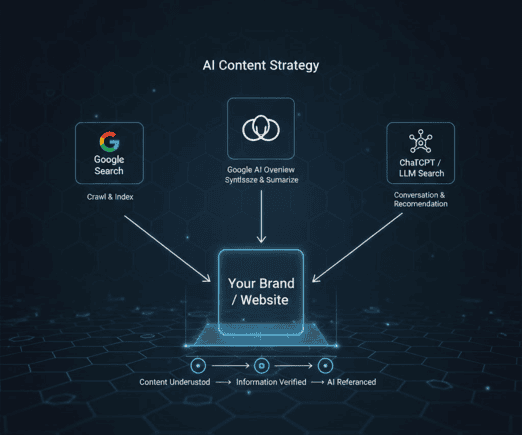
What Is Generative Engine Optimization (GEO)?
Generative Engine Optimization addresses answer experiences such as ChatGPT, Gemini and Google AI Overviews. Instead of concentrating only on keyword positions, it asks whether an AI system can understand a brand and its content correctly, cite credible material and include the brand in a suitable context.
A team may continue investing in SEO and content yet remain hard to find in AI answers. The reason is not necessarily poor content. Generative systems do not understand and select sources in exactly the same way that conventional search systems order results.
Our GEO service coordinates on-site and off-site work around this difference. The work aims to help AI systems find the brand and consider it in suitable answers. It cannot control whether a model mentions, cites or recommends a brand.
The Chinese source points readers to What Is GEO? and How GEO Relates to Google AI Overviews. English versions of these two source articles are not currently published, so their labels are retained without unsafe cross-language links.
Core GEO Priorities
AI Understanding
Help AI systems interpret the brand, products and services accurately.
Credible Citations
Present consistent brand facts across multiple credible and verifiable sources.
Recommendations in Relevant Scenarios
Improve the chance of inclusion when a user is comparing options or making a decision. The system still decides what to recommend.
Long-Term Visibility
Build maintainable AI-search assets instead of relying on a single answer snapshot.
What Problems Can GEO Address?
GEO Can Help With the Following
Help AI Systems Recognize the Brand
Clarify who the organization is, what it does and where its real advantages lie.
Help AI Systems Assess the Brand's Evidence
Repeat the same verifiable facts in suitable, credible sources rather than manufacturing apparent consensus.
Make Useful Material Easier to Cite
Show supporting facts where people compare options, choose one and ask what an AI system recommends. A model may then include the material more consistently.
GEO Does Not Promise the Following
No Guaranteed Recommendation
We can make the brand clearer, support it with evidence and improve the chance that an answer includes it. We do not control model outputs.
Not a Short-Term Traffic Rescue
GEO is better treated as a medium- to long-term visibility program than an emergency traffic switch.
Not a Substitute for the Product or Conversion Journey
GEO can amplify real value. It cannot repair an unsuitable offer or make a weak customer journey convert.
That is why we begin with feasibility. When a project is not ready, the source says the team may recommend waiting, completing foundational work first or stopping at the point that is sufficient.
The Chinese source also names What Problems Can GEO Solve? and Why GEO Is Not Suitable for Every Business. Their English pages are not currently published.
Is Your Business Ready for GEO?
Customers Ask AI Systems for Advice
Representative questions include How should I choose?
, Which option fits better?
and Can you recommend a brand or provider?
The Decision Depends on Trust and Judgment
This pattern is common in B2B, business services, SaaS, tools, cross-border trade, international commerce and brands entering overseas markets.
The Product or Service Needs Explanation
Before deciding, the customer needs a comparison, explanation or recommendation rather than a price alone.
SEO Work Exists, but AI-Search Visibility Is Limited
The company has content, yet representative answers in ChatGPT, Gemini or Google AI Overviews rarely cite or recommend it.
Medium- and Long-Term Acquisition Matters More
The company wants to develop a base of visibility and trust before AI search becomes a more important discovery route.
In simple terms, GEO may be worth assessing if a prospective customer could ask an AI system whether to choose you. That does not mean the business is automatically ready or that a recommendation will follow.
Request a GEO feasibility assessment.
One further source label is Which Industries Are Suitable for GEO?. Its English page is not currently published.
Our GEO Optimization Services
We do not apply one GEO template to every business. The Chinese source defines three ways to work together according to the business stage and competitive setting.
Before work begins, we research prompts and assess whether GEO fits the business. We identify AI questions that may have commercial value and test whether spending more is justified. During the work, we sample different models and use what we observe to change course. Prompts, models, accounts, markets, languages, dates and scoring rules must be recorded because outputs vary.
The source says execution is adapted to different recommendation systems, with overseas models as the main focus and selected Chinese models covered where needed. Naming a model does not imply access to its internals, training data or source-selection controls.
Overseas AI Models
The source names ChatGPT, Gemini, Claude and Perplexity and describes support for English and multilingual work.
Major Chinese AI Models
The source names DeepSeek, Doubao, Tencent Hunyuan, Moonshot AI, Kimi, ERNIE and Qwen. Product names, availability and behavior can change.
On-Site GEO: First Help AI Systems Understand Who You Are
The source presents on-site GEO as a suitable starting point for many companies that are new to the field.
The immediate question is not how to amplify exposure. It is whether an AI system can correctly understand the business, positioning and value.
What We Do
- Clarify the brand entity and reorganize site semantics so the organization and offer are explicit.
- Improve how the content is expressed and structured so useful passages are easier to summarize or cite; this is not keyword rewriting alone.
- Explain the core position, connect the brand to its products and use cases, show what sets the offer apart and state why a buyer might choose it. These links reduce avoidable ambiguity.
What the Source Says You Can Gain
- Better recognition of the brand in sampled AI-search contexts.
- Content that is easier for AI systems to describe or cite correctly.
- A clearer foundation for later off-site GEO or broader SEO work.
Potential Fit
- The sector is not yet highly competitive in representative AI answers.
- The website already has some useful content and a sound SEO base.
- The organization wants to test feasibility with a controlled initial scope.
Off-Site GEO: Build Repeated, Credible Context Beyond the Site
When competition increases, owned content alone may not be enough for an AI system to include the brand in a recommendation. Off-site work asks whether multiple credible contexts present the same verifiable expertise and facts.
Work Emphasized by the Source
- Place accurate content in legitimate, credible third-party contexts with suitable disclosure.
- Design routes through which qualified industry sources may cite the evidence.
- Assess sources that AI systems appear to retrieve, without claiming control over training data or retrieval.
- Participate appropriately in relevant overseas forums, media and communities without fabricating activity or manipulating discussion.
- Map prompt scenarios to the questions real buyers ask.
What the Source Says You Can Gain
- Stronger source-backed trust signals around the brand.
- A better chance of inclusion in highly competitive questions.
- More repeatable visibility across a retained sample instead of one isolated appearance.
Service Characteristics
- Requires continuing maintenance and review.
- Can be scoped monthly, with a shorter initial test where appropriate.
- Is more suitable for highly competitive sectors or mature projects.
On-Site and Off-Site Consistency: Present the Same Verifiable Brand
The source calls this its most stable and sustainable GEO option based on practical work, but supplies no project records or comparison method for that claim. The underlying idea is that AI systems can assess a brand more easily when owned pages and credible external contexts present compatible facts.
Work Carried Out Together
- Clarify the brand and content system on the website.
- Develop legitimate off-site citations, contexts and recommendation paths.
- Monitor the two so important statements remain consistent and current.
Continuing Monitoring and Optimization
- Observe how sampled AI answers change.
- Track recommendation logic and triggering scenarios as observable patterns, not known model internals.
- Adjust the work as evidence changes instead of treating publication as the finish line.
What the Source Says You Can Gain
- A more consistent brand representation across sampled contexts.
- A better chance of repeated inclusion.
- AI-search assets that can be maintained and may build value over time.
Potential Fit
- The business model and offer already work.
- The organization wants to develop AI search as a continuing acquisition route.
- The objective is a maintainable visibility system rather than a one-time test.
A Quick Way to Choose a Starting Point
Unsure Whether GEO Will Help
The Chinese source suggests starting with an on-site assessment and controlled on-site work.
Competitors Appear Frequently in a Highly Competitive Market
The Chinese source suggests evaluating off-site GEO, subject to source quality and disclosure.
Seeking a Stable, Long-Term AI-Search Program
The Chinese source suggests coordinating on-site and off-site work.
Key Deliverables During GEO Optimization
Complete AI-Search Current-State Material
Shows whether the brand appears in the retained sample, how answers describe it and how named competitors appear under the same conditions.
Pages and Messaging for AI-Search Scenarios
Addresses the core questions people ask when they compare, choose or enquire through AI systems.
Directly Verifiable Third-Party Results
Shows how the brand actually appears in suitable external content and context, including the source URL and relationship.
Website AI-Friendliness Checklist
Identifies pages that present the entity and evidence clearly and pages that still need changes.
AI Recommendation and Mention Change Record
Retains example outputs with the model, prompt, date, market and limitations needed to interpret changes.
The source says all deliverables remain client-owned assets after the service ends. The signed terms must say which files the client owns, which formats it receives, how it keeps access and how long records remain available.
How to evaluate a GEO provider
First ask whether the evidence can be reproduced; then consider production volume and promises. A qualified provider should record how it tested, what pages changed, which external sources support the claims, how it will measure results and when it will stop. One screenshot or an estimate of reach is not enough.
| Evaluation area | Evidence to require before approval | High-risk signal |
|---|---|---|
| Baseline and prompt set | Platforms, models, markets, dates, questions and current answers | A single screenshot with no retained test conditions |
| On-site execution | Page-level before/after evidence, sources, Schema and release records | A report that only counts published content |
| Off-site corroboration | Publicly verifiable source URLs, relationships and disclosure | Promises of bulk mentions or sources that cannot be shown |
| Measurement | Record when answers mention or cite the brand, whether the wording is accurate, how AI referrals are counted and what the data cannot show | Treating one answer or estimated reach as an enquiry |
| Boundaries and stopping rules | No citation or ranking guarantee; clear pause, adjustment and rollback conditions | A promise to enter AI answers within a fixed period |
The Chinese source recommends checking samples and definitions with its GEO Case Verification Method, then comparing scope with its Professional GEO Provider Checklist. Those English article pages are not currently published. During measurement, keep a consistent website and AI-referral measurement framework.
Should You Manage GEO Internally or Use a Specialist Team?
It is reasonable to ask whether the current team can try GEO first. The answer depends partly on whether the organization is prepared to absorb the time, uncertainty and decision-making cost described by the source.
An internal program can work when the team has clear ownership, sources, technical access and a reproducible way to test representative answers. Hiring a provider does not remove the client's responsibility to approve claims and evidence.
Managing GEO Internally Often Involves Three Costs
More Than One Person's Time
GEO spans content, structure, semantics, off-site context and continuing observation. If the existing team treats it as a side task, it may be difficult to tell which change influenced an observed answer.
Learning Through an Immature Method
AI-search feedback is not transparent. Some changes may show no clear movement for one or two months. The source warns that a team may then spend three to six months without reaching a useful conclusion. This is a source estimate, not a universal timetable.
Deciding When to Stop
The team must distinguish a weak direction from an insufficient test period, poor execution or a market that is not suitable. Without stopping rules, spending can continue without resolving the question.
What Does a Specialist GEO Team Add?
The source says the value is not simply outsourcing tasks. It is assigning the most error-prone decisions to people with relevant experience. That experience claim requires current project records.
For many clients, the source presents three more direct benefits:
Judge Sooner Whether Further Investment Is Justified
Choose On-Site, Off-Site or Combined Work Earlier
Receive a Clear Recommendation to Stop When the Fit Is Poor
The source says some people felt clearer about the direction after one conversation even when they did not engage the team. It supplies no survey, sample or testimonial record, so this remains an unverified source statement.
The source offers Can You Manage GEO Yourself? and DIY GEO versus Managed Service for this decision. Their English pages are not currently published.
Why Choose GlobalBrandsDigital for GEO Optimization?
Judgment Before Execution
We first assess whether GEO is worth doing and how far the current project should go. As work continues, we ask whether what we can observe still justifies the spend. If it does not, the budget should not continue along the same path.
A Complete, Graduated Path
On-site and off-site work can be combined or introduced in stages. The client does not need to commit every resource at the beginning; it can start at an appropriate level, verify the evidence and expand only when justified.
A Defined Objective
The objective is not the number of pages produced. It is to make accurate, useful and supported information easier for AI systems to understand and potentially cite. Selection remains probabilistic and outside the provider's control.
Controlled Risk
When spending more no longer appears worthwhile, the source says the team changes the plan or pauses instead of producing work for its own sake. The signed terms should say how often reviews happen, who decides and how either party can stop.
Two source labels cover the next review step: How to Assess a Managed GEO Provider and Common Managed GEO Pitfalls. Their English pages are not currently published.
GEO compared with a conventional SEO or content program
Being able to deliver SEO does not automatically establish GEO capability. A search position is not the same thing as inclusion in an AI answer. Conventional SEO may be sufficient when the sole aim is search traffic. GEO addresses the separate question of how AI systems understand, cite and may recommend the brand. The two disciplines can work together.
| Comparison | Conventional SEO or content team | Our GEO service |
|---|---|---|
| Primary objective | Earn keyword rankings and clicks | Improve how accurately AI systems understand and may cite the brand |
| Main discovery surfaces | Traditional search-result pages | ChatGPT, Gemini and Google AI Overviews, alongside search |
| System being addressed | Search ranking and retrieval systems | Large-language-model retrieval, synthesis and source selection |
| Content logic | Organized mainly around keywords | Organized around questions, scenarios and decisions |
| Priority assets | Pages and links | Semantic structure, entities, evidence and credible context |
| Evaluation | Traffic and rankings | Whether representative answers mention and describe the brand accurately |
| Execution requirements | Many tasks can be standardized | Requires close judgment about claims, sources and model variability |
| Best-fit stage | Building a foundation of search demand | Supporting brand understanding and later-stage decisions |
The source labels another comparison GEO versus SEO. Its English page is not currently published.
Let Experienced Judgment Define the Direction First
Our GEO work is not a collection of actions or a template. Each project returns to one question: how can an AI system continue to accept accurate brand information in real search and conversation contexts?
We therefore care more about clear, consistent and verifiable facts than about appearing once in an answer. The team must keep the work current because the brand, its sources and model outputs can all change.
GEO is not something every business must do now. Whether the work is worth funding, where to start and how far to go are material decisions in their own right.
If you want to determine fit before committing to production, begin with a conversation and a reproducible baseline.
Talk with a GEO Consultant
The Chinese source asks visitors to scan a QR code. The China-only QR image is omitted from the English page, but the consultation intent remains available through the global contact path.
Frequently Asked Questions About GEO Optimization
How Much Budget and Time Does GEO Require?
Cost depends on competitive intensity, the current foundation and the intended service level, so the source says it is usually estimated as a range. It says a clear directional signal about whether to keep investing can generally appear within three to six months. That is an unverified source estimate, not a commitment. The timing changes with model behavior, how quickly the client acts, how the sample is designed and how well the sources support each claim.
Is GEO a One-Time Project or an Ongoing Program?
The source says continuing operation is more suitable in most sectors because AI answers and recommendation patterns change. A baseline or a defined phase can end, but a team may still need to maintain facts, sources and recurring measurements. Continuing work cannot guarantee stable inclusion or compounding visibility.
Will GEO Affect My Existing SEO?
The source answers no and says GEO normally builds on a sound SEO foundation. Compatible work should support, rather than replace, useful SEO. Even so, no change is inherently risk-free: page content, rendering, internal links, Schema and technical changes should be tested for search, accessibility and user impact before release.
What If Results Are Weak After Three to Six Months?
Regular reviews should test the prompts and models, check whether sources still support the claims and confirm that the chosen market and work remain suitable. If those checks do not justify further spending, the source says the team will adjust or pause instead of continuing only to complete a contracted period. The signed terms govern that decision and any remaining obligations.
How Should GEO Results Be Measured?
Do not count one mention alone. Retain representative prompt samples and measure whether the brand appears repeatedly, whether the description is accurate, which sources are cited and whether suitable users proceed to a measurable next step. Each observation needs the platform, model/version where available, market, language, prompt, account context and date. These indicators may precede direct conversions but do not prove that GEO caused them.