
On this pageTable of contents+
- Key Takeaways
- What Are Google AI Overviews and AI Mode?
- How Do AI Overviews and AI Mode Work?
- Do AI Overviews Affect SEO?
- Do AI Overviews Reduce Organic Click-Through Rates?
- How Does AI Mode Change the Conversion Journey?
- Why Can Lower Traffic Occur Without Worse Conversion Performance?
- Which Keywords Are More Likely to Trigger AI Overviews?
- Query Types That Are More Likely to Trigger AI Results
- Which Keywords Are Less Likely to Trigger AI Overviews?
- Which Businesses Are Most Exposed to AI Overviews and AI Mode?
- Which Pages Are Most Affected by AI Overviews?
- How Should Businesses Respond to AI Overviews and AI Mode?
- Reassess Page Roles Before Focusing on Total Traffic
- Move From "Explain Everything" to "Answer, Prove and Attribute"
- Prioritize Pre-Screening and Decision Pages, Not More Generic Explainers
- The Hard Part Is Deciding Which Layer to Change First
- How Can You Track the Impact and Performance of AI Overviews and AI Mode?
- How Do AI Overviews and Featured Snippets Differ?
- Frequently Asked Questions
- Can AI Overviews Traffic Be Identified Separately in Search Console?
- Which Pages Should Be Redesigned First?
- Should a Business Improve Content or Conversion Pages First?
- Do Google AI Overviews and AI Mode Require Additional Technical Work?
- Conclusion

When teams discussed SEO in the past, rankings, clicks and organic traffic usually received the most attention. As Google has progressively embedded AI Overviews and AI Mode into Search, however, the change extends beyond the appearance of the results page. Users may now complete more of their research, comparison and screening before they ever visit a website.
More companies are encountering a new mismatch: traffic to some pages is declining without an equivalent decline in enquiries. At the same time, pages that once explained a subject early in the journey lose clicks, and pages that help users compare, decide and convert become more important.
This shift deserves particular attention from B2B companies, international brands, professional-service firms and high-value businesses. Their sales journeys already depend on research, explanation and trust. If Google moves more of that initial understanding onto the results page, the website takes on a later role in the conversion journey.
Key Takeaways
If you remember only the central conclusions, keep these five points in mind:
- AI Overviews have a greater effect on above-the-fold attention and informational clicks.
- AI Mode has a greater effect on how deeply users research and screen options before visiting a website.
- Both can reduce some organic clicks, but fewer clicks do not necessarily mean worse conversion performance.
- Explanatory content usually faces the greatest pressure, whereas comparison pages, FAQs, case studies and service pages tend to gain value faster.
- The most important question for a business is not simply whether traffic has fallen, but how the search funnel and the roles of its pages have changed.
What Are Google AI Overviews and AI Mode?
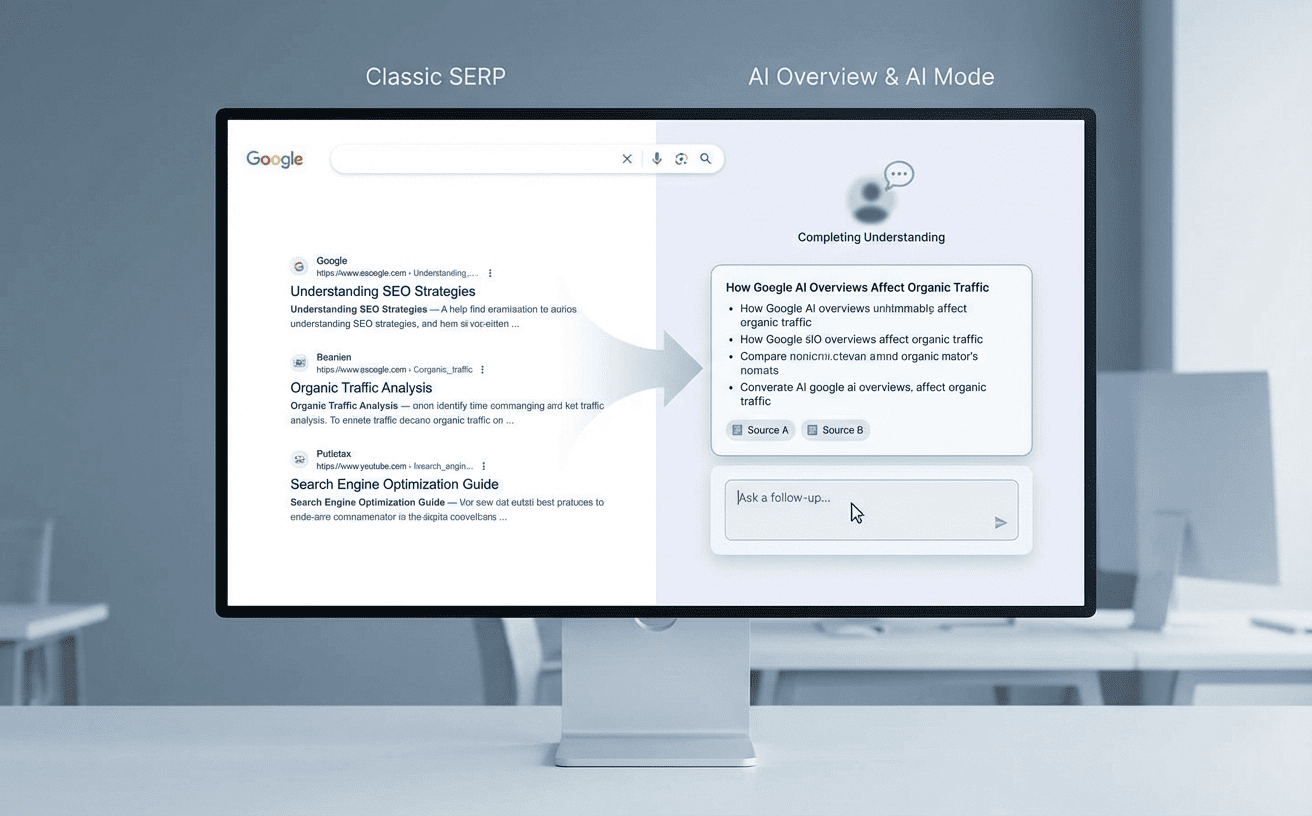
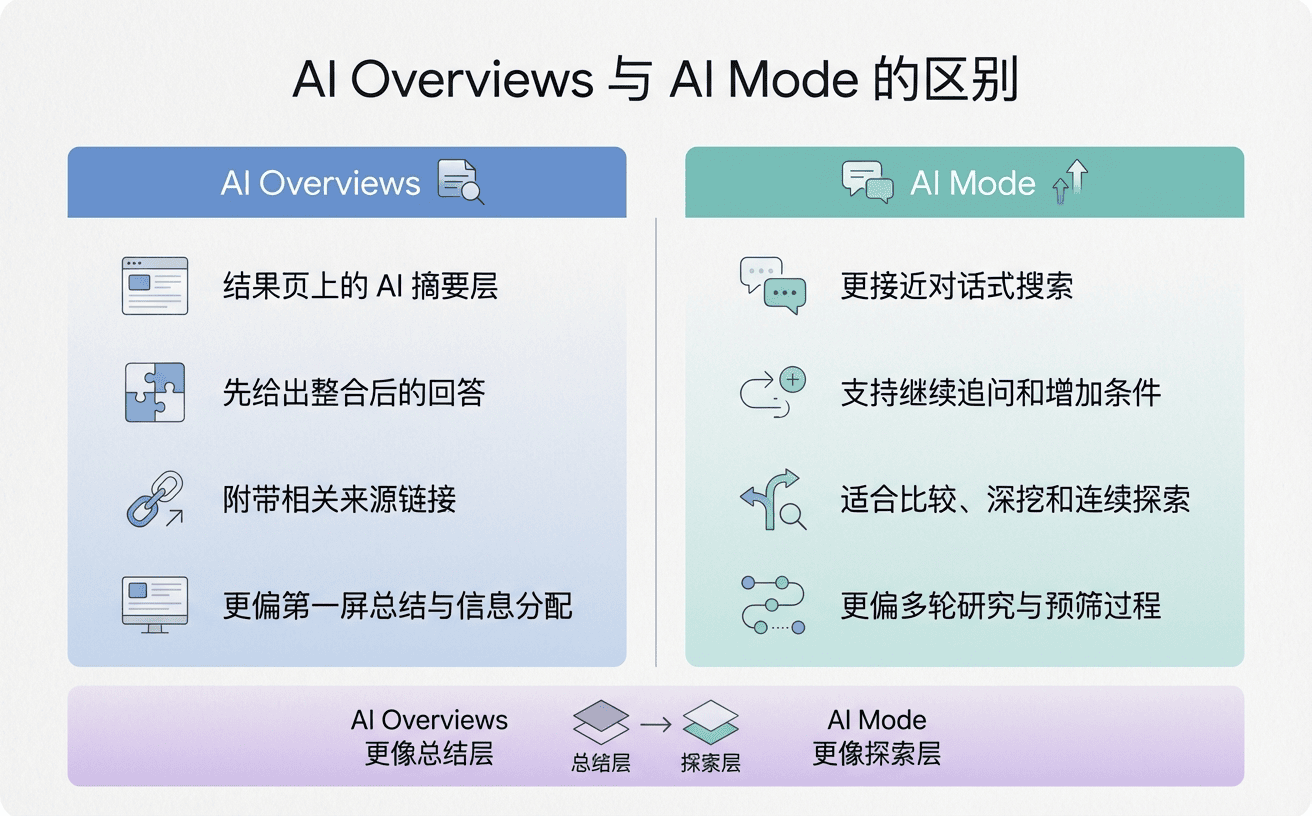
AI Overviews can be understood as an AI-generated summary layer on Google's search-results page. For some queries, Google presents an integrated response with links to relevant sources so that users can grasp the main points quickly.
AI Mode is closer to conversational search. It does more than provide a single summary: users can ask follow-up questions, add constraints, compare options and explore related questions in greater depth.
Both are Google AI features, but they work at different levels. AI Overviews are primarily a summary layer on the results page, whereas AI Mode supports multi-step exploration and ongoing comparison. Although both can affect organic traffic, they do so differently: AI Overviews are more likely to change how attention is distributed above the fold. AI Mode can reshape the research process before a user visits a website.
Google's path in generative search has broadly progressed from SGE to AI Overviews and then AI Mode. The product names matter less than the direction: Google is turning the traditional results page into a combined interface of answers, sources and continued exploration.
How Do AI Overviews and AI Mode Work?
These AI results do not merely ask which page matches a keyword. They try to interpret what the question means. Explanatory, comparative, scenario-based and multi-constraint questions are therefore more likely to engage AI Overviews or AI Mode. Google has also stated that AI Mode is particularly useful for complex comparisons, continued exploration and follow-up questions.
AI responses are not created in isolation. Google's guidance says that its AI features still build on Search systems and web sources and that foundational SEO practices remain relevant. AI Overviews and AI Mode do not bypass websites; they reorganize how web content and public information are presented.
The answer, cited sources and placement can vary for the same query at different times and in different contexts. Query wording, available sources and dynamic adjustments to the results page are among the reasons. Websites therefore cannot assess these features only through the lens of a fixed traditional ranking.
Do AI Overviews Affect SEO?
Yes, and the effect is no longer limited to isolated cases.
Google's guidance includes AI Overviews and AI Mode among its Search AI features and states that foundational SEO best practices still apply. When the Chinese source article was published in March 2026, Google said that no additional special technical requirements applied to inclusion in these results.
That has two implications:
- SEO has not stopped working.
- But SEO competition is no longer confined to blue-link results.
Businesses once competed mainly to rank. They must now also consider whether the AI summary layer will absorb the first part of the user's journey.
Do AI Overviews Reduce Organic Click-Through Rates?
Several third-party studies have observed that queries with AI Overviews compress clicks on traditional organic results, particularly for informational queries. The size of the decline varies across samples.
An Ahrefs study of 300,000 keywords found that the top-ranking page for informational queries with an AI Overview had an estimated CTR about 34.5% lower than the comparison group. An Amsive study of 700,000 keywords reported an average CTR decline of about 15.49%, with a larger drop for non-branded queries. The studies cited by the source point in the same direction: AI Overviews generally reduce the click space available to traditional organic results.
This does not mean that users stop clicking altogether. It means that a growing share of queries can be partly satisfied on the results page before a user opens several pages. This helps explain why many teams still see impressions even though click growth has become harder to achieve.
Definition queries, explanatory queries, early-stage research and non-branded informational queries are usually affected most. A single AI summary can satisfy 60% to 80% of the need behind these queries, so the pressure on CTR is often more pronounced.
How Does AI Mode Change the Conversion Journey?
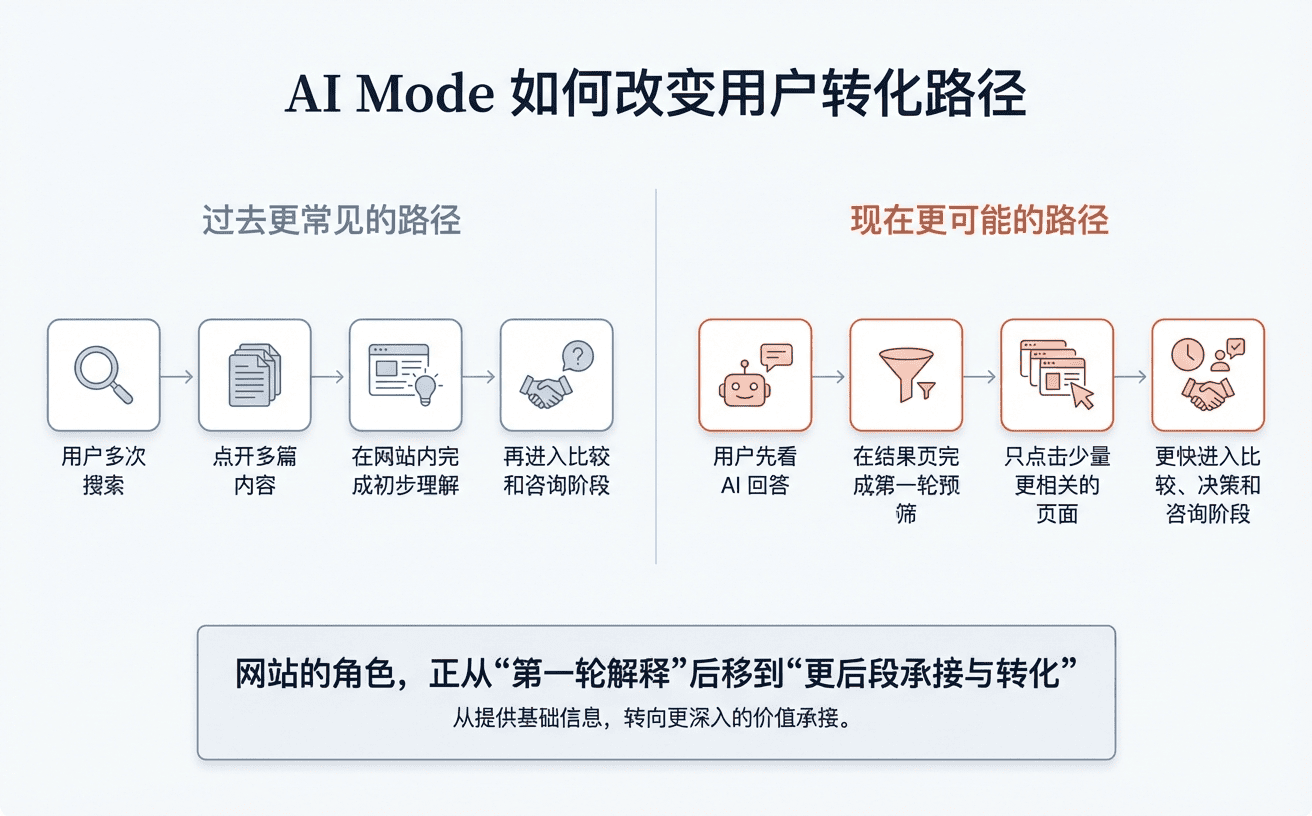
The more familiar path was:
The user runs several searches -> opens several articles -> develops an initial understanding on those websites -> moves into comparison and enquiry.
The emerging path is more likely to be:
The user reads an AI response -> completes an initial screening on the results page -> opens a smaller number of more relevant pages -> reaches comparison, decision and enquiry sooner.
The website therefore does not always provide the first explanation. It more often receives and converts the user at a later stage.
Why Can Lower Traffic Occur Without Worse Conversion Performance?
This is one of the easiest changes for a company to misread.
A traffic decline deserves attention, but it does not automatically mean poorer outcomes. AI Overviews and AI Mode may filter out some low-intent, shallow clicks from people who only wanted a quick answer. Users who continue to a website may already have completed an initial round of learning and screening.
Google's guidance has also said that clicks from AI results may be of higher quality. Some industry research on AI referrals has reported a similar pattern: although AI referrals remain limited, visitors may interact more, view more pages and arrive closer to a decision than ordinary informational-search visitors.
Teams should therefore look beyond total clicks and reassess engagement after the click, page depth, enquiry quality and progress through the journey.
Which Keywords Are More Likely to Trigger AI Overviews?
Saying only that definitional, explanatory and comparative queries trigger AI results more often does not tell a business what to prioritize. It is more useful to classify queries by how readily an answer can be compressed and how complex the question is.
Query Types That Are More Likely to Trigger AI Results
The most likely triggers are queries for which Google can answer much of the need with a summary. The user is not usually seeking a particular website; they want an answer they can understand quickly. Examples include:
- What is an AI Overview?
- What is the difference between SEO and GEO?
- When is AI Mode useful?
- What is the purpose of an FAQ page?
- What does AIO mean?
These questions share a common trait: the user wants an explanation, not immediate execution.
Long-tail, conversational and multi-constraint questions also fit the context of AI results more readily. Examples include:
- Should an international SaaS company invest in SEO or GEO first?
- Which CRM systems are suitable for small and medium-sized teams?
- How should a B2B website respond to AI Overviews?
- With a limited budget, should a company improve its FAQs or its service pages first?
Across the year preceding the source article, several SEO data platforms reported a similar direction: AI Overviews still appeared mainly for informational queries, and longer, more complex queries phrased as complete questions generally triggered them more often.
Pre-decision queries deserve even more attention from businesses. Examples include:
- Which option is more suitable?
- Which type of solution should I choose?
- What is the difference between these two approaches?
- Which providers serve a particular scenario?
These may not be final conversion queries, but they can occur immediately before a decision.
Which Keywords Are Less Likely to Trigger AI Overviews?
Direct brand queries, strongly navigational queries and strongly transactional queries may be less likely to trigger an AI summary consistently. This is better treated as a prioritization signal than a fixed boundary because the trigger range continues to expand.
Some third-party studies cited by the source also observed rising activation for commercial and transactional queries. A safer interpretation is not that AI Overviews affect only informational terms, but that they are expanding from informational searches into the pre-decision stage.
Which Businesses Are Most Exposed to AI Overviews and AI Mode?
Industries that require extensive explanation and early-stage research tend to observe the impact more clearly. Examples include:
- Healthcare
- Education
- Travel
- SaaS
- Professional services
- Information publishing
B2B companies, international brands and high-value businesses should watch this change early. Their buyers rarely purchase after a single search; they research, compare and narrow a shortlist. When AI moves this screening onto the results page, the effect is not limited to clicks. It changes how much work the user completes before entering the site.
For SaaS companies, the shift often appears first in explanatory, alternative and comparison content. For professional services, FAQs, case studies and service pages become more important receiving points. For international brand sites, consistent definitions and third-party visibility have a more direct effect on how AI systems understand the brand.
Which Pages Are Most Affected by AI Overviews?
| Page type | Level of impact | Most suitable response |
| Definition page | High | Reduce redundant explanation; strengthen the direct answer and brand attribution. |
| Basic explainer page | High | Improve structural clarity and add a clear next step. |
| FAQ page | Medium to high | Structure scenario-based questions and strengthen onward links. |
| Comparison page | Rising value | Strengthen evidence, comparison dimensions and suitable use cases. |
| Scenario page | Rising value | Clarify decision criteria, audience fit and action paths. |
| Service page | Rising value | Strengthen brand context, audience fit and the conversion path. |
| Case-study page | Rising value | Add credible evidence specific to the industry. |
AI can help users develop an initial understanding, but it cannot easily replace the comparison, screening and pre-enquiry assessment these pages provide.
Many teams overlook this distinction. In our observations, the first misread usually occurs on content pages that once supplied early-stage explanations, not on the homepage. Teams often focus on total traffic when they should first separate changes in the roles of definition, comparison and case-study pages.
How Should Businesses Respond to AI Overviews and AI Mode?
Google's guidance is clear that foundational SEO best practices still apply to AI features. A business should not abandon SEO in pursuit of new AI tactics. It should reassess which pages attract traffic, which pages support decisions, and which content can be extracted, cited and attributed accurately in AI results.
Reassess Page Roles Before Focusing on Total Traffic
When teams see AI Overviews, many first ask how much organic traffic has fallen. That view is too broad because AI does not absorb every visit; it affects a particular part of the search journey. A more useful approach is to separate pages into four roles: definitions and explainers attract users; FAQs, comparisons and scenario pages pre-screen them; service, product and solution pages support decisions; and enquiry, demo, contact and trial pages handle conversion.
Only after clarifying these roles can a team tell whether AI is absorbing early-stage explanatory traffic or whether its later pages are unprepared to receive higher-intent visits. For many companies, the problem is not simply that traffic has fallen; they are still judging pages with an outdated model.
Move From "Explain Everything" to "Answer, Prove and Attribute"
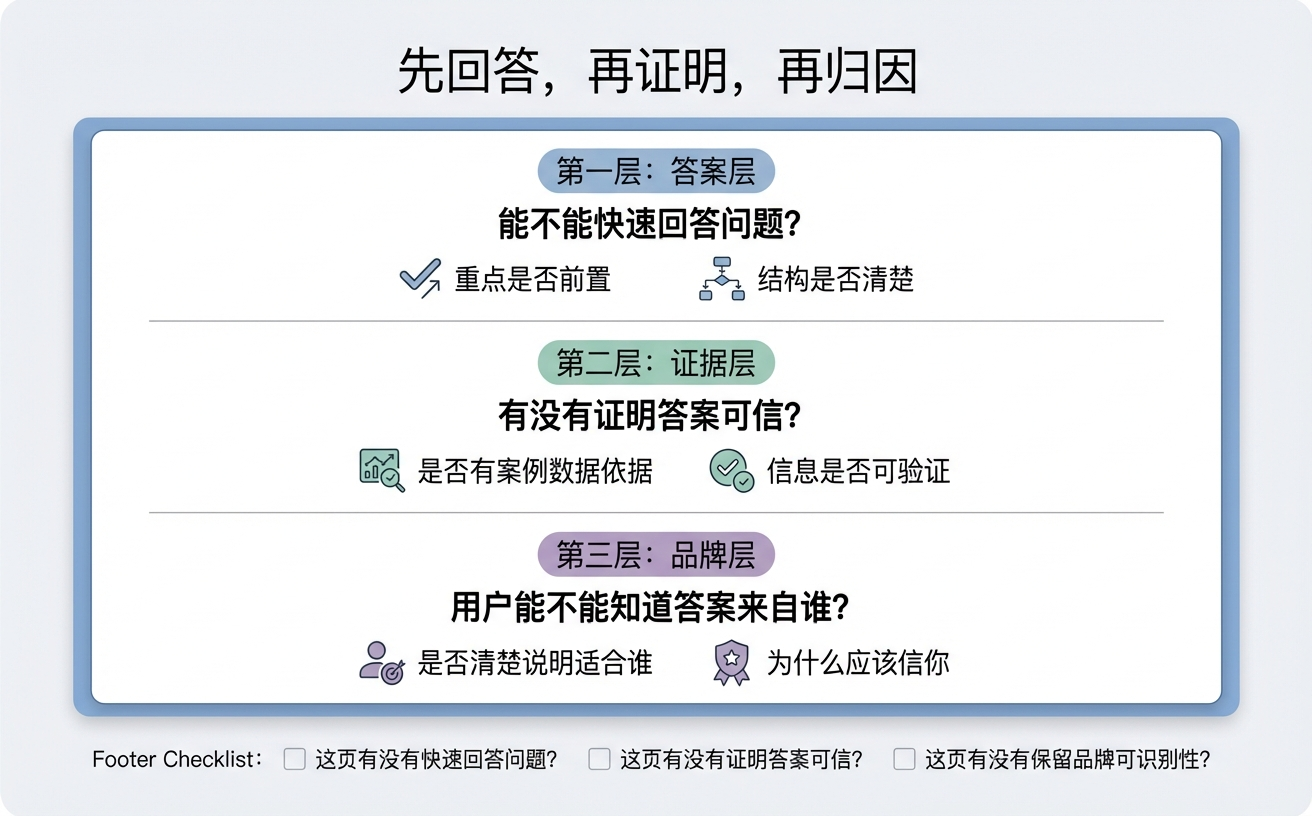
In an AI Overviews and AI Mode environment, the content most readily extracted is not necessarily the longest. It is the content with the clearest structure. An effective page usually answers the question first, states the key points, develops the explanation, and then provides an FAQ, comparison or next step.
A useful page has at least three layers. The answer layer helps the reader resolve the question quickly. The evidence layer establishes why the answer is credible. The brand layer lets the reader identify who supplied the information, whom it suits and why the source deserves trust.
This framework can become a direct page-review standard:
- Does the page answer the question quickly?
- Does it show why the answer is credible?
- Does it preserve a recognizable brand source?
If any one of these layers is missing, the content is more likely to become information that AI consumes without producing lasting value for the brand.
Prioritize Pre-Screening and Decision Pages, Not More Generic Explainers
Many companies once treated FAQs, comparisons, scenario pages and case studies as supporting content. In AI search, their importance rises because a user who has completed the first round of learning in an AI interface does not need another general explainer. They need help comparing, screening and validating options.
The pages most often worth prioritizing are:
- Comparison pages: the differences between A and B, whom each suits and how to choose.
- FAQ pages: the decisive questions users ask most often.
- Scenario pages: choices for a particular industry, requirement or budget.
- Case studies: concrete evidence of an otherwise abstract capability.
- Service pages: a clear explanation of the brand's capability and the path to action.
Put simply, definition pages earn the right to explain; comparison and scenario pages support screening; case studies and service pages receive and convert demand.
The Hard Part Is Deciding Which Layer to Change First
Many teams already know that AI Overviews affect traffic and that content structure needs to change. The difficult question is sequence. Should they rebuild definition pages or add FAQs first? Should they improve service pages or first make brand definitions and third-party evidence consistent?
A more practical decision rule is:
- If the largest change is a fall in CTR, inspect explanatory content first.
- If traffic is relatively stable but enquiries are weak, inspect receiving and conversion pages first.
- If the brand is unclear in AI responses, align brand definitions and external evidence first.
For many companies, the central challenge is not awareness of AI Overviews. It is identifying which layer deserves priority: traffic entry points, content structure or the page system that receives and converts demand. A wrong diagnosis can misdirect every investment that follows.
How Can You Track the Impact and Performance of AI Overviews and AI Mode?
When the Chinese source article was published in March 2026, Search Console did not provide a complete, separate report for AI Overviews and AI Mode; Google included traffic from these AI features in overall Web search data. Teams that looked only at total impressions, clicks and traffic could therefore misread the change. Google introduced separate generative-AI reporting later in 2026, so current measurement should also use the latest Search Console controls and reports where available.
A useful measurement model separates three groups of signals.
The first group is foundational search performance: indexing, rankings, organic traffic and CTR. It shows whether traditional search performance has changed and which queries and pages are losing their previous click opportunity.
The second group concerns page roles: which pages are losing visits, and which page types are becoming more important. The most useful distinction is often not the rise or fall of one article, but the changing roles of definitions and explainers compared with comparisons, FAQs, case studies and service pages.
The third group concerns the conversion journey: visits may be fewer, but are incoming users closer to enquiry, comparison and decision? For a business, these signals often reflect outcomes more accurately than traffic volume alone.
Rather than monitoring every query indiscriminately, keep a stable watchlist of four question types:
- Definition questions: the user is confirming a concept.
- Comparison questions: the user is screening solutions.
- Selection questions: the user is narrowing a shortlist.
- Decision questions: the user is approaching action.
To assess the full effect of AI Overviews and AI Mode on conversion, divide the analysis into four layers:
- Traffic: which queries and pages are gaining or losing visits.
- Pages: which roles are being compressed and which pages deserve redesign.
- Intent: whether incoming users are closer to comparison and decision.
- Conversion: whether enquiries improve, users move further through the journey and later stages perform differently.
This framework is closer to business reality than asking only whether traffic has fallen. The important question is whether, after AI absorbs more of the early search journey, the website is ready to receive fewer but higher-intent visits.
Related reading: Why Google Rankings Do Not Guarantee AI Citations
How Do AI Overviews and Featured Snippets Differ?
This is a common question that deserves a direct answer.
| Dimension | AI Overviews | Featured Snippet |
| Source material | An AI response synthesized from multiple sources | Usually extracted from one page |
| Presentation | Summary + sources + further exploration | A single extract or short structured answer |
| Purpose | Help the user understand the question first | Provide one concise answer directly |
| Effect on clicks | More likely to compress clicks across several result positions | Usually changes click distribution within a smaller area |
In simple terms, a Featured Snippet extracts a passage; an AI Overview presents an integrated answer first.
Frequently Asked Questions
Can AI Overviews Traffic Be Identified Separately in Search Console?
When the source article was published in March 2026, it generally could not be separated completely because Google included AI-feature traffic in overall Web search data. Google introduced dedicated generative-AI reporting later in 2026, so teams should now check the latest Search Console report alongside page, query and behavior data.
Which Pages Should Be Redesigned First?
Start with pages that once handled early-stage explanation and can now be partly replaced by an AI summary, along with pages that should receive higher-intent visits but still have weak structure. Definitions, comparisons, FAQs, case studies and service pages are common priorities.
Should a Business Improve Content or Conversion Pages First?
It depends on where the problem occurs. If AI is visibly absorbing explanatory content near the start of the journey, restructure the content role first. If high-intent users already visit the site but the receiving pages and enquiry path are weak, improve conversion pages first. This is usually a sequencing question, not a binary choice.
Do Google AI Overviews and AI Mode Require Additional Technical Work?
At the time of the March 2026 source article, Google said no special technical work, AI file or dedicated schema was required and that foundational SEO practices applied. Google later added controls in Search Console that let sites choose whether to take part in generative AI. Teams should now review the latest official settings before they act.
Conclusion
AI Overviews and AI Mode do more than take a share of traffic. They change how much understanding and screening users complete before visiting a website. Businesses should reassess not only whether traffic has fallen, but also which pages still perform an old role and which pages should move forward to receive the new journey.
If you have noticed a change in organic traffic but are unsure whether to rebuild definition pages, FAQs, comparisons, service pages or case studies first, begin with a systematic diagnosis. If you have noticed a change in organic traffic but are unsure whether to rebuild definition pages, FAQs, comparisons, service pages or case studies first, begin with a systematic diagnosis. GlobalBrandsDigital works on content and page strategy for Google GEO and AI-search scenarios. A diagnosis can help separate the issues and set priorities before you decide where to invest.