
On this pageTable of contents+
- What Is AI-Search FAQ Optimization?
- FAQ Content vs. FAQ Schema vs. FAQ Rich Results
- Why Do FAQs Still Matter in AI Search?
- Which Pages Should Contain AI-Search FAQs?
- Product-Page FAQs Resolve Specific Pre-Purchase Questions
- Service-Page FAQs Resolve Common Pre-Engagement Misunderstandings
- Help-Center FAQs Solve Problems During Use
- Knowledge-Page FAQs Are Better for Definitions and Judgement
- Not Every Page Needs an FAQ
- Where Do AI-Search FAQ Questions Come From?
- Find Real Questions Before Writing the FAQ
- Organize the FAQ Around Four Question Types
- Decide Whether a Question Belongs in the FAQ
- How Should AI-Search FAQ Answers Be Written?
- Answer First, Then Add Conditions and Boundaries
- Answer One Question Per FAQ Entry
- Make Each Answer Stand on Its Own
- Common FAQ Problems in AI Search
- Is FAQ Schema Still Necessary?
- Understand the Difference Between FAQPage and QAPage
- FAQPage Represents Standard Site-Provided Questions and Answers
- QAPage Is for Pages Where Users Can Contribute Answers
- How Do You Measure AI-Search FAQ Optimization?
- Start With Changes to the Content
- Then Assess Search Performance
- Finally, Assess Business Effects
- An AI-Search FAQ Optimization Workflow
- 1. Inventory Page Types
- 2. Build a Question Pool
- 3. Select High-Value Questions
- 4. Rewrite Answers With One Consistent Pattern
- 5. Update Regularly
- AI-Search FAQ Optimization Checklist
- Conclusion
- Frequently Asked Questions
- How Does AI-Search FAQ Optimization Differ From Traditional FAQ SEO?
- Should an FAQ Be a Stand-Alone Page or Part of a Product Page?
- Should Every Page Have an FAQ?
- Does AI Search Prefer Short or Complete Answers?
- How Long Does FAQ Optimization Take to Show Results?
- Are FAQs Suitable for Every Industry?

When teams optimize FAQs for AI search, they often begin by adding a set of common questions and marking it up with FAQ schema. That approach is not wrong, but it is no longer enough.
For most websites, an FAQ does more than change how a page may appear in search. It can help people and systems understand, extract and reuse the content. Focus on genuine questions, clear answers, explicit structure and verifiable facts. If these foundations are weak, schema alone is unlikely to make much difference.
This guide explains where FAQs belong, how to find the right questions, how to write useful answers and how to evaluate the results of AI-search FAQ optimization.
What Is AI-Search FAQ Optimization?
AI-search FAQ optimization organizes common questions on a page into genuine, clear answers that are easy to extract and reuse. The aim is to help search systems and AI tools understand what the page answers and which answers can stand on their own.
FAQ Content vs. FAQ Schema vs. FAQ Rich Results
- FAQ content is the question-and-answer information visible on the page.
- FAQ schema is structured markup for that content.
- An FAQ rich result is a format that may appear in search results.
The three are related, but they are not interchangeable.
Many teams once focused on adding schema to qualify for rich results. In AI search, the more important questions are whether the FAQ reflects real needs, whether each answer is clear, whether the structure is explicit, and whether a passage still makes sense outside its original context. Systems can often use content more easily when question boundaries are precise and the answers are self-contained, not merely because a page contains an FAQ section.
A templated FAQ built around invented questions and vague answers offers little value to users or systems. It becomes useful only when the questions come from real users and the answers are sufficiently specific.
Why Do FAQs Still Matter in AI Search?
FAQs handle specific questions well. Questions in AI search are often detailed and phrased in everyday language. A question-and-answer structure can respond more directly than a long introduction and may be easier to understand and extract.
The value of an FAQ has shifted from display to extraction. FAQs were once used largely to win additional search-result visibility. Their more important role now is to answer specific questions clearly and make the content easier to extract and reuse. The task is not simply to add another module, but to organize answers that can be used directly.
Which Pages Should Contain AI-Search FAQs?
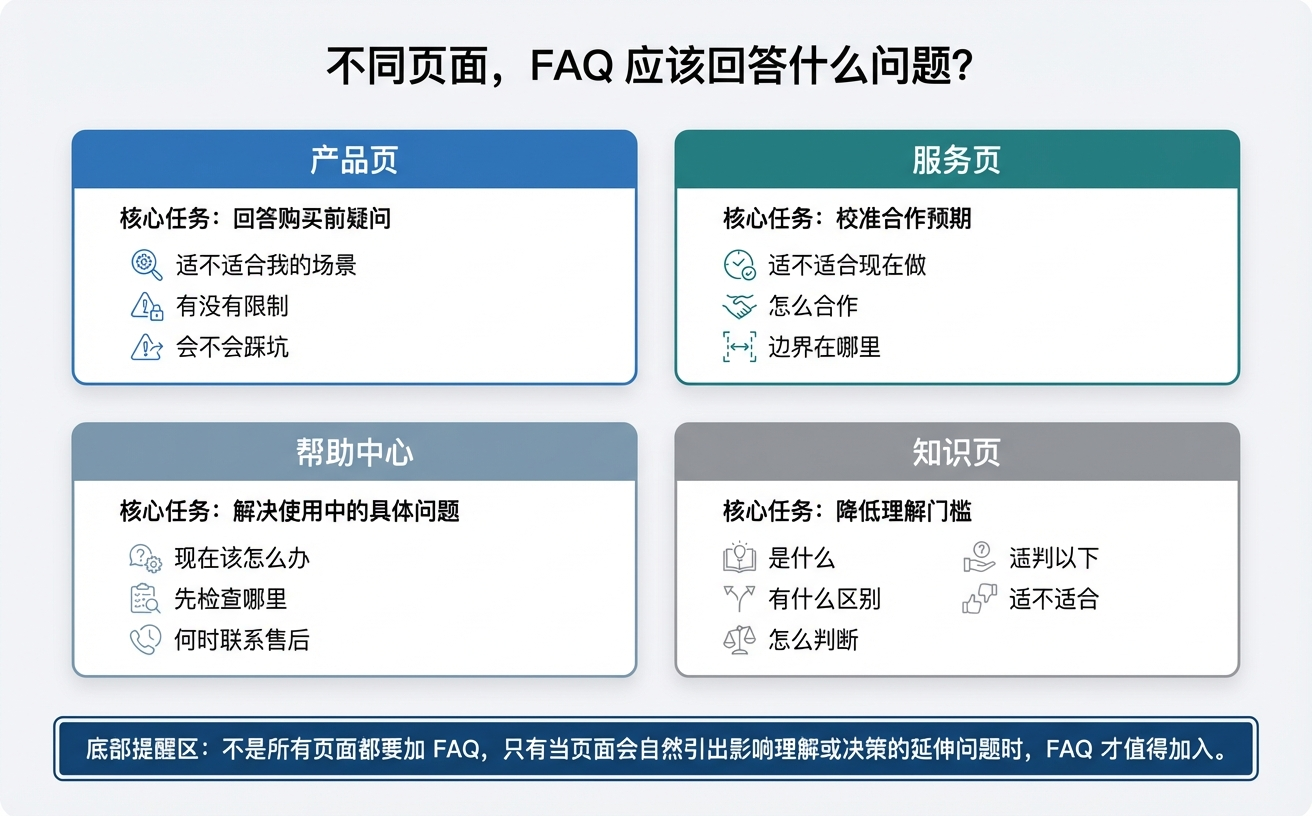
An FAQ should reflect the purpose of its page. The questions should match the task the page performs. Product pages, service pages, help centers and knowledge pages can all use FAQs, but they do not address the same needs.
Without this distinction, every page can end up with an FAQ that looks complete but fails to answer what the user actually needs at that moment.
Product-Page FAQs Resolve Specific Pre-Purchase Questions
The main purpose of a product-page FAQ is not usually to explain what the product is. A visitor who reached the page probably already knows what is being sold. They want to know whether the product suits them, whether it will work in their situation, and whether it has limitations they have not anticipated.
For a robot vacuum, suitable product-page questions might include:
- Is this model suitable for a home with long-haired pets?
- Will it get stuck on thresholds?
- Can it work normally without a fixed water inlet and drain?
- How much floor area can it clean on one charge?
- Is it suitable for a home with extensive carpeting?
These questions belong on the product page not merely because they are common, but because they directly affect the purchase decision. The user is not looking for a conceptual lesson; they are deciding whether the product will work in their home, whether it is worth buying and whether it could create a problem. The most useful product-page FAQ does not repeat selling points. It resolves the questions that could prevent a purchase.
Service-Page FAQs Resolve Common Pre-Engagement Misunderstandings
A service page answers a different question from a product page. The product page asks whether an item is worth buying; the service page asks whether the work should be undertaken now, how the provider will approach it and what the client must contribute. At this stage, users often worry about two things: unclear service boundaries and unrealistic expectations.
For a GEO service, useful FAQs usually skip broad prompts such as "What is GEO optimization?" Better questions include:
- Can we begin GEO work if our content foundation is still weak?
- Should we improve page structure or organize the question system first?
- What materials does the client usually need to provide?
- What is the usual pace of the engagement?
- What can be improved, and which results cannot be promised directly?
These questions explain the service and calibrate expectations. A service-page FAQ is not ineffective because its answers are short. It is ineffective when it keeps saying that the service is good without clarifying fit, collaboration and boundaries. The real task is usually to support an engagement decision, not merely explain a concept.
Help-Center FAQs Solve Problems During Use
A help-center FAQ follows another logic. The user is no longer deciding whether to buy or proceed. They have encountered a specific problem and want an answer quickly. This is the wrong place for generalities or a long background section that never explains what to do now.
For a water-purifier brand, help-center questions might look like this:
- Why does the replacement alert remain after I change the filter?
- The power is on but no water is flowing. What should I check first?
- After a long period without use, should I flush the unit before restarting it?
- What usually causes the water flow to drop suddenly?
- When should I contact after-sales support immediately?
For a SaaS help center, users may be more likely to ask:
- Why did an invited member not receive the email?
- What should I do if exported data differs from the dashboard?
- How do I restore a locked account?
- Can one account be signed in on several devices at once?
These questions have one thing in common: the user needs an actionable answer, not a broad explanation. Help-center FAQs should therefore be specific and, where necessary, include steps, conditions and exceptions. Their purpose is to reduce troubleshooting effort, not increase the page's word count.
Knowledge-Page FAQs Are Better for Definitions and Judgement
A knowledge-page FAQ serves a different stage. The reader may not yet be making a decision. They are trying to understand the subject or make an initial assessment. Questions such as what something is, how two options differ, how to evaluate a situation and whether something is suitable fit this role.
For an article about the difference between a water purifier and a direct-drinking water dispenser, useful questions might include:
- Are a water purifier and a direct-drinking dispenser the same thing?
- If a home already has a pre-filter, does it still need a water purifier?
- Which type of unit is more suitable for a rental home?
- What is the difference between reverse osmosis and ultrafiltration?
- Does a household in a city with average water quality need a water softener?
For an article about the difference between GEO and traditional SEO, suitable questions might include:
- Will GEO replace SEO?
- Which types of websites should organize their question system first?
- Why can FAQs affect how AI search understands content?
- Does AI search value content length or answer clarity more?
The role of a knowledge-page FAQ is not to close a sale or solve a fault. It extracts points that are likely to be searched or asked independently and explains them clearly. In effect, it lowers the threshold for understanding the subject.
Not Every Page Needs an FAQ
This is easy to overlook. An FAQ is not a mandatory section or a standard feature for every page. Whether a page needs one should depend on whether its subject naturally creates a series of follow-up questions, not on a template.
Some pages genuinely do not need FAQs. On an event page, users primarily need to know when and where it happens, what to expect and how to sign up. The priority is complete information and a direct path. A company profile usually needs to explain the organization's background, work and qualifications. Forcing a set of FAQs into either page can make it less focused.
The decision can be simple: when users reach this point, will they naturally have questions that affect understanding or a decision? If so, and if the main content cannot answer them cleanly, an FAQ is useful. If not, or if the page is already clear, there is no reason to add a section merely for completeness.
Where Do AI-Search FAQ Questions Come From?
Find Real Questions Before Writing the FAQ
FAQ quality begins with the source of the questions. If the questions are artificial, later work on structure, wording and markup has little value.
Reliable sources include customer-service records, sales calls, on-site searches, form enquiries, social posts, support tickets, feedback on third-party platforms and questions that competitor pages fail to answer clearly.
Keyword tools can show what people have searched, but they do not necessarily reveal where users actually become stuck.
Organize the FAQ Around Four Question Types
To keep the FAQ coherent, group questions into four types:
- Definition: "What is this?"
- Assessment: "Is it suitable?"
- Action: "How do I do it?"
- Boundary: "When does it not apply?"
This prevents different question types from becoming mixed together and makes the page structure easier to manage.
Decide Whether a Question Belongs in the FAQ
Use three criteria:
- Does the question recur frequently?
- Does it affect understanding, enquiries or conversion?
- Does it deserve a stand-alone answer?
If none of these criteria apply, the question probably does not belong in the FAQ. The goal is not quantity; it is to retain genuinely useful questions.
How Should AI-Search FAQ Answers Be Written?
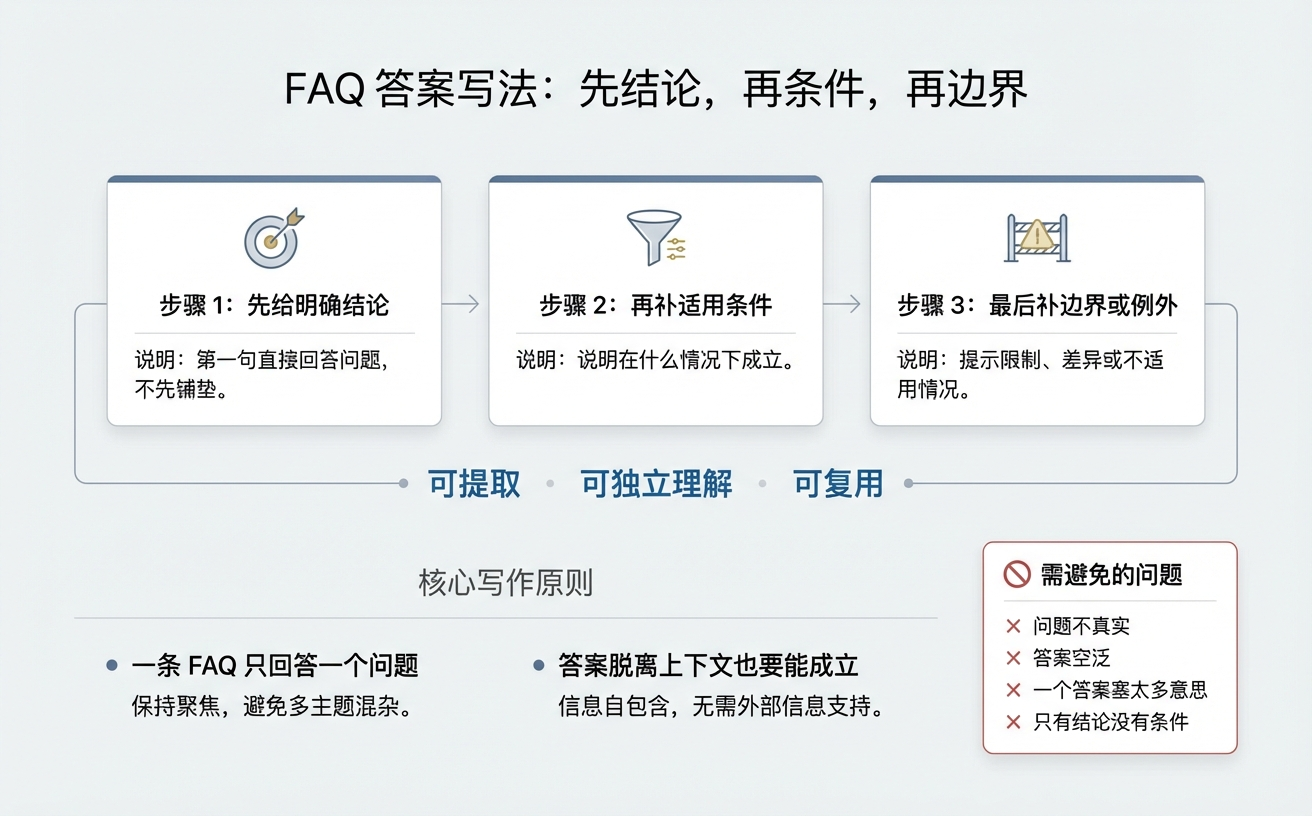
Answer First, Then Add Conditions and Boundaries
An FAQ answer should begin with a clear conclusion. Then explain when it applies and where the answer changes by scenario or exception. This order is easier to understand and better suited to stand-alone extraction.
Do not begin with a long preamble and reach the answer slowly. Answer the question directly.
Suppose a robot-vacuum product page asks: Is this robot vacuum suitable for a home with carpets?
An unhelpful answer would be: It depends on the specific situation. Carpet materials and thicknesses vary, and household cleaning needs affect performance, so you should consider the circumstances as a whole.
The problem is that the answer uses many words without first giving the information the user wants.
A better answer is: Usually yes, but it depends on carpet thickness and your cleaning priorities. Short-pile, low-profile carpets generally present little difficulty. For thick carpets or raised edges, check the machine's obstacle-clearance capability and how well it handles hair around the brush.
Answer One Question Per FAQ Entry
Each FAQ entry should answer one central question. The more focused the question, the easier it is to answer clearly and the more likely a system is to interpret it correctly.
If one question combines what something is, how to do it, how much it costs and whether it is suitable, the answer becomes confused and difficult to reuse.
Make Each Answer Stand on Its Own
Use a simple test: if this answer is removed from the surrounding page, does it still make sense?
If it becomes unclear outside its context, it relies too heavily on the main text and is not suitable as an FAQ answer. Keep it self-contained: avoid excessive pronouns, vague references and details that make sense only after earlier sections.
Common FAQ Problems in AI Search
The questions are not genuine. The most common problem is an FAQ created by a content team simply to fill a section rather than respond to real needs. The wording often feels artificial and does not match how users search or ask questions.
The answers are vague. Another common problem is an answer with no practical information that merely repeats the page's slogan in different words. The section looks complete but resolves nothing.
One answer contains too many ideas. If an FAQ entry tries to make several judgements at once, it usually explains none of them well. Keep each information unit small and explicit instead of forcing several meanings into one entry to save space.
The answer has no qualifications. Some FAQ entries try to be so brief that they give a conclusion without saying when it applies or where its limits lie. The result may look direct but can be inaccurate or misleading.
Is FAQ Schema Still Necessary?
At the time of the Chinese source article in April 2026, FAQ schema could still be retained, but it was not the central part of FAQ optimization. For most commercial websites, the priority was genuine, clear and visible question-and-answer content. Google discontinued FAQ rich results in May 2026, so current implementations should treat the visible content as the durable asset and review the latest official structured-data guidance before keeping markup.
If the question has little value and the answer is empty, schema alone cannot produce a substantive improvement.
First make sure the page contains explicit questions and answers, that the content is visible as text, that it is easy to crawl, and that its wording is consistent with the rest of the page.
After those foundations are in place, decide whether any remaining structured data is appropriate under current search-engine guidance.
Understand the Difference Between FAQPage and QAPage
FAQPage Represents Standard Site-Provided Questions and Answers
When a site supplies both the questions and answers and each question has one standard answer, that content follows the logic historically associated with FAQPage.
Product-page FAQs, service-page FAQs and knowledge-page FAQs commonly fit this content model, even though Google discontinued its FAQ rich-result feature in May 2026.
QAPage Is for Pages Where Users Can Contribute Answers
If the page hosts a discussion in which users can submit different answers, add opinions or propose multiple solutions, QAPage is the closer fit, not FAQPage.
Before implementing structured data, identify the page's actual content type instead of applying markup automatically.
How Do You Measure AI-Search FAQ Optimization?
Start With Changes to the Content
Do not begin by looking only at rankings. First check:
- Does the FAQ cover recurring questions?
- Do the questions match the page's role?
- Are the answers more direct?
- Has outdated information been updated?
- Does the site describe the same subject consistently?
If these foundations have not improved, later changes in search performance are unlikely to be stable.
Then Assess Search Performance
At the search layer, do not watch only one primary keyword. Assess whether the page covers more question, comparison and scenario queries and whether it addresses specific needs well.
An accurate FAQ usually helps a page address long-tail questions instead of relying on a single primary term.
Finally, Assess Business Effects
FAQ work can also make business conversations more efficient. Look for these signals:
- Do users understand more before submitting an enquiry?
- Does the sales team repeat fewer explanations?
- Are critical questions on product and service pages occurring less often?
- Does the help center reduce repeat support tickets?
If an FAQ only increases the page's word count without reducing explanation and support costs, the optimization is not yet effective.
An AI-Search FAQ Optimization Workflow
1. Inventory Page Types
Identify product pages, service pages, help-center pages and knowledge pages, then determine which questions each page type should handle.
2. Build a Question Pool
Collect recurring questions from customer service, sales, on-site search, comments and support tickets before writing answers.
3. Select High-Value Questions
Prioritize questions that recur or affect understanding, enquiries or conversion. Low-value questions do not need to enter the FAQ.
4. Rewrite Answers With One Consistent Pattern
Answer first, add the conditions, and then state the limits. This pattern keeps answers consistent and makes later work easier at scale.
5. Update Regularly
An FAQ should not remain unchanged indefinitely after its first publication. Refresh the question pool, rewrite old entries, remove questions that no longer matter and record why each change was made.
AI-Search FAQ Optimization Checklist
Before publishing, check the following:
- Does the FAQ come from real questions?
- Does each question fit the current page?
- Does the wording resemble the language users employ?
- Does the first sentence answer the question directly?
- Does the answer include conditions and boundaries?
- Does each FAQ entry answer only one question?
- Is the content visible on the page?
- Is important information presented as text?
- If structured data is used, does it match the visible content?
- Have FAQPage and QAPage been distinguished correctly?
- Is there a process for future updates?
Conclusion
AI-search FAQ optimization is not the act of adding an FAQ module or a schema block. It organizes genuine questions into a clear, structured system of answers that can stand on their own.
The difficult part for a business is not writing a few common questions. It is maintaining reliable sources, page roles, answer standards, content consistency and a long-term update process. Only then can an FAQ support user understanding, search coverage and later reuse at the same time.
If you are deciding whether to improve FAQs for AI search, or you already have them but are unsure what to ask, where to place them or how to answer, GlobalBrandsDigital can review the system. We begin with real user questions, the job of each page and the existing content. From there, we decide which FAQs are worthwhile, where they belong and how they should be written instead of starting with a template and adding markup afterward.
If you want AI search to understand and cite your site more readily, contact GlobalBrandsDigital for a review grounded in your business.
Frequently Asked Questions
How Does AI-Search FAQ Optimization Differ From Traditional FAQ SEO?
Traditional FAQ SEO focuses more on long-tail queries and extra visibility in search. Work for AI search asks whether each question is genuine, each answer is clear, the structure is easy to extract and the passage can stand on its own.
Should an FAQ Be a Stand-Alone Page or Part of a Product Page?
It depends on the question. Pre-purchase questions belong on product or service pages; operational and troubleshooting questions fit a help center; definitions and comparisons fit a knowledge page.
Should Every Page Have an FAQ?
No. The page's purpose and the density of genuine questions should determine whether it needs an FAQ. It should not be a fixed template on every page.
Does AI Search Prefer Short or Complete Answers?
Clarity matters more than length. An answer that states the conclusion first and then explains conditions and boundaries is more useful than one optimized merely for a word count.
How Long Does FAQ Optimization Take to Show Results?
There is no universal timeline. First confirm that the page answers more of the right questions and that the answers have improved. Then watch whether the page covers more queries and whether customers need fewer explanations.
Are FAQs Suitable for Every Industry?
Most industries can use FAQs, but the writing should differ. Industries with high explanation costs, difficult decisions or greater risk of misunderstanding usually need them most. Simple pages should not be padded with unnecessary questions and answers.