
On this pageTable of contents+
- What Is AI SEO, and Why Is It Changing Traditional SEO?
- How Does Google Search Interpret Content?
- The Evolution of Google's AI Systems: Understand the Rules Before Acting
- How Do Google and AI Systems Assess Content Quality?
- AI SEO vs. Traditional SEO: Which Should You Choose?
- How Can You Improve SEO Effectively with AI?
- 1. Model Search Intent Instead of Stuffing Keywords
- 2. Build Topical Authority
- 3. Engineer the Content Structure
- 4. Improve the Page with Performance Data
- Five Practical Business Benefits of AI SEO
- Which Businesses Fit AI SEO, and Which Are Likely to Waste Money?
- Seven Common AI SEO Mistakes
- AI SEO Tools Named in the Source
- What Comes Next: GEO, AI Overviews and Business Planning
- Frequently Asked Questions
- Can AI Do SEO?
- How Much Does AI SEO Cost?
- Can ChatGPT Do SEO?
- Is AI SEO Worth It?
- What Are the Disadvantages of Using AI for SEO?
- Does AI Make SEO Obsolete?
- Can Google Detect AI-Assisted SEO Content?

Over the past two years, AI has become increasingly common in SEO. Many people now use it to write content, research keywords and revise titles, but the results are often weaker than expected. Some websites publish faster without gaining rankings; others receive traffic briefly and then watch it decline.
The underlying problem is simple: AI is being used in the wrong place.
AI can improve efficiency, but SEO has never been a contest to write faster. Rankings still depend on understanding search intent, solving the reader's problem and showing that the website deserves trust. AI can assist with the analysis, but it cannot make those judgments for you.
Ignoring AI completely will make SEO work increasingly demanding, yet relying on AI alone can send the work in the wrong direction. A more practical approach is to use AI as a tool while keeping experience and judgment with people.
This article is not a list of tools or a tutorial for generating content in bulk. Drawing on project experience, it explains where AI is genuinely useful in SEO and how a business can apply it at the right stages to reduce wasted effort.
What Is AI SEO, and Why Is It Changing Traditional SEO?
AI SEO, or artificial-intelligence-assisted search engine optimization, means using AI during SEO analysis, decision-making and execution to help interpret search intent, build a content structure and improve the overall strategy. It does not simply mean using AI to write articles.
AI SEO has become important because Google's search systems already use machine learning. When a search engine evaluates content, it considers whether the page solves the problem, presents the answer clearly and appears trustworthy, rather than merely counting how many times a keyword occurs.
SEO teams that do not use AI may gradually lose an efficiency advantage. Teams that treat AI as a content-production machine can make ineffective work fail even faster. Useful AI SEO applies AI to strengthen analysis and relies on people to make the final choices.
How Does Google Search Interpret Content?
To use AI effectively in SEO, start with one principle: SEO is not about pleasing an algorithm. It is about aligning the page with the way Google interprets a search.
The Evolution of Google's AI Systems: Understand the Rules Before Acting
Google did not enter the AI era all at once. It progressively added systems designed to interpret searches, and each stage offers a lesson about how content is understood rather than how keywords can be inserted.
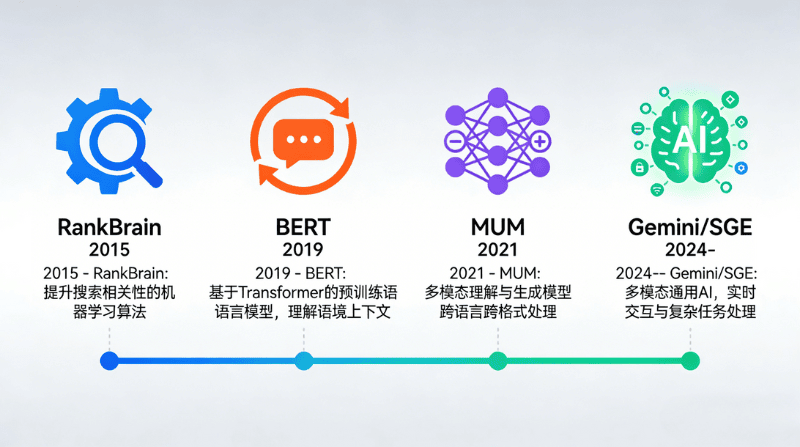
RankBrain: an early shift toward search intent
- From this stage, Google increasingly tried to understand the problem behind a query instead of checking only whether a page contained the same words. That helps explain why one keyword can produce several different kinds of search result.
BERT: moving from keyword matching to contextual meaning
- BERT improved the system's ability to interpret context, especially in longer sentences, qualified questions and natural phrasing. Content written for people consequently became more useful than copy written only for a search engine.
MUM: complex questions and cross-language understanding
- MUM reflected a move toward handling several related questions and combining information across languages and formats. A single isolated answer was less sufficient; organized and connected coverage became more important.
Gemini, SGE and AI Overviews: the era of generated search answers
- Search result pages can now present synthesized answers and cite sources instead of showing links alone. Whether a passage can be understood and used as a source has therefore become another competitive consideration.
How Do Google and AI Systems Assess Content Quality?
In AI-assisted search, Google does not decide whether a page should rank or be used in a summary simply by finding a keyword. The page must answer the user's problem reliably. The source groups the review into five kinds of signal:
- Does the page match the search intent?
- Does the user want a definition, instructions, a comparison, pricing, a case study or help choosing an option?
- If the page answers a different question, precise keyword use alone is unlikely to make the result stable.
- Is the semantic coverage complete?
- Strong content naturally covers the concepts, limitations and relationships needed to explain a topic instead of repeating synonyms.
- The practical question is whether the subject has been explained clearly, not how many times a phrase appears.
- Does the page add information?
- This matters even more when AI can rewrite existing results quickly. Useful additions can include clearer criteria, an executable process, data sources, lessons from mistakes or a basis for comparison.
- A page that only rearranges or paraphrases existing material is easier to regard as low value.
- Is the content credible?
- Experience, expertise, authoritativeness and trust are baseline considerations rather than decorations in an AI-assisted environment.
- Readers and systems need to know who the author or organization is, what relevant experience supports the page, whether its claims can be checked and who is accountable for it.
- Do readers find the page useful?
- Do visitors return immediately to the results, continue reading or take an appropriate next step?
- Such observations can help a team test whether the page was useful, although no single behavioral metric reveals a fixed Google ranking formula.
| Dimension | AI content more likely to lose value | AI-assisted content with a stronger foundation |
|---|---|---|
| Source material | Stitches together or rewrites existing high-ranking content | Uses AI for efficiency while the main insight comes from real experience or data |
| Search intent | Looks relevant but does not answer the user's actual problem | Matches the intent, gives the answer first and then explains why |
| Information value | Sounds correct but remains generic | Adds criteria, boundary conditions, methods or experience |
| Content structure | Adds material merely to look comprehensive and has no clear logic | Moves clearly from the problem to judgment, explanation and action |
| Professional credibility | Provides no clear author or accountable organization | Identifies the relevant author or organization and its experience |
| Detail and verification | Offers no data, case detail, process or checkable method | Provides a basis in data, a case explanation or a reusable method |
| Maintenance | Is generated in bulk once and then left unchanged | Is reviewed on a cadence that reflects changes in the subject |
| Search performance | May receive short-term traffic but remains volatile | Has a stronger chance of remaining useful as competition changes |
The conclusion is straightforward: the useful distinction is not whether AI participated. It is whether the content is valuable, reliable and capable of solving the problem over time. AI is a tool; the quality and professional grounding of the page still determine whether it has a durable foundation.
AI SEO vs. Traditional SEO: Which Should You Choose?
Many websites are not deciding whether to do SEO at all; they are deciding whether an older approach still fits today's search environment. The question is not a simple choice between two opposing methods, but which combination fits the current search experience.
| Dimension | Traditional SEO | AI SEO with human review |
|---|---|---|
| Core approach | Executes around keywords and established rules | Works from search-understanding models and user needs |
| Keyword research | Manual analysis can be slow and limited in coverage | AI supports broader clustering and search-intent modeling |
| Content production | Depends on human experience and available capacity | AI improves efficiency while people own judgments and conclusions |
| Intent analysis | Relies mainly on practitioner experience and can miss distinctions | Combines data and semantic analysis with human commercial judgment |
| Quality control | Manual review alone can be difficult to scale | AI helps find gaps while people remain responsible for quality |
| Technical SEO | Often reacts after a problem appears | Pattern analysis can help identify risks earlier |
| Ranking stability | Can be sensitive when work is tied to a fixed checklist | Can align content more closely with intent and topic relationships |
| Scalability | Growth is constrained by manual processing time | Research and review can scale when quality remains controlled |
| AI-search readiness | May not consider extractable answers or AI Overviews | Can account for clear answers, source context and generated search experiences |
Traditional SEO often concentrates on how to carry out known tasks, while AI can help a team explore what deserves attention and why. Teams that cannot use AI may lose efficiency, but teams that replace judgment with AI can create problems faster.
How Can You Improve SEO Effectively with AI?
Much AI SEO advice focuses on operating a tool. In practice, AI is more useful as an aid to decisions than as a content factory. The source presents four steps repeatedly used in its projects.
1. Model Search Intent Instead of Stuffing Keywords
A keyword is the surface expression; the search intent is the underlying need. AI can scan many keywords and result pages quickly to suggest which phrases point to one need and which represent different tasks.
In projects, the cluster with the largest reported search volume does not always produce the best enquiries. Valuable demand may appear in specific questions with modest volume.
A person must therefore make the final decision about intent. AI can suggest candidates, but it does not know which demand matches the organization's offer and commercial goals.
2. Build Topical Authority
AI can make a website's content library grow quickly without making rankings more stable. The problem is often not the quality of each isolated page but the lack of relationships among them.
From a search perspective, a website that consistently answers a connected chain of questions within one topic provides clearer subject depth than a collection of unrelated articles.
In practice, performance becomes more predictable only when pages around the same topic cite and complement one another instead of operating separately.
3. Engineer the Content Structure
The largest weakness in AI-written content is often not its grammar but its judgment. Asking AI to write a complete article in one step can produce something that looks comprehensive without giving readers much help with a decision.
A more dependable approach is to decide the structure first: which questions must be answered, what belongs near the beginning and what needs only a short explanation.
Some pages do not need a complete rewrite. Moving decisive information from the end of the page to the beginning can materially improve the experience.
4. Improve the Page with Performance Data
Many SEO projects treat publication as the finish line. When AI increases production speed, that habit can amplify problems.
A better approach is to keep reviewing search performance. Some pages show weaker click-through rates or engagement before rankings fall; others retain traffic while producing fewer relevant enquiries.
These signals are not inherently complicated, but without a regular review cadence they are easy to overlook.
Five Practical Business Benefits of AI SEO
The useful value of AI SEO is not simply faster writing. It can help a business reduce avoidable experiments and make growth decisions with better information.
1. Find high-conversion search demand sooner: AI can compare many search behaviors, question chains and page structures to reveal needs that already exist but are not yet served well, before the competitive field becomes crowded.
2. Reduce content experimentation costs rather than merely cutting writing costs: the largest waste in traditional SEO is often producing pages that were unlikely to generate relevant demand. AI-assisted screening can reject weak directions before production.
3. Build a more resilient basis for rankings: content organized around intent, topic structure and E-E-A-T is less dependent on one optimization tactic. It may be easier to review and recover when search conditions change, although stability is never guaranteed.
4. Expand topical coverage systematically: AI can help a business map a complete problem area instead of publishing disconnected articles, while editors protect accuracy and distinct page roles.
5. Support qualified B2B, export and SaaS enquiries: specific, later-stage searches can bring prospects who already understand their context and need. The quality of those enquiries still depends on the market, offer and conversion path.
Which Businesses Fit AI SEO, and Which Are Likely to Waste Money?
AI SEO can be a good fit when:
- The offer has a high order value and a long decision cycle, as in many B2B, export and SaaS businesses.
- The organization has clear product boundaries or professional differentiation.
- The goal is sustained organic enquiries rather than a short burst of traffic.
It may be a poor fit when:
- The plan is to publish AI content in bulk and chase short-term rankings.
- The product is highly commoditized and the business cannot explain a professional difference.
- No one is responsible for editorial judgment and quality control.
Seven Common AI SEO Mistakes
When a business does not see results from AI SEO, the problem often began with how it chose to use AI.
1. Using ChatGPT to produce content in bulk
Treating AI as a content factory can generate many apparently relevant pages with little additional information. They may fluctuate in the short term, but they are unlikely to create durable topical authority.
2. Skipping human review
AI can accelerate the work, but it cannot accept responsibility for facts, limitations or claims. Unreviewed content often sounds correct without helping the reader, and its details can fail under scrutiny.
3. Watching rankings without watching conversions
Some queries bring traffic without enquiries. Focusing on positions alone can push content toward search visibility that has little commercial relevance.
4. Ignoring technical SEO
Even strong writing cannot overcome a page that cannot be crawled, is slow to index, has structural errors or sits behind broken internal paths. Technical faults can make content investment inefficient.
5. Publishing scattered topics without a structure
An article about the definition of AI SEO followed by an unrelated tool list gives search systems little evidence of depth in one subject. More disconnected content can create more noise.
6. Updating content without a reason
An update should have a defined aim, such as adding missing intent coverage, evidence, links or structure. Changing a few sentences without that aim creates more versions without a clearer signal.
7. Treating AI as an employee instead of a tool
Asking AI to complete a page from one instruction is very different from using it for retrieval, clustering, an outline draft or a coverage check while people retain the critical decisions. The outcomes can differ substantially.
AI SEO Tools Named in the Source
The source lists established tools used in its AI SEO work. Features, pricing and availability change, so confirm the current product before procurement. A tool can improve efficiency, but it is not the strategy.
| Tool category | Tool named in the source | Role described in the source |
|---|---|---|
| Integrated SEO platform with AI | Semrush One | Keyword research, AI visibility, SERP structure and competitive analysis |
| Integrated SEO platform with AI | Ahrefs | Content coverage, competitor analysis and AI content assistance |
| On-page content optimization | Surfer SEO | Content structure and semantic coverage suggestions |
| Content and semantic optimization | Clearscope | Coverage and structure feedback during editing |
| Index and technical optimization | Indexly | Indexing support, crawl monitoring and URL status checks |
| Keyword clustering and intent analysis | Keywordly | Long-tail discovery and intent segmentation |
| Content structure and process support | Koala AI | Custom outline preparation and content assistance |
| AI visibility tracking | Rankscale.ai | AI citation and visibility monitoring |
| AI result monitoring | SE Ranking | AI Overview and SERP feature comparisons |
| Search data and automation | DataForSEO | API-based search data and custom analysis |
What Comes Next: GEO, AI Overviews and Business Planning
The arrival of AI search does not mean SEO has ended. It raises the standard of the work.
In AI Overviews, ChatGPT and similar experiences, users can see a synthesized answer directly. The competitive question consequently shifts from position alone to whether a company's content can be selected, cited or combined into that answer.
That is the focus of Generative Engine Optimization (GEO). It considers whether content is structured clearly, states conclusions plainly, comes from a credible source and provides information that can be checked. It cannot guarantee that a particular AI system will cite the page.
Professional SEO therefore remains important. AI can generate text, but it cannot decide the boundaries of a search intent, the architecture of topical authority or the long-term signals that earn trust. Those decisions still depend on a coherent method and experience.
If you need an SEO team that can adapt its approach as AI search changes instead of repeatedly guessing, the work described here may fit the conversation you want to have.
While serving export, B2B and SaaS clients, the source team says it has expanded its goal beyond ranking a page. It now also considers GEO: helping content become understandable and potentially usable in Google AI Overviews and other generated search experiences.
The source gives one project example.
An industrial-equipment exporter had a large but fragmented content library. Its themes were scattered, and rankings were unstable even when pages reached visible positions.
The team says it did not simply increase AI output. It used AI to help separate search intents and map the topic, while people decided which pages deserved production. After the content map was rebuilt, the source reports more stable rankings for core pages, appearances in Google AI summaries and more relevant enquiries. These are the team's project observations, not a guaranteed result for another site.
Publishing more AI content alone cannot produce that system, and a tool cannot substitute for the decisions behind it. A business planning the next stage of SEO needs sustained visibility and trust in an AI-search environment, not only a temporary ranking.
The source team does not present a fixed package based on an AI word count. It proposes starting with the industry and existing content to decide whether the current SEO approach should be expanded or changed.
If you are facing specific problems with keyword research, website diagnostics, SEO optimization or link building, you can discuss the direction with an SEO consultant before committing to the next action.
For further reading, explore the GlobalBrandsDigital SEO knowledge center.
Frequently Asked Questions
Can AI Do SEO?
It can do part of the work. AI is useful for analysis, organization and efficiency, including keyword clustering, content-structure suggestions and data screening. People still need to decide the search intent, editorial priorities and strategy.
How Much Does AI SEO Cost?
Costs vary widely. Tools can range from tens to hundreds of dollars per month, but the larger cost is whether someone can apply them well. Used poorly, a larger content library creates more waste.
Can ChatGPT Do SEO?
It can assist with a first draft, an outline and information organization, but it should not independently own keyword decisions, content quality control or long-term SEO strategy.
Is AI SEO Worth It?
It can be valuable in a suitable setting. B2B, export and other businesses that depend on long-term acquisition may reduce experimentation costs. It offers much less value when the plan is to chase short-term rankings with bulk content.
What Are the Disadvantages of Using AI for SEO?
The largest risk is applying AI in the wrong place. Treating it as a content-production machine can create many plausible pages that offer readers little value and make stable performance harder to maintain.
Does AI Make SEO Obsolete?
No. AI changes the way SEO is carried out, not the need for SEO. Search still needs discoverable, understandable and trustworthy information that solves a real problem.
Can Google Detect AI-Assisted SEO Content?
The more useful question is not whether a tool participated. A page still needs to be useful, reliable and aligned with the search intent. Low-value content is the risk, regardless of how it was produced.