
On this pageTable of contents+


Many people ask for advice about placing keywords on a page.
I have researched hundreds of keywords and know which type each one belongs to. When I place them on the page, what keyword density should I use?
Keyword density is no longer a useful rule. Search rankings are not won by packing a page with repeated terms.
Google can interpret the content and assess its relevance.
Focus instead on the result after you place a keyword in a particular position.
Why Should You Run an SEO Test?
First, many SEO decisions depend on the circumstances. SEO practitioners often answer a question with It depends.
In other words, an action that performs well on someone else's website will not necessarily produce the same result on yours.
If you want to know whether a keyword belongs near the beginning or the end of a page, whether a particular backlink is worth pursuing, or what value the change creates, test it.
Your decisions should be guided by observed results rather than by an untested personal opinion.
Second, a test helps confirm that the time and effort invested are producing a positive result.
If a change has a negative effect, limiting it to a subset of pages can also prevent one mistake from affecting the entire site.
Is Your Website Ready for Testing?
If your website receives little traffic, do not make testing the immediate priority.
First, without baseline traffic there may be too little activity to reveal a meaningful difference.
Concentrate on the SEO fundamentals and build traffic first. Once the site has a usable baseline, it becomes more practical to assess the result of one change.
Second, a very small traffic sample is unlikely to be broadly representative.
Statistical conclusions drawn from too few observations may not apply more widely.
You may now be wondering how much traffic counts as enough.
The answer is again: it depends.
Each niche has a different potential traffic pool, so one threshold cannot apply to every website.
As a rough reference from the source, many niches may need at least ten thousand visits before a page-group result becomes easier to distinguish. This is practical guidance, not a universal sample-size calculation.
Do not be discouraged if the site has not reached that level. Traffic can move from four digits to five surprisingly quickly when several pages begin performing.
Which Type of SEO Test Should You Use?
Several kinds of SEO test are possible. The source mentions sequential testing but does not recommend it.
It can take a long time, and a harmful result can affect the whole website, making recovery much harder.
The result can also be influenced by third-party variables outside your control.
The source instead recommends an A/B or split test across comparable page groups because it is easier to operate and contains some of those risks.
What does A/B testing mean in this context?
In simple terms, change one element on a selected group of pages, leave another comparable group unchanged and then compare the two groups.
The unchanged pages form the control group; the changed pages form the variant group. Because search traffic is not a randomized user experiment, this design reduces some confounding factors but cannot remove every algorithm, seasonality or competitor effect.
How Do You Set Up the Test?
1. Decide what you want to test and write the hypothesis.
List the proposed change, the result you expect and the type of page to be included.
Select pages with many characteristics in common so that other variables interfere as little as possible.
The hypothesis must have a reasonable basis. Although the test limits the number of pages exposed to a possible downside, the goal is still to obtain useful positive evidence.
Do not change something merely for the sake of running a test.
2. Use pages that already receive a reasonable amount of organic traffic.
As noted above, this gives the result a better chance of being representative.
3. Decide which pages will form the variant group.
This choice involves random sampling.
If you do not have a testing tool, Google Sheets can help with the allocation.
Put the eligible page URLs into a Google Sheet and use Randomize range to shuffle them.
Select a defined set of URLs from the randomized list for the change. The pages left unchanged become the control group.
4. Set the test duration. The source recommends at least one month and sometimes longer.
How can you tell whether enough data has accumulated to support a useful conclusion?
- Confirm that Google has recrawled the variant pages and that they have received a reasonable amount of traffic.
- A test must run long enough for recrawling; otherwise, even a large movement cannot safely be attributed to the change.
- Continue until the pages have accumulated enough traffic for the result to be interpreted with appropriate caution.
The basic logic is to give Google time to recognize the change and then collect a visible response. Remember that timing alone does not prove causality.
Choose How You Will Track the Test
Whether you are testing organic traffic, click-through rate or search position, Google Search Console can be used to monitor the relevant trend.
If the question concerns rankings, Ahrefs can also report the positions observed by its tracker.
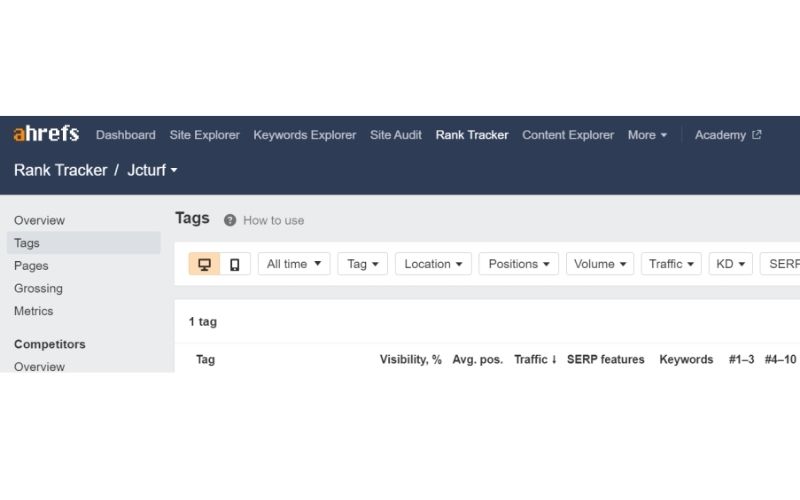
In Ahrefs Rank Tracker, add and label the variant and control groups. You can then compare their positions through the Tags view.
Make the Change
Apply the change only to the variant group and change just one variable. Otherwise, it becomes difficult to tell which action is associated with the result.
Keep a complete record of every change.
The record should state what changed, when it changed and what the page contained beforehand.
Many teams fail to preserve the earlier state, discover that the result is poor and then cannot restore the page accurately.
A test should always leave a reliable path back to the previous version if the outcome is unsatisfactory.
Review the Result
Track the result using the monitoring method chosen in the previous step.
If the groups were labelled in Ahrefs beforehand, choose the relevant date range in Tags to examine the movement after the test began.
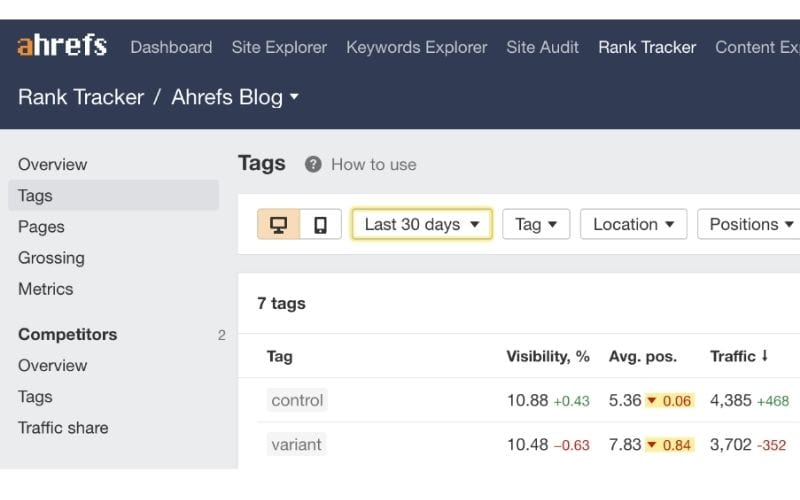
The difference helps the team decide whether to retain the changed approach or restore the earlier one, without relying only on repeated opinions. Check implementation, recrawl timing and outside events before treating the observed movement as the effect of the test.
Two final reminders:
1. Run this kind of test only when the website has enough traffic to make the comparison useful.
2. Test only when the answer will guide a decision. If trusted findings already support an essential fix, make it instead of delaying for another test.
For more guidance, explore our SEO knowledge center.
If you want to improve rankings and attract more qualified traffic in a competitive market, GlobalBrandsDigital can connect keyword research, SEO content, technical optimization and link building in a plan tailored to the site. No test or SEO service can guarantee rankings or traffic.