
On this pageTable of contents+
- Why Bing SEO Deserves Attention Alongside Google
- Bing's Reported Market Share and Audience Profile
- Three Less-Obvious Advantages of Bing Traffic
- How ChatGPT, the New Bing and Copilot Changed Search Discovery
- Bing SEO vs Google SEO: Do Not Copy One Playbook Blindly
- Comparing the Source's Main Algorithm Observations
- Six Factors the Source Emphasizes for Bing
- Which Practices May Work Differently on Bing?
- Bing SEO Setup Checklist for Beginners
- Step 1: Add the Site to Bing Webmaster Tools
- Bing Webmaster Tools Login and Common Access Problems
- Submit a Sitemap or Feed to Support Discovery
- Basic Technical SEO Checks: Build a Sound Foundation
- Three Common Beginner Mistakes in Bing SEO
- Bing SEO Keyword Strategy: Build a Suitable Keyword Set
- Use Data to Find Bing Keyword Opportunities
- Keyword Types Worth Exploring on Bing
- Place Keywords Where the Page Topic Is Clear
- Example: Bing Keyword Planning for an Export Website
- Bing Content Optimization: Useful Formats and Structures
- How the Source Evaluates Content Quality for Bing
- A Clearer Content Layout for Bing
- How to Support Bing Search and AI-Assisted Discovery
- Practical Template: A B2B Service Page for Bing
- Backlinks and Brand Signals: Building Trust for Bing
- The Source Treats Backlinks as an Important Signal
- Where Relevant, Editorial Backlinks Can Come From
- Branded Searches, Clicks and Bing Visibility
- Local and Multilingual Bing SEO
- Optimizing Bing Places for Business
- Multilingual and Multiregional Site Setup for Bing
- A Typical Bing Inquiry Path for Export Websites
- Bing SEO Analysis: Reports to Review in Webmaster Tools
- Performance Reports: Clicks, Impressions and Ranking Distribution
- URL Inspection: Diagnose Why a Page Is Not Indexed
- Indexing, Crawl-Issue and Site-Scan Reports
- Turn the Data into Specific Improvements
- Bing SEO Trends and Opportunities Identified for 2025
- How AI Search Changes Content Formats
- Structured Data and Entity Information Matter More
- How a Smaller Site Can Build Its First Bing Organic Traffic

In China, Google is usually the first search engine people think of when overseas SEO comes up. Many companies focus only on Google rankings and give Bing little attention. Across our projects, however, we have repeatedly seen that careful Bing SEO can add a stable stream of overseas organic traffic with commercially relevant visitors.
Many Bing users in Europe and North America work in offices or corporate environments. They often use Windows and the built-in Edge browser, where Bing may be the default search engine. Ignoring Bing can therefore mean giving up a source of qualified demand.
In this article, we will use a relatively simple method to show you step by step:
- Why Bing deserves consideration alongside Google
- The main differences the source sees between Bing and Google SEO
- The initial Bing SEO setup for new and established sites
- How to adapt content, keywords and backlinks for Bing
Treat this article as a beginner's guide and practical checklist for Bing SEO. Work through it step by step to begin building organic visibility on Bing.
Why Bing SEO Deserves Attention Alongside Google
Bing's Reported Market Share and Audience Profile
Google remains the largest search engine worldwide, but the source article reports steady Bing use, particularly in Europe and North America. It estimates desktop share at roughly 8%-12% in many countries. Treat that range as the source's market observation rather than a universal current figure, and confirm the opportunity in your own analytics and Bing reports.
Bing users also have their own distinct characteristics:
- The source associates the audience with higher-spending markets in North America, Europe and Australia
- The source describes many users as being between 30 and 55
- Common contexts include office work, procurement and information research
- Many corporate users work on Windows and Edge
- Microsoft accounts and tools can make Bing a natural search choice in some organizations
In practical terms, the source argues that Bing can reach business users with budgets and purchasing needs, making it relevant to export and B2B websites. Validate that audience fit against first-party data for the market you serve.
Three Less-Obvious Advantages of Bing Traffic
In the author's long-term project experience, focusing only on Google can leave a cost-efficient source of traffic unexplored.
First, the source has often observed less competition, lower costs and earlier signs of SEO progress on Bing. These outcomes vary by query and market.
Because many companies give Bing little attention, the source has encountered lower competitive pressure for some keywords. It has also observed lower Microsoft Advertising CPCs than Google Ads in some campaigns. These are project observations, not guaranteed platform-wide results.
Second, the source has seen commercially useful inquiries in B2B and export projects.
The author's equipment, software, service and export projects have sometimes produced strong Bing leads. The pattern should be measured for each business rather than assumed from audience stereotypes:
- Bing may not produce the highest volume of inquiries
- The source has sometimes seen a higher conversion rate
Third, Bing has built-in entry points across parts of the Microsoft ecosystem.
Bing is integrated with parts of the Microsoft ecosystem, including Windows, Edge and Copilot. Workplace defaults can lead some users to search with Bing without actively changing settings. A site with no Bing visibility may therefore miss part of that audience.
In overseas SEO projects, we usually assess Google and Bing together. Bing has sometimes become an additional inquiry source that the client did not initially expect.
How ChatGPT, the New Bing and Copilot Changed Search Discovery
Microsoft integrated generative AI experiences into Bing and expanded Copilot. Search results can now include generated answers that synthesize information from multiple pages, changing how users encounter sources.
First, make content easy for people and systems to understand. Clear headings and focused paragraphs can support extraction; keyword stuffing and confused hierarchy weaken the page. Clear structure improves eligibility but does not guarantee citation or visibility.
Second, generated answer areas create another place where sources may be shown. A cited page may receive additional exposure, but placement and click-through rate remain controlled by the platform and cannot be guaranteed.
Strategically, building a systematic Bing presence is not just about adding another search engine. It also prepares the site for AI-assisted discovery as those experiences evolve.
Bing SEO vs Google SEO: Do Not Copy One Playbook Blindly
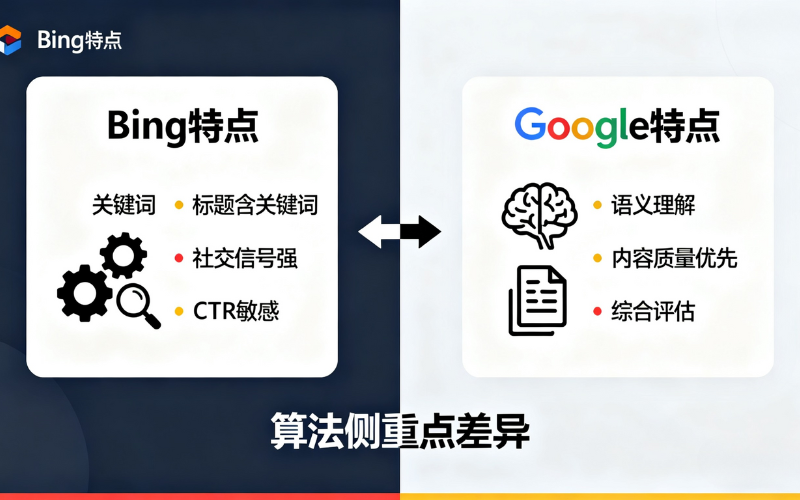
A common Bing SEO mistake is to copy a Google playbook without checking the differences. The two systems share fundamentals, but the source argues that their emphasis is not identical. A tactic that works on Google may have a different effect on Bing.
The following comparison preserves the source's practical observations. Treat them as hypotheses to test against current Bing documentation and your own results, not as a complete description of either ranking system.
Comparing the Source's Main Algorithm Observations
1. Content Relevance vs Keyword Matching
Google prefers to understand semantics and determine whether a piece of content meets user intent. Bing is relatively more "direct" and pays more attention to whether keywords appear clearly. In simple terms:
- Google: Does the page solve the problem?
- Bing: Does the page state the topic clearly?
The source therefore recommends making the topic explicit in the title, H1 and URL and keeping the wording natural.
2. Brand Trust and Social Signals May Carry Different Weight
The source gives particular attention to brand trust and social evidence, including:
- Whether the brand has credible online visibility
- Whether independent media mention it
- Whether its social profiles show genuine activity
- Whether people actively search for the brand
Both engines can use many signals; the source's point is that Bing appeared more responsive to these indicators in its projects.
3. User Interaction Signals May Be Weighted Differently
The source also asks teams to monitor interaction measures such as:
- Click-through rate (CTR)
- Dwell time
- Bounce rate
- Whether a visitor returns to the results and chooses another page
A clear title and useful page can improve clicks and engagement. The source associates those outcomes with stronger Bing visibility, but a quick ranking increase is not guaranteed and aggregate analytics do not reveal a complete ranking formula.
Six Factors the Source Emphasizes for Bing
Drawing on project experience, the source groups its Bing priorities into six areas. These are working observations rather than an official or exhaustive factor list.
1. Domain history and brand trust: established domains and recognizable brands may have an easier starting point. A newer site can build legitimate trust through consistent brand information and relevant editorial backlinks.
2. Clear keyword placement: make the main topic explicit in the title and H1, keep the URL descriptive and avoid keyword stuffing. The source observed gains from this clarity, but no placement guarantees higher rankings.
3. Original multimedia content: combine clear writing with useful images or video when they add information. Media alone does not guarantee a better position.
4. User engagement: the source recommends watching how visitors respond to the page. Do not treat any single engagement metric as a disclosed ranking formula.
5. Location relevance: accurate local and regional information can help a search engine match a service to the right audience. It does not create automatic ranking weight.
6. Page speed and technical quality: faster, stable pages create a better experience. Image-heavy sites should compress and optimize their media.
Which Practices May Work Differently on Bing?
The source found the following practices more noticeable on Bing in some projects. They should be tested rather than treated as universal rules.
1. Slightly more direct keyword wording
Make the page topic explicit, so:
- Make the title direct and descriptive
- Repeat the primary term only where it reads naturally
- Use relevant terms in subheadings when they describe the section
Do not stuff keywords. Use exact language only where it reads naturally, and still cover the subject semantically.
2. Use helpful images with descriptive alt text
Useful images and accurate alt text can support image discovery and help explain the page. More images do not automatically create more stable rankings, so include only media that adds value.
3. Use descriptive anchor text in moderation
Excessive exact-match anchors can look manipulative on any platform. The source recommends clear internal-link wording when it genuinely describes the destination--for example, "Bing SEO tutorial"--without forcing the same phrase into every link.
Bing SEO Setup Checklist for Beginners
Some sites perform poorly on Bing because basic access and configuration were never completed. Start with the technical foundation before expecting the platform to discover and assess the content.
Step 1: Add the Site to Bing Webmaster Tools
Bing Webmaster Tools is Microsoft's official portal for site owners. It reports search impressions, clicks, queries, backlinks and technical issues. Any team working on Bing SEO should establish access and review the data.
Visit https://www.bing.com/webmasters and log in with a Microsoft account (Outlook, Hotmail, Office 365, etc.). If you usually log in with a Google account or GitHub account, you can also directly authorize it for use without additional registration.
After signing in, add the website and prove ownership. Current Bing documentation supports importing a verified Google Search Console property or adding a site manually and using one of Bing's documented verification methods. Common manual options include:
- Add the documented DNS verification record
- Upload Bing's HTML verification file to the documented location
- Import an already verified Google Search Console property or use another currently supported method
In practice, we prefer a durable DNS record or HTML verification file. Once ownership is confirmed, the portal provides the reports and tools used for sitemap submission, index review and error diagnosis.
Bing Webmaster Tools Login and Common Access Problems
Every time you want to view Bing data in the future, directly visit the same address: https://www.bing.com/webmasters, and log in with the account you used to verify the website.
In practice, access problems usually fall into two groups:
The first is account mismatch: a site added with account A will not necessarily appear when someone signs in with account B. Use the verified account or grant individual access through the supported user-management controls.
The second involves a lost verification method. Server moves, DNS changes or deletion of an HTML verification file can invalidate ownership. Restore a current documented method and allow the portal time to recheck it.
If several employees need access, do not share one password. Give each person an individual account and the appropriate permission level.
Submit a Sitemap or Feed to Support Discovery
Once the site is added, help Bing understand its structure by submitting a sitemap or supported feed.
For most sites, generating a sitemap is straightforward:
- WordPress plugins such as Yoast SEO or Rank Math can generate a sitemap index
- Shopify provides a sitemap.xml file; open https://yourdomain/sitemap.xml to confirm that it works
- For a custom site, generate sitemap.xml from the canonical URL inventory and place it at a stable public URL
Use the Sitemaps section in Bing Webmaster Tools to submit the appropriate URL. A sitemap helps Bing discover URLs efficiently, but submission does not guarantee crawling, indexing or ranking.
Keep the sitemap limited to canonical, indexable URLs that return success. Remove obsolete 404s, parameter duplicates, private routes and broken file paths, and review the file regularly.
Basic Technical SEO Checks: Build a Sound Foundation
With the portal and sitemap in place, review the basic technical controls. This does not require advanced development work, but it does require care with several important settings.
The first is robots.txt. This is a file that tells search engines "which directories are accessible and which are not." If you write it wrong here, it is very likely that the entire website will be blocked from search engines. The most typical error is: Disallow: /
This is equivalent to directly telling Bing: "Don't crawl any of my pages." Under normal circumstances, we only need to allow most pages to be crawled and block some backend directories.
Second, use HTTPS and maintain it correctly. Browsers may label HTTP pages as insecure, and a secure connection is a baseline expectation for a business website.
Finally, check mobile usability. Bing may contribute substantial desktop traffic, but visitors still arrive on phones. Test responsive behavior, readable type and loading performance across devices.
Three Common Beginner Mistakes in Bing SEO
When we were working on the project, we found that many companies had encountered the following three major pitfalls in Bing SEO.
1. Only do Google Search Console, not Bing Webmaster Tools
Without Bing Webmaster Tools, the site has no first-party Bing reporting and the team cannot diagnose channel-specific problems. Even a team with no immediate Bing campaign should consider adding the property and preserving access.
2. Blindly post content without looking at Bing data
Bing demand and result formats can differ from Google. Publishing without reviewing Bing data can send the content plan in the wrong direction.
3. Not distinguishing between markets: apply domestic logic to European and American markets
Search language, intent and device use differ by market. A content plan built only around domestic assumptions may not serve users in Europe or North America.
If you lack technical staff or time to check each detail, we can handle the initial SEO audit and setup, then establish a suitable Bing and Google foundation for the site.
Bing SEO Keyword Strategy: Build a Suitable Keyword Set
Many companies reuse their Google keyword plan unchanged for Bing. Because the observed audience, results and query patterns can differ, build the Bing set from Bing evidence rather than assuming complete equivalence.
Use Data to Find Bing Keyword Opportunities
Choose keywords from data rather than intuition, and judge which terms fit the site and its market.
1. Expand Google Keyword Research and Cross-Check It on Bing
Many mainstream tools provide limited Bing datasets. We therefore use Google keyword data as a starting reference, then cross-check each opportunity in Bing results and first-party Bing reporting.
The process is as follows:
- Find closely relevant terms in Ahrefs, Semrush or Google Keyword Planner
- Search each candidate in Bing and review:
- The query suggestions
- The related searches
- The types of pages ranking near the top
- Whether the term fits the industry, market and intended page
This cross-check is a practical way to reduce unsupported assumptions.
2. Review Bing Suggestions, Related Searches and Results
Check whether Bing suggestions reveal additional long-tail language. For example, "machine cutting tool" may produce more specific intent variants. Confirm competition and conversion potential with actual results rather than assuming every suggestion is valuable.
Review Related Searches at the bottom of the results. They can reveal how Bing currently groups the topic and the language searchers may use.
Study the page types on the first results page: products, solutions, guides or another format. Record the market and date because result pages change.
This process produces a set of Bing keyword opportunities supported by observed demand and result fit instead of blindly copying the Google list.
Keyword Types Worth Exploring on Bing
In the author's experience, several keyword types have worked well for B2B, export and corporate sites on Bing. Test them against the actual audience:
The first category is long-tail, multiword intent queries, such as "best accounting software for small business" or "how to choose industrial vacuum pump." The source associates these specific searches with stronger commercial intent, but conversion must be confirmed from the site's data.
The second category combines B2B industry language with brands or products, such as "Siemens PLC module price" or "industrial chiller manufacturer USA." Search volume may be modest, but the query often expresses a concrete business need.
The third category combines a city and an industry, such as "Seattle metal fabrication company" or "London B2B IT support." This can be useful for businesses with real local operations or customers, provided location claims are accurate.
These terms share clear intent and may face less competition, which can make them useful for smaller businesses and export websites seeking qualified inquiries.
Place Keywords Where the Page Topic Is Clear
Finding keywords is only the first step. The next is placing them naturally where the topic is clear. The source observed that explicit titles and headings helped Bing understand pages, but clarity should never become repetition.
We usually follow five basic principles:
First, include the main keyword naturally in the title and place the distinguishing information early. Keep it clear rather than forcing repetition.
Second, let the H1 complement the title. It need not repeat the same sentence, but both should describe the same subject. For example:
- Title: Industrial Chiller Manufacturer in China
- H1: Professional Industrial Chiller Supplier for Global Companies
Third, use long-tail terms naturally in H2 and H3 headings where they accurately describe the section.
Fourth, keep the URL short and descriptive; it may include the core topic. For example: /industrial-chiller-manufacturer/
Fifth, a meta description can affect how the result is presented and clicked even though it does not directly determine ranking. Write it for users and include the topic naturally.
Finally, use related terminology where it belongs. An industrial-chiller page may naturally mention compressors, cooling systems and temperature control. Call these contextual terms rather than relying on the outdated idea of a fixed "LSI keyword" formula.
Example: Bing Keyword Planning for an Export Website
Suppose an export manufacturer of industrial chillers is preparing a Bing SEO plan. The keyword set can be divided into three levels:
Level one: core commercial terms
These are the primary product terms, for example:
- industrial chiller
- water chiller system
- industrial cooling machine
These terms generally belong on the main category or core product pages.
Level two: long-tail and intent queries
These queries express a more specific need:
- industrial chiller for plastic industry
- how to choose industrial water chiller
- best industrial cooling system for factory
These topics suit blog articles or solution pages.
Level three: regional and branded queries
For a business that genuinely serves North America, examples include:
- industrial chiller supplier USA
- industrial chiller manufacturer for Canada
- Brand + product: YourBrand industrial chiller
Map the three groups to the site architecture:
- Place core commercial terms on category and product pages
- Use long-tail topics for articles or solution pages
- Use regional terms only on genuine market or location pages
This creates a coherent Bing keyword system that covers valuable topics and supports conversion paths.
Bing Content Optimization: Useful Formats and Structures
The right keywords tell Bing what the page covers; useful content gives the page a reason to deserve visibility. The source emphasizes clarity, organization and problem-solving but acknowledges that no format guarantees ranking.
How the Source Evaluates Content Quality for Bing
From the author's project experience, three qualities matter most: originality, depth and structure.
First is originality. Copied or stitched-together content is unlikely to compete. If you consult other articles, synthesize the subject in your own words and add useful information or experience rather than merely translating or reproducing them.
Second is depth. A page about choosing an industrial chiller should go beyond "quality and price" to explain applications, specifications, energy use and maintenance cost. That gives the reader a substantive answer instead of a generic summary.
Third is structure. Headings, paragraphs and summaries help people scan the page and help systems identify its subject. A single undifferentiated block of text serves neither group well.
Most importantly, solve the reader's problem and provide clear conclusions or next steps. The source recommends reviewing engagement data after publication, but no single bounce or dwell-time measure should be treated as a disclosed ranking rule.
A Clearer Content Layout for Bing
Content should be well written and well organized. A readable layout improves the experience and makes the page's subject easier to understand.
First, give each article a clear H2/H3 hierarchy. Let each heading address one question or dimension so readers can scan the document and locate the part they need.
Second, use lists and tables when they clarify comparisons, steps, cautions, specifications or configurations. Do not force every passage into a list.
Third, combine text with useful diagrams, screenshots, images or video. Write accurate alt text and keep media crawlable and efficient; image search can then become another discovery route.
The principle is simple: make the page easy for both people and machines to understand. This is central to our content work.
How to Support Bing Search and AI-Assisted Discovery
Bing now includes AI-assisted answer experiences in many results. To improve extractability, organize the writing around explicit questions and answers, and remember that no structure guarantees selection.
One practical approach is to answer Who, What, Why and How questions clearly. For example:
- What is it, and who is it for?
- Why does it matter, and what are the benefits or risks?
- How does it work, and what steps are involved?
- How should the result be evaluated, and what happens next?
This structure can make a passage easier to extract and summarize, but Bing decides whether and how a source appears.
After an important section, a short summary can state the main conclusion--for example, "The three core parameters when choosing an industrial chiller are ..." Keep the summary useful to readers rather than writing it solely for an algorithm.
Steps, processes and cautions also work well as ordered or unordered lists. These structures make information easier to scan and reuse, but they are not a citation guarantee.
Practical Template: A B2B Service Page for Bing
Consider a B2B service page for an industrial-automation solution. The source recommends the following structure:
- Open with a short explanation of the service, the problem it solves and the businesses it serves.
- Use one or two sections to describe real customer problems, such as low output, frequent errors or high labor cost.
- Introduce the solution under clear headings, covering scope, implementation and technical features. Use a list or flow diagram when it improves understanding.
- Add one or two bounded case examples, stating exactly which metrics changed and preserving attribution.
- Answer practical questions such as timing, system requirements and maintenance in a dedicated section; use an FAQ only when the source truly contains those questions.
- Close with a clear next step, such as requesting an assessment, obtaining a quote or contacting a consultant.
From the source's perspective, this page offers several advantages:
- Clear topic: the service is immediately identifiable
- Clear structure: each heading answers a specific question
- Complete information: the page connects the problem, solution and evidence
- Extractable presentation: problems, solutions, steps and questions are easy to scan
In our B2B service-page work, this structure has usually performed better than a thin product page when paired with natural keyword placement and sound technical SEO. Treat that as project experience, not a promised result.
Backlinks and Brand Signals: Building Trust for Bing
Backlinks remain an important part of search visibility. The source observed that Bing responded to relevant editorial references and consistent brand exposure, but neither element guarantees a better position.
The following sections preserve the source's backlink and brand observations and distinguish them from official ranking disclosures.
The Source Treats Backlinks as an Important Signal
The source treats backlinks as an important credibility signal and emphasizes relevance and quality over raw quantity.
Links from reputable industry publications, specialist sites and genuine blogs can send useful referral traffic and demonstrate independent recognition. Bulk-purchased, irrelevant or spammy links can undermine trust and violate search guidelines.
Relevance also matters. An industrial-automation company may benefit from legitimate references on manufacturing or engineering sites; an exporter may earn coverage from an industry association or trade publication. The source's "one relevant link can outweigh ten generic links" is a practical metaphor, not a fixed weighting formula.
The principle is to earn authentic, useful and relevant references rather than chase volume.
Where Relevant, Editorial Backlinks Can Come From
The next question is where legitimate references can come from. The source suggests several channels that may suit a business.
One is editorial coverage or a contributed article for an industry publication, professional blog or technical community. The material must be original and useful, and any placement should follow the publisher's disclosure rules.
Another is a complete company profile on a relevant marketplace such as Alibaba or Made-in-China, or in a legitimate industry directory. Treat these primarily as accurate business references and referral channels, not automatic authority transfers.
A third is a genuine contribution to a forum, Q&A site or technical community such as Reddit, Quora or a specialist forum. Participate to answer the question; do not manufacture posts merely to place links.
Do not pursue large volumes of weak backlinks. Focus on channels that can create real brand exposure and industry relevance; a few valuable references are better than dozens of irrelevant ones.
Branded Searches, Clicks and Bing Visibility
The source also connects brand demand and search interaction with broader visibility. Treat this as an observed association, not proof that increasing branded searches directly causes rankings to rise.
The source reviews several indicators of brand recognition, including:
- Whether people actively search for the brand
- Whether they select the official site in branded results
- Whether independent media or industry sites mention the brand
- Whether the brand maintains authentic social activity
As recognition grows, a site may become easier for users and systems to identify as an established source. The author has sometimes seen nonbranded visibility improve alongside branded search demand in export and SaaS projects, but correlation does not establish causation.
To strengthen legitimate brand recognition, the source suggests three directions:
- Create useful branded pages, such as a brand-and-product page, a genuine regional page or a company profile.
- Earn legitimate PR through industry coverage, company stories or technical interviews rather than paid link schemes.
- Maintain a consistent, authentic social presence so public business information stays current.
These efforts need not be large, but they should remain accurate, consistent and sustained.
Local and Multilingual Bing SEO
Beyond general search, Bing can also surface local, multilingual and multiregional results. Accurate configuration can help an overseas business reach users whose location and language match its real offer.
Optimizing Bing Places for Business
If the business has a real overseas office, factory, agent or local service operation, Bing Places for Business is worth configuring carefully. Do not create listings for locations that do not exist.
First, claim the business listing. Search by company name or address and claim an existing record, or create one if appropriate. Complete the description, category, opening hours and website details accurately.
Second, keep the name, address and phone number consistent across the official site, social profiles and legitimate directories. Resolve conflicting information rather than creating duplicate listings.
Third, invite genuine customer reviews where the platform permits it. Quality and authenticity matter more than volume; never fabricate or incentivize misleading reviews.
These steps make the business easier to verify and can support matching for relevant local searches, without guaranteeing a position.
Multilingual and Multiregional Site Setup for Bing
Multilingual sites are common for exporters and international businesses. Help Bing identify each language and market version with clear, crawlable signals.
First, implement reciprocal hreflang annotations for canonical, indexable language or regional alternatives--for example, en-US and en-GB where the content genuinely differs. Test the implementation and do not assume that an annotation forces a search engine to select a particular URL.
Second, make the language switcher clear and crawlable. Avoid automatic redirects or forced language changes based only on IP, which can hide versions from users and crawlers.
Finally, give each country or language version its own stable URL, such as:
- example.com/en/
- example.com/fr/
- example.com/de/
A consistent URL structure makes the variants easier for users and search systems to navigate.
For a global business, these controls can improve the discoverability and usability of multilingual content for target markets.
A Typical Bing Inquiry Path for Export Websites
For an export website, the source summarizes the inquiry journey as: keyword -> content -> form, WhatsApp or email conversion.
First, target queries with clear intent. Buyers may search by model, application or purchasing need, creating useful long-tail opportunities.
Second, answer that intent with product pages, application pages or technical guides. Explain capabilities, specifications, suitable industries and delivery expectations clearly enough for a buyer to evaluate the offer.
Third, provide visible, functional contact options such as email, WhatsApp or an online form. Test form delivery and response handling, and consider a direct WhatsApp action for mobile users where appropriate.
The path is simple, but alignment among the query, content and conversion route can make Bing a useful inquiry source. Results still depend on the market, offer and execution.
Bing SEO Analysis: Reports to Review in Webmaster Tools
Adding Bing Webmaster Tools is only the beginning. Review its core reports regularly so optimization decisions come from observed data rather than guesswork.
Performance Reports: Clicks, Impressions and Ranking Distribution
Start with performance reporting to identify queries with impressions, pages receiving clicks and representative ranking positions.
Look for three kinds of information:
- Queries already receiving Bing impressions even though the team has not targeted them deliberately; these may deserve focused improvements.
- Pages that already contribute most Bing traffic; maintain them and look for justified extensions.
- Trends in impressions, clicks and positions; rising impressions without clicks may justify testing a clearer title and description.
URL Inspection: Diagnose Why a Page Is Not Indexed
When an important page does not appear in Bing's index, inspect that exact URL.
URL Inspection can report crawl and index status, robots or noindex restrictions, HTTP responses and supported markup issues. If the page is eligible but not indexed, a request can be submitted subject to current limits. Submission supports discovery; it does not guarantee indexing.
Indexing, Crawl-Issue and Site-Scan Reports
Site Explorer and related index views show which discovered URLs are indexed, excluded or affected by issues such as duplication, soft 404s and redirects.
Crawl reports can reveal technical barriers such as slow responses, timeouts, robots restrictions and server errors.
Site Scan is an on-demand technical audit that can flag common issues such as missing tags, duplicate titles or structural problems. Treat the reports as a prioritized diagnostic list, then verify each finding on the live site.
Turn the Data into Specific Improvements
Data is useful when it guides action. Three practical lines of work are:
- First, improve pages or plan content for queries with impressions and positions near the second results page, provided the query fits the page.
- Second, test clearer titles and descriptions on pages with reasonable positions but weak CTR. Measure the result rather than assuming CTR itself will drive ranking.
- Third, use URL Inspection and crawl reports to fix broken responses, inappropriate redirects, parameter duplicates and accidental noindex directives. Verify every repair.
Build a repeatable loop: review reports -> identify a problem -> make a controlled change -> review the reports again. That turns Bing SEO into a measured process rather than a publishing gamble.
Bing SEO Trends and Opportunities Identified for 2025
As Bing expanded AI-assisted results, result presentation changed substantially. The source viewed 2025 as an opportunity window, but any current opportunity must be confirmed against today's competition and first-party performance.
How AI Search Changes Content Formats
The source identifies two main implications:
- Use clear summaries, steps and question-led modules where they help the reader. This may improve extractability but cannot guarantee selection as an answer source.
- Answer what, why and how with specific, actionable guidance. Do not pile up information without a conclusion or practical next step.
In other words, write for people first and structure information so machines can interpret it accurately.
Structured Data and Entity Information Matter More
The source expects entity clarity and structured data to matter more as AI-assisted discovery grows. Practical steps include:
- Add supported Product, FAQ, HowTo or Organization markup only when the visible page content meets the relevant requirements
- State the brand, product, industry and use case accurately on the page
- Use a clear site architecture connecting products, applications and industry solutions
Accurate structured data and consistent entity information can help Bing understand the organization and its offer. They create eligibility for supported uses but do not guarantee an AI citation or enhanced result.
How a Smaller Site Can Build Its First Bing Organic Traffic
Smaller companies and new site owners often ask whether Bing can produce an earlier foothold.
It can be possible, and the source has sometimes found Bing less competitive than Google. The actual result depends on the topic and market.
For a new site, the source recommends starting with three areas:
First, prioritize specific Bing opportunities that the site can answer well.
This may include industry long-tail queries, use cases, pain points and brand-product combinations. The source has sometimes seen initial movement within weeks, but there is no universal ranking timeframe.
Second, establish the technical foundation so Bing can discover and process the site.
That includes adding Bing Webmaster Tools, submitting a clean sitemap, fixing technical problems and maintaining a clear content hierarchy.
Third, consider a small paid-search test alongside the SEO work.
The source observed lower Microsoft Advertising click costs than Google Ads in some campaigns in Europe and North America. Check current auction data before allocating budget.
- Run a small Microsoft Advertising test for selected primary terms
- Build long-tail organic content at the same time, then compare paid and organic outcomes separately. Ads do not cause organic rankings, but the test can reveal useful demand.
For a small business with limited resources, a measured paid test plus sustained SEO can be a relatively controlled way to learn which demand is valuable.
Effective Bing SEO can add another source of organic visibility, particularly when the site serves business users in Europe or North America.
If you have followed SEO guidance but rankings have not improved, we can help diagnose the gap.
GlobalBrandsDigital provides Google SEO services and can also optimize Bing search rankings for you. We will develop a plan suitable for both search engines based on your website conditions.
If you want to know what specific optimization opportunities your website has, you can contact our SEO consultant for a free consultation.
To learn more, feel free to explore our SEO Optimization Knowledge Center.