On this pageTable of contents+
- How Can You Tell Whether a Brand Appears in AI Responses?
- Start With These Four Question Types
- Why Does the Same Brand Perform Differently Across AI Platforms?
- What Types of Brand Absence Occur in AI Search?
- The Brand Never Appears in Relevant Responses
- The Brand Is Mentioned, but Its Official Website Is Not Cited
- The Brand Appears Only for Branded Queries, Not Problem Queries
- The Brand Appears, but Its Positioning or Description Is Wrong
- Why Does AI Use Information About One Brand but Not Another?
- Six Common Reasons a Brand Does Not Appear in AI Search
- Reason 1: The Page Exists but Does Not Answer Questions Directly
- Reason 2: Inconsistent Brand Information Prevents a Stable Understanding
- Reason 3: The Website Covers Brand Terms but Not Problem Terms
- Reason 4: The Brand Lacks Third-Party Discussion and External Verification
- Reason 5: Technical Settings Allow Indexing but Still Make Content Harder to Use
- Reason 6: The Team Confuses "No Click" With "No Appearance"
- What Should You Check First When the Brand Is Absent?
- If the Brand Never Appears, Check:
- If the Brand Is Mentioned but the Official Website Is Not Cited, Check:
- If the Brand Appears but the Description Is Inaccurate, Check:
- If You Are Unsure Which Problem Applies, Investigate in This Order:
- How Should Repair Priorities Be Ordered?
- Add Missing Page Types Before Rewriting Existing Copy
- Align the Brand Definition Before Expanding Content Coverage
- Address High-Intent Problem Queries Before Broad Topics
- Validate on a Small Scale Before Expanding
- What Conditions Help a Brand Appear Consistently in AI Search and LLM Responses?
- Accessible: Pages Can Be Crawled and Read Reliably
- Understandable: Positioning and Suitable Use Cases Are Clear
- Verifiable: Consistent Public Information Exists Beyond the Official Site
- Usable: Official and External Information Can Be Organized Into an Answer
- Frequently Asked Questions
- Why Does My Website Not Appear in Google AI Overviews?
- Why Does ChatGPT Not Mention My Brand?
- Does a Brand Count as Visible if It Is Mentioned Without an Official-Site Citation?
- Why Can a Brand Rank in SEO but Remain Absent From AI Responses?
- How Long Does It Take to See a Change After Improving the Official Website?
- Why Does the Same Brand Perform Differently Across Platforms?
- Conclusion

Start with one premise: when a brand does not appear in AI responses, the problem is often not a missing tactic. Its information may not yet be sufficiently accessible, understandable, verifiable and usable. When the Chinese source article was published in April 2026, Google said that AI Overviews and AI Mode required no additional special optimization and that foundational SEO practices still applied; OpenAI also said public websites could appear in ChatGPT search when the relevant search crawlers were not blocked. Current implementations should also review the latest platform controls and documentation because these systems continue to change.
This article addresses one question: when a brand is absent from AI search and large-language-model responses, where does the problem usually occur and in what order should a team investigate it?
How Can You Tell Whether a Brand Appears in AI Responses?
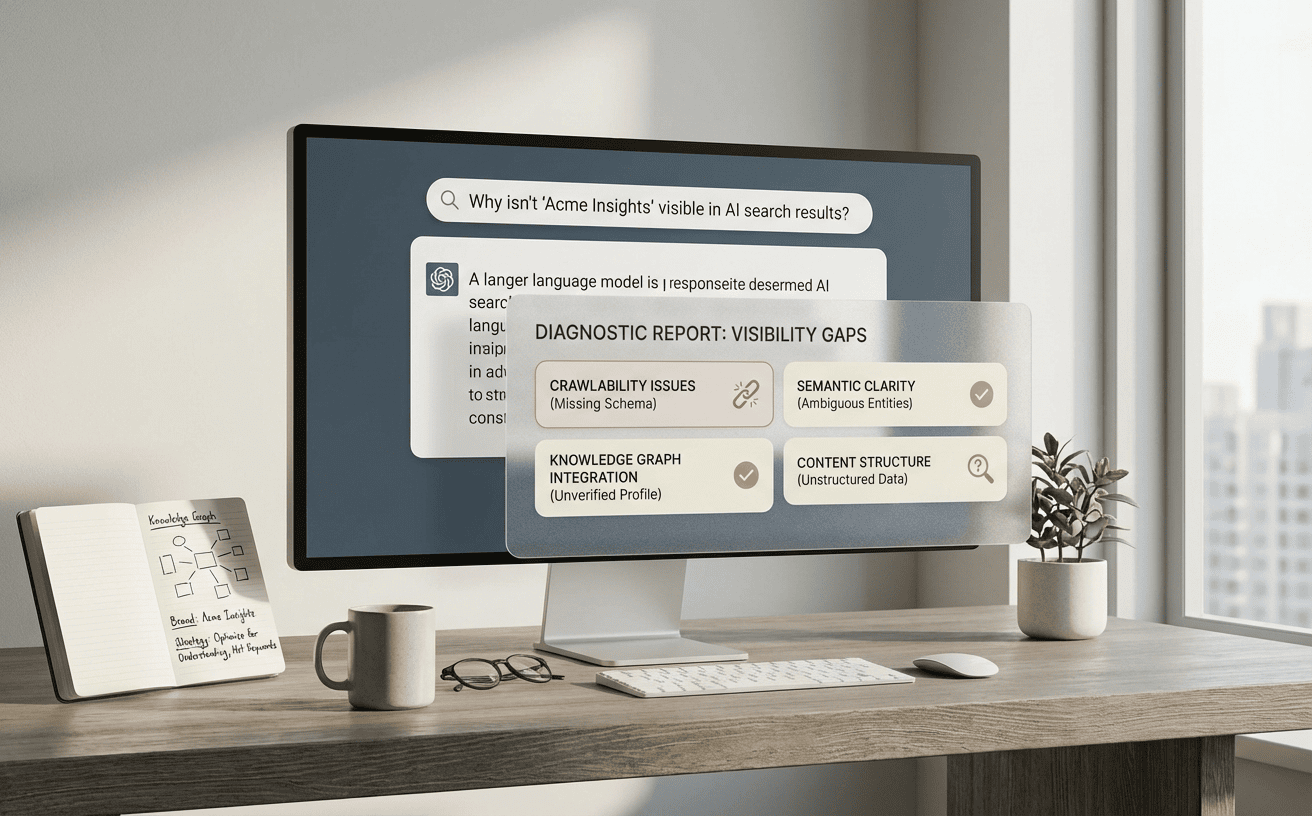
Many companies improvise a few prompts, such as "What is Company X like?" or "Can you recommend a provider of X?" They then generalize from a small number of responses.
This method has obvious weaknesses: the sample is too small and the question types are too narrow. AI responses vary with wording, context, platform behavior and time. Testing only a few prompts can turn a chance result into a mistaken view of overall performance. Semrush has also cautioned that one-off or small manual prompt samples are unreliable.
A safer method does not try to find one perfect question. It builds a minimum test set and checks the same brand across several types of query.
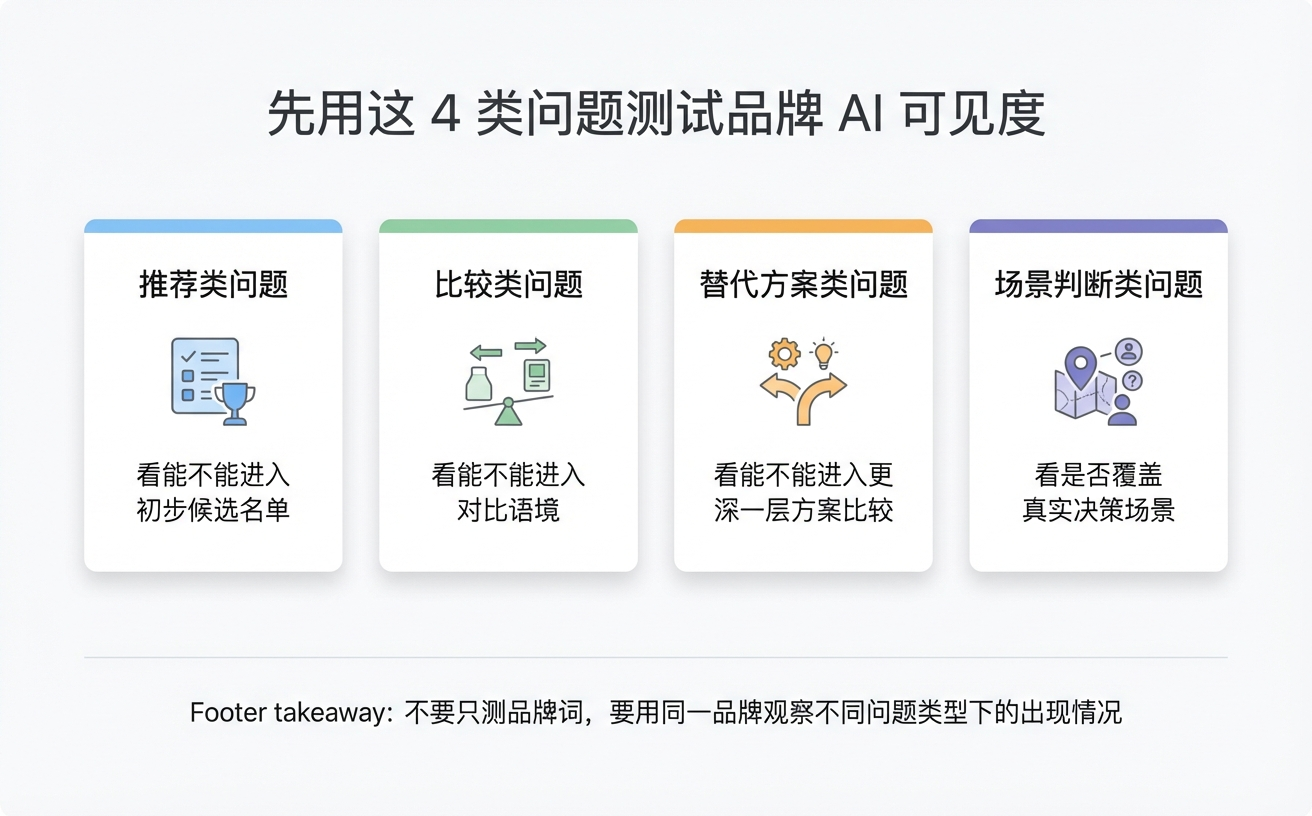
Start With These Four Question Types
Recommendation questions: for example, "Which companies provide X?" or "Which providers are commonly used in the X sector?" These reveal whether the brand enters an initial shortlist.
Comparison questions: for example, "How does X differ from Y?" or "How should I choose between type A and type B providers?" These reveal whether the brand appears in a comparative context.
Alternative questions: for example, "What can I do instead of X?" or "Can B replace A?" These show whether the brand enters a deeper comparison of possible solutions.
Scenario-assessment questions: for example, "When is X suitable?" or "Should this type of company use X?" These are closer to high-intent decisions and expose whether the content actually addresses customer decision scenarios.
Together, these four types provide a more realistic picture of AI-search visibility than brand-name queries alone.
Why Does the Same Brand Perform Differently Across AI Platforms?
A brand may appear on one platform but not another, or different platforms may describe it differently in response to a similar question.
That is normal. Platforms differ in how they obtain information, organize answers, prefer citations and refresh their systems. The goal is not identical results everywhere. Look instead for the question types in which the brand appears consistently and those in which it remains absent. Platform differences usually expose a content, information or technical problem rather than mere luck.
What Types of Brand Absence Occur in AI Search?
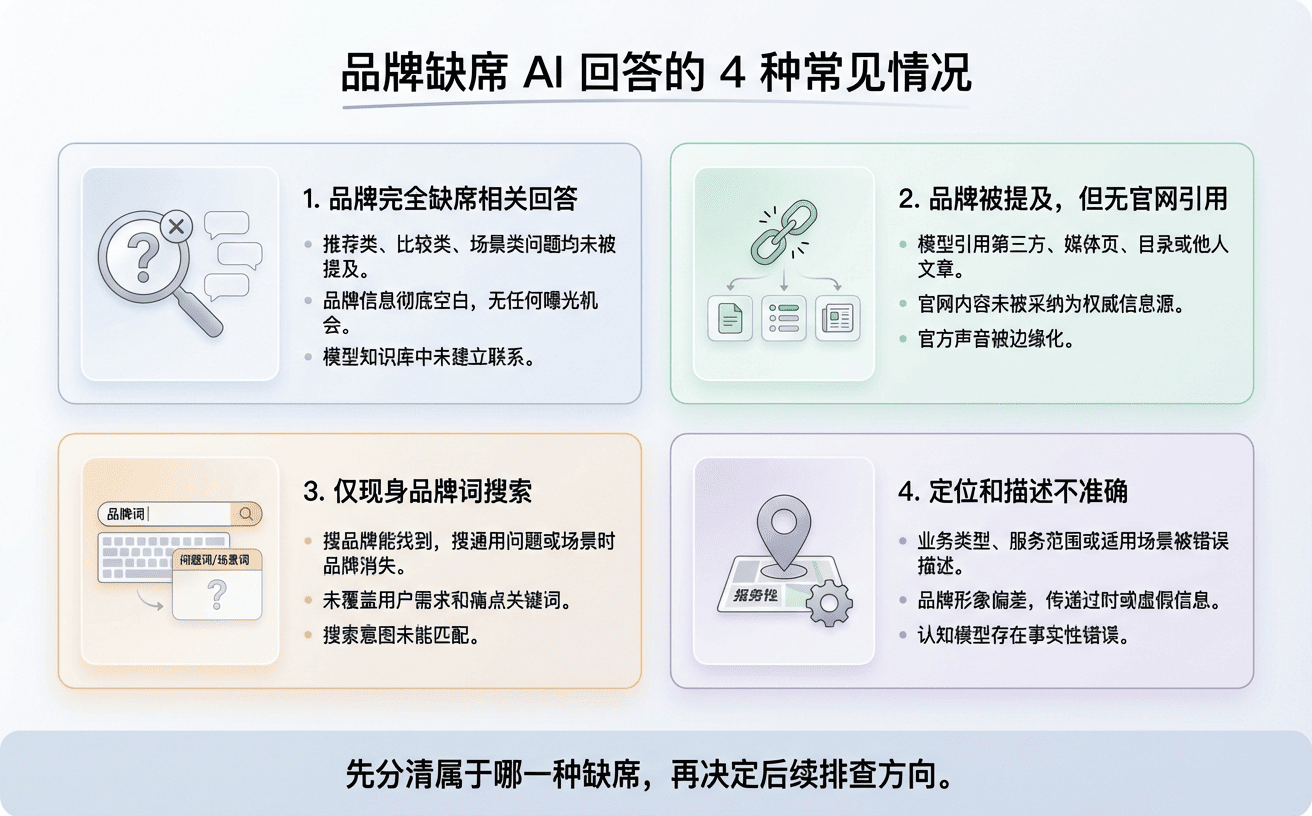
The Brand Never Appears in Relevant Responses
The brand never appears when users ask for a provider, compare options or assess a scenario. They can read the entire response without discovering that the brand exists.
The Brand Is Mentioned, but Its Official Website Is Not Cited
The response names the brand but cites a third-party platform, media page, directory or another publisher's article rather than the official website.
The Brand Appears Only for Branded Queries, Not Problem Queries
The brand appears when someone searches for its name, but disappears when the question changes to how to choose, which scenarios fit or how it compares.
The Brand Appears, but Its Positioning or Description Is Wrong
The brand is mentioned but assigned to the wrong business category, or the service scope and use cases do not match its actual positioning.
The problem is not merely that too few people see the brand; they see it inaccurately. In practice, this can deserve higher repair priority than complete absence.
Why Does AI Use Information About One Brand but Not Another?
AI does not look only for a relevant page. It looks for information units that can be organized readily into an answer.
Information is generally easier to use when it has several of these qualities:
- Clear structure
- Explicit definitions
- Clear boundaries of suitability
- The ability to compare the brand with other solutions
- Facts that several sources can corroborate
- A stable context across the open web
In other words, the model considers not only whether the page exists, but whether the page and external information can answer a question directly.
Six Common Reasons a Brand Does Not Appear in AI Search
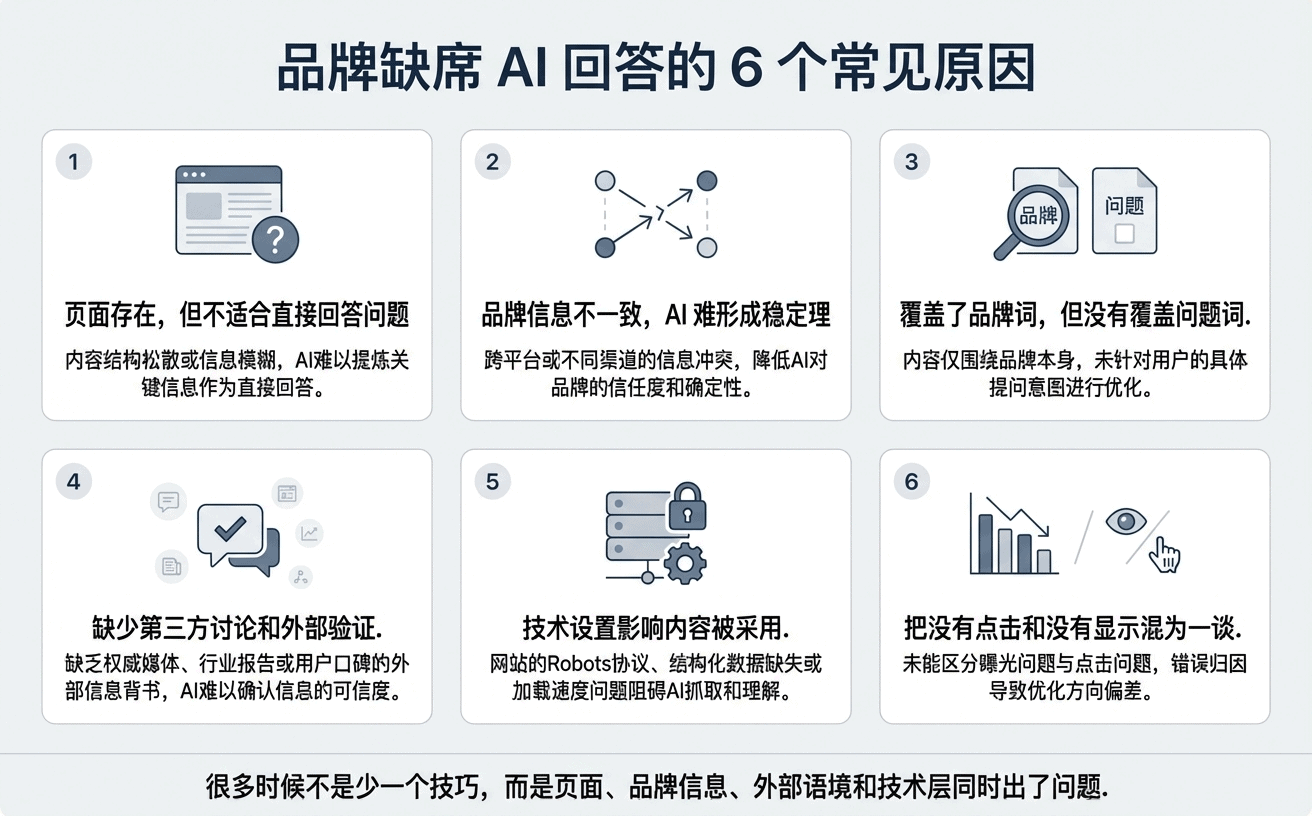
Reason 1: The Page Exists but Does Not Answer Questions Directly
This is one of the most common causes. The company has pages, but they read more like marketing introductions than answers.
The pages may contain brand language, service advantages and mission statements, yet omit what the user needs: what the company is, whom it suits, whom it does not suit, how to evaluate it, how it compares with alternatives and what conclusion to draw.
If the paragraphs are scattered and important facts are buried, a model may read the page without using it. The page also becomes harder to use when it lacks descriptive subheadings, direct answers and passages that work on their own. Many pages are not invisible; they are difficult to pick up and apply.
Reason 2: Inconsistent Brand Information Prevents a Stable Understanding
AI systems struggle to form a stable view when the official website, case studies, social profiles, directories and media coverage describe the brand differently.
Common inconsistencies include shifting service boundaries, conflicting descriptions of customer types and mixed terminology. One page describes a consulting team, but another suggests a managed-service agency; one emphasizes advisory work, but another presents the brand as a technical provider.
The problem in this situation is not too little content. The content contradicts itself.
Reason 3: The Website Covers Brand Terms but Not Problem Terms
Many company websites contain a brand page and service pages and can be found for the brand name, but have no corresponding content for problem-led searches.
They may lack FAQs, comparisons, scenario pages, glossary entries and alternative-solution pages. A model can know who the brand is without knowing which questions should include it.
Reason 4: The Brand Lacks Third-Party Discussion and External Verification
Absence from AI responses is not always an official-website problem. The external context may be too thin.
If the brand makes claims almost exclusively on its own site, few third parties discuss, compare, cite, mention or endorse it. A model then has little public material with which to corroborate what the brand does and why it matters.
This goes beyond having too few backlinks. The external information surface is too narrow. Without a third-party context, the brand is harder to treat as a stable, verifiable source.
Reason 5: Technical Settings Allow Indexing but Still Make Content Harder to Use
In some cases the page is accessible but poorly suited to retrieval and reuse.
Examples include unreliable crawlability, unstable JavaScript rendering of the main content, important text outside the readable layer, or inappropriate robots, noindex and snippet settings. The page may not be completely excluded from an index, but a model may read it incompletely, extract it inconsistently and become less likely to cite it.
Reason 6: The Team Confuses "No Click" With "No Appearance"
Sometimes the brand is mentioned but receives no visit. In other cases it never enters the response. These are different problems with different remedies.
The first means the brand appeared but failed to capture the next step; the second means it never entered the candidate set. Combining them sends the diagnosis in the wrong direction.
Related reading: Why Google Rankings Do Not Guarantee AI Citations
What Should You Check First When the Brand Is Absent?
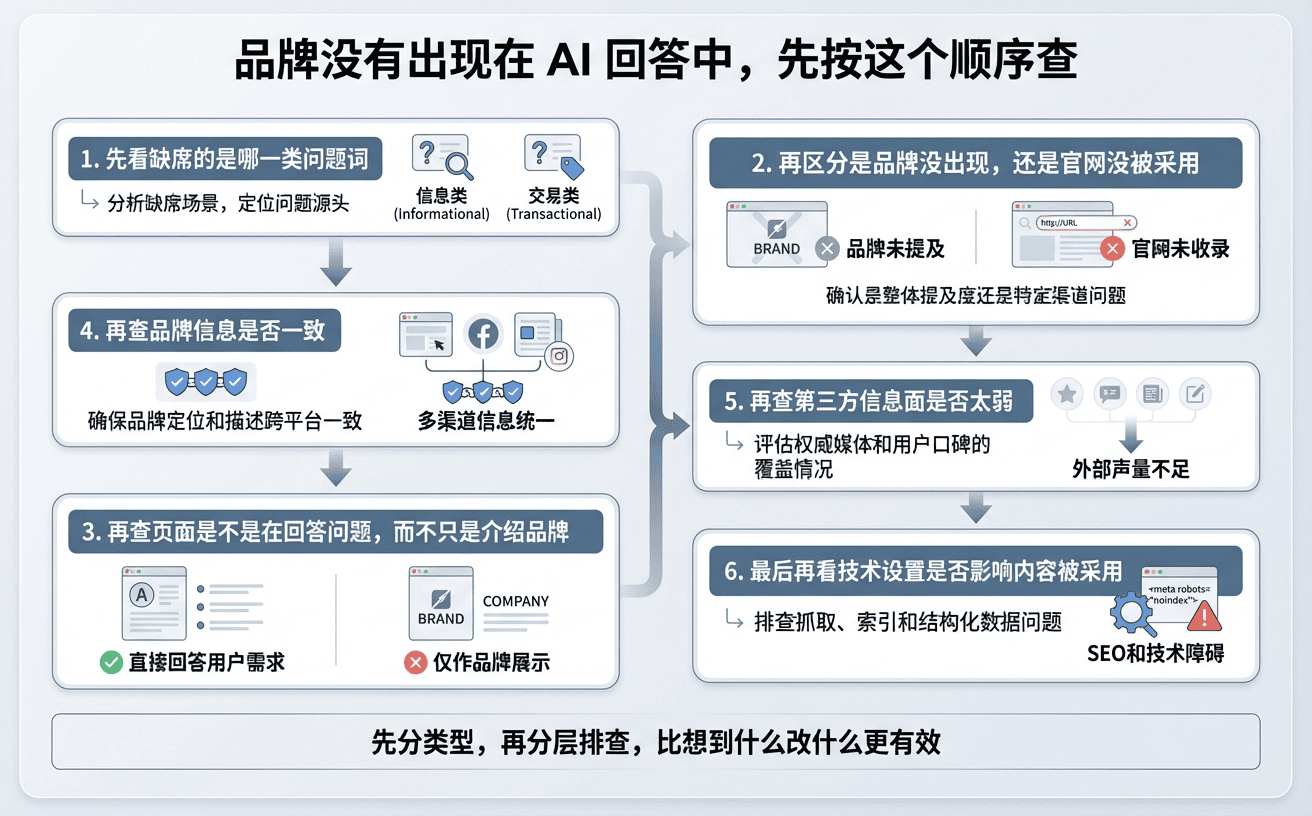
Immediately rewriting copy, adding schema or publishing many articles is usually inefficient. A steadier approach identifies the type of absence first and then investigates in order.
If the Brand Never Appears, Check:
- Whether problem-query coverage is insufficient.
- Whether the range of page types is too narrow.
- Whether the brand definition is unclear.
- Whether third-party information is too limited.
- Whether there is an obvious technical-accessibility problem.
If the Brand Is Mentioned but the Official Website Is Not Cited, Check:
- Whether the official pages are easy to quote and cite.
- Whether they provide clear definitions, boundaries, criteria and comparisons.
- Whether question-led content such as FAQs, comparisons and scenario pages is missing.
- Whether third-party pages answer the question better than the official site.
If the Brand Appears but the Description Is Inaccurate, Check:
- Whether the official site and external materials define the brand consistently.
- Whether core terminology and business boundaries are confused.
- Whether third-party pages are amplifying the wrong positioning.
- Whether the organization has described itself in different ways across many channels over time.
If You Are Unsure Which Problem Applies, Investigate in This Order:
- Identify the question types in which the brand is absent.
- Distinguish between a missing brand mention and a missing official-site citation.
- Check whether the page answers a question or merely introduces the brand.
- Check whether brand information is consistent.
- Check whether the third-party information surface is too weak.
- Finally, check whether technical settings interfere with retrieval and reuse.
How Should Repair Priorities Be Ordered?
Add Missing Page Types Before Rewriting Existing Copy
If the site lacks FAQs, comparison pages, scenario pages, glossary entries or alternative pages, filling those gaps usually deserves higher priority than repeatedly polishing an existing service page.
When the page type is missing, many questions have no destination at all.
Align the Brand Definition Before Expanding Content Coverage
Do not rush to publish more content if pages and platforms still describe the brand inconsistently.
First align what the brand is, what it does, whom it suits, whom it does not suit and which alternatives it may be confused with. Expansion around problem queries will then rest on a more stable foundation.
Address High-Intent Problem Queries Before Broad Topics
Prioritize questions that ask for a recommendation, compare options, seek an alternative or assess a scenario. They directly influence how customers decide.
Validate on a Small Scale Before Expanding
Do not begin with a large content rollout or a full-site redesign. Test a small set of important questions and pages first, then decide whether to invest more broadly.
What Conditions Help a Brand Appear Consistently in AI Search and LLM Responses?

Accessible: Pages Can Be Crawled and Read Reliably
This is the foundation. Pages need to be consistently accessible, crawlable and readable, with important content available outside fragile rendering layers.
Understandable: Positioning and Suitable Use Cases Are Clear
Accurate mentions require a clear explanation of who the brand is, what it does and the scenarios it serves.
Verifiable: Consistent Public Information Exists Beyond the Official Site
A brand narrative that exists only on the official website is usually less stable. Ideally, consistent public information outside the site corroborates the positioning and service direction.
Usable: Official and External Information Can Be Organized Into an Answer
Information must not merely exist; it needs to be usable. Structure the page so systems can extract it, state conclusions clearly and connect each question to its answer. External sources should reinforce the same context.
Frequently Asked Questions
Why Does My Website Not Appear in Google AI Overviews?
Common causes include pages that do not answer users directly, too few problem-led topics, an unclear description of the brand, little support from third parties or technical settings that make the content harder to use. Not every problem occurs at the indexing layer.
Why Does ChatGPT Not Mention My Brand?
If the brand has too little context across the open web, or if the official content is not clear, repeatable and quotable, ChatGPT is less likely to organize the brand into an answer.
Does a Brand Count as Visible if It Is Mentioned Without an Official-Site Citation?
It is partially visible, but the result is not ideal. The brand has entered the candidate set, but the official website is not the model's preferred information source.
Why Can a Brand Rank in SEO but Remain Absent From AI Responses?
Organic rankings and AI mentions are not the same. AI systems also depend on whether page content can be organized into an answer, whether brand information is stable and whether enough external sources corroborate it.
How Long Does It Take to See a Change After Improving the Official Website?
There is no fixed schedule. Platforms differ in refresh cadence, crawling and answer construction. A safer approach is to validate a focused set of pages and monitor a stable group of priority questions over time.
Why Does the Same Brand Perform Differently Across Platforms?
Platforms differ in retrieval sources, citation preferences and model behavior. The goal is not identical performance, but to identify whether the same question types remain absent across platforms.
Conclusion
When a brand is absent from AI search and large-language-model responses, several issues often combine: the site may lack the right pages, describe the brand inconsistently, receive little outside support or be technically difficult to use.
Do not publish indiscriminately or keep guessing from a few tests. First identify where the brand is absent. Then check which questions fail, whether the brand appears, whether the official site is cited, how the pages describe the brand, whether other sources agree and whether technical settings interfere.
If your brand has remained absent from AI responses, or it appears with an inaccurate description and the official website is repeatedly overlooked, GlobalBrandsDigital can conduct a focused diagnosis. The review can identify whether the problem lies in content, structure, information consistency or technical access before you choose which layer to repair first.