On this pageTable of contents+
- 1. What Is Digital PR, and How Does It Differ From Traditional PR?
- 2. How Digital PR Supports GEO: Why GEO Needs PR
- 3. When Is a Brand Ready for Digital PR for GEO?
- 4. Four Core Digital PR Activities for GEO
- 1. Thought Leadership: Placing Viewpoint-Led Content in the Media
- 2. Original Data: Research, Surveys and White Papers
- 3. Third-Party Reviews and Best-of Lists
- 4. Journalist Request Platforms Such as HARO, Qwoted and Featured
- 5. Should a GEO Team Run Digital PR Internally or Hire an Agency?
- 6. Three Common Ways Digital PR Budgets Are Wasted in GEO
- 7. How to Measure Digital PR for GEO
- Core Metrics to Monitor Monthly
- Process Metrics to Monitor Quarterly
- Metrics That Should No Longer Lead the Report
Digital PR for GEO earns coverage and mentions from credible online third-party media, industry commentators and authoritative platforms so that AI systems such as ChatGPT, Perplexity and Google AI Overviews can treat a brand as a credible source when answering users. Its central objective is not a backlink. It is a worthwhile brand mention even when no link is present.
Not every brand working on GEO needs to launch a Digital PR program immediately, and a PR team cannot solve GEO on its own. This guide explains how Digital PR fits into a GEO system, when to begin, what to do and how to measure the work.
1. What Is Digital PR, and How Does It Differ From Traditional PR?
Digital PR uses content, viewpoints and data to earn editorial coverage or mentions from third-party online media, industry blogs, authoritative review platforms, podcasts, YouTube channels, LinkedIn and similar outlets.
Its main difference from traditional PR is the venue and the form of the result. Traditional PR serves offline media, print publications, television and radio. Digital PR produces digital assets that search engines and AI systems can retrieve: an in-depth trade-media report, an expert recommendation on an authoritative review site, a podcast interview with a founder or an original dataset cited by several publishers. Google can index these assets, and AI can encounter them during training or live retrieval. Offline PR cannot provide the same digital footprint.
Several common misunderstandings need to be cleared up. Digital PR is not synonymous with distributing press releases; a press release is only one PR tactic and is generally less powerful. Digital PR is also neither advertising nor sponsored editorial copy. Advertising pays a publisher to say something favorable, and sponsored copy buys space designed to resemble editorial coverage. Digital PR earns coverage because the material offered to the publication is useful to its readers.
Put simply, Digital PR produces genuine third-party coverage or mentions about a brand. It earns credibility rather than buying visibility.
2. How Digital PR Supports GEO: Why GEO Needs PR
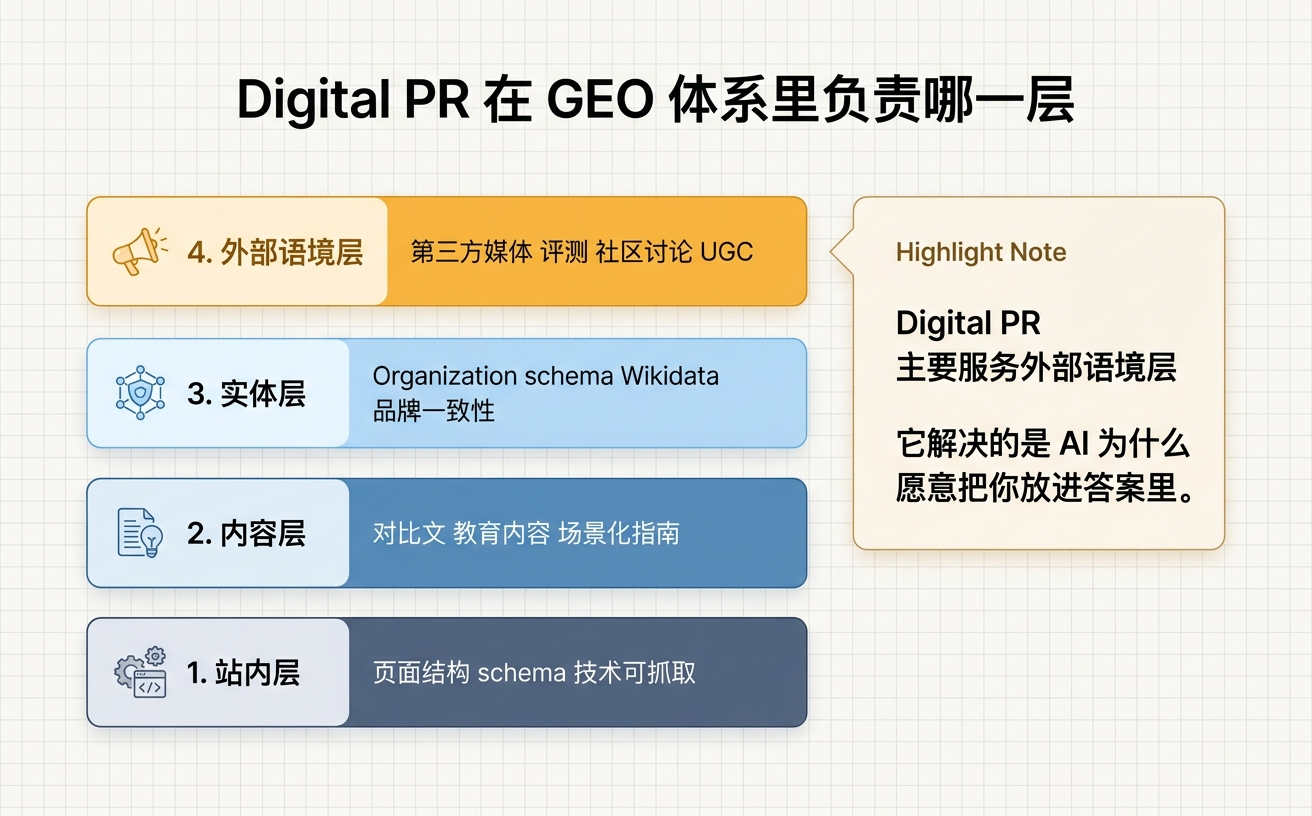
GEO, or Generative Engine Optimization, aims to help a brand earn citations in AI answers. The way AI evaluates whether a brand is worth citing resembles the way ordinary users assess credibility: it considers whether trusted third parties mention the brand repeatedly, the context of those mentions and the topics associated with it.
A complete GEO system has four broad layers. The on-site layer - page structure, schema markup and technical crawlability - determines whether AI can read the site. The content layer - comparisons, educational resources and scenario-based guides - provides material that AI can cite. The entity layer uses Organization schema and Wikidata to describe the brand consistently. It helps AI combine scattered signals into a coherent view. The external-context layer - third-party media, reviews, community discussions and user-generated content - helps AI assess the brand's real standing in its category.
Digital PR primarily supports the external-context layer. The first three layers help AI find, recognize and understand a brand. PR addresses a separate question: does AI have a reason to include the brand in an answer?
The source article points to quantitative evidence. A 2025 Ahrefs study found that brand mentions tracked AI visibility at 0.664; backlinks tracked it at 0.218. The former figure was about three times stronger. Hard Numbers also studied ChatGPT answers about 100 major global brands. It found that earned media supplied roughly 61% of the cited sources. Search engines use links to pass link equity; AI systems also evaluate mentions, including how densely and consistently a brand appears in credible media, even when the mention is unlinked or the link is nofollow.
There is useful historical context here. Credible media mentions have always been a core PR objective. Over the past 20 years, however, the SEO industry often shifted PR reporting toward link totals and Domain Rating. The GEO era returns attention to the original strategic purpose. PR has not changed as much as its original objective has become visible again.
3. When Is a Brand Ready for Digital PR for GEO?
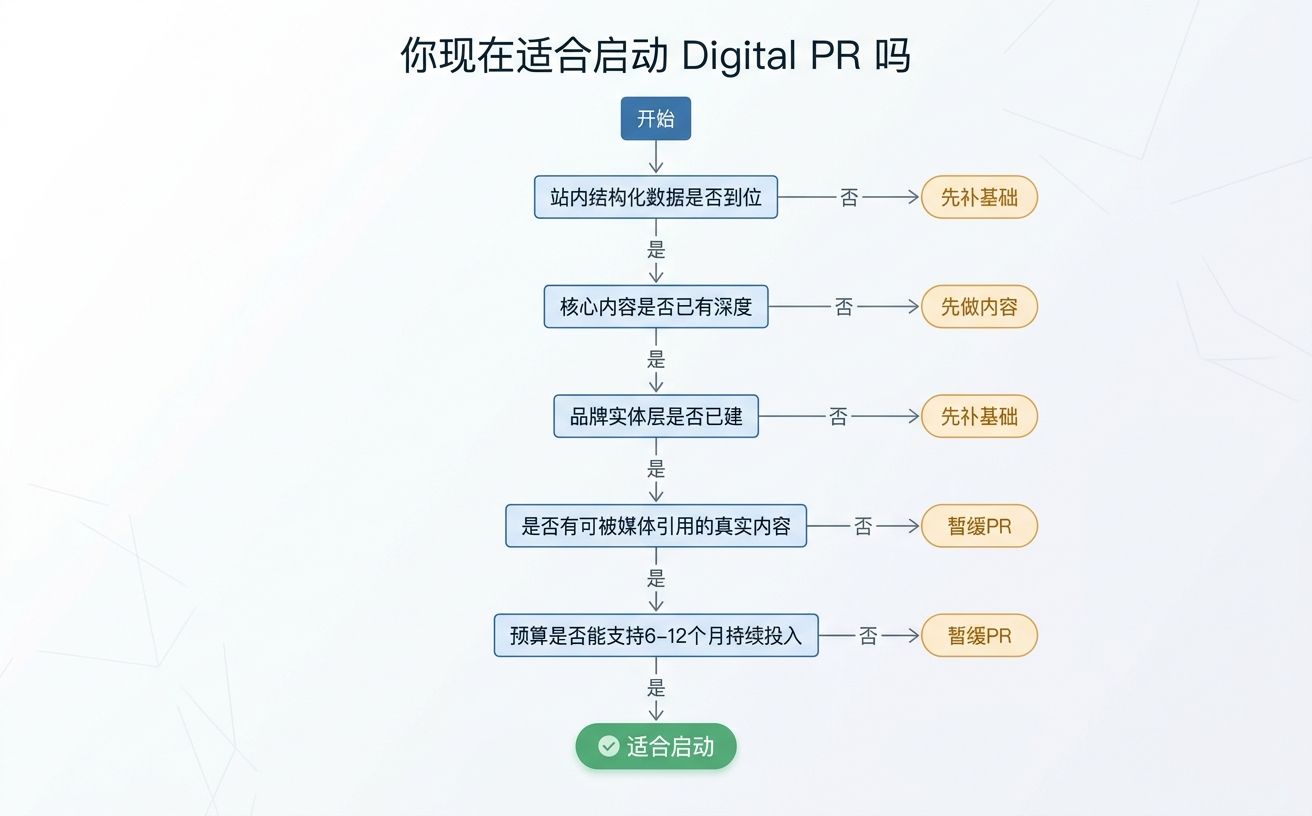
Not every brand working on GEO should begin PR immediately. Several conditions determine whether the timing is right.
Three foundations should be in place first.
- On-site structured data is implemented, including Organization schema, sameAs properties and page-level schema.
- Core content has sufficient depth, so the brand's own answers to essential category questions can at least be retrieved by AI systems.
- Build the brand entity first. At minimum, create a Wikidata entry or confirm that the Google Knowledge Graph recognizes the brand.
If these three steps are incomplete, external coverage may send AI systems to the official site for a secondary check. Weak on-site material can then waste the PR budget.
After the foundations are ready, two further questions determine whether to begin. First, does the brand possess material that a publication can genuinely cite? A founder needs a worthwhile point of view, the company needs original data, or the product or service needs a differentiating technical fact. Without such material, PR becomes a volume exercise rather than a reason to be cited. Second, can the budget support at least six to twelve months of consistent work? Digital PR develops slowly and limited short-term activity rarely delivers much. If the budget covers only two or three months, concentrating first on on-site content is usually more sensible.
If there is nothing worth citing, create that material before discussing PR. If the budget cannot sustain six months, wait. If the foundations are unfinished, PR is not yet the next priority.
4. Four Core Digital PR Activities for GEO
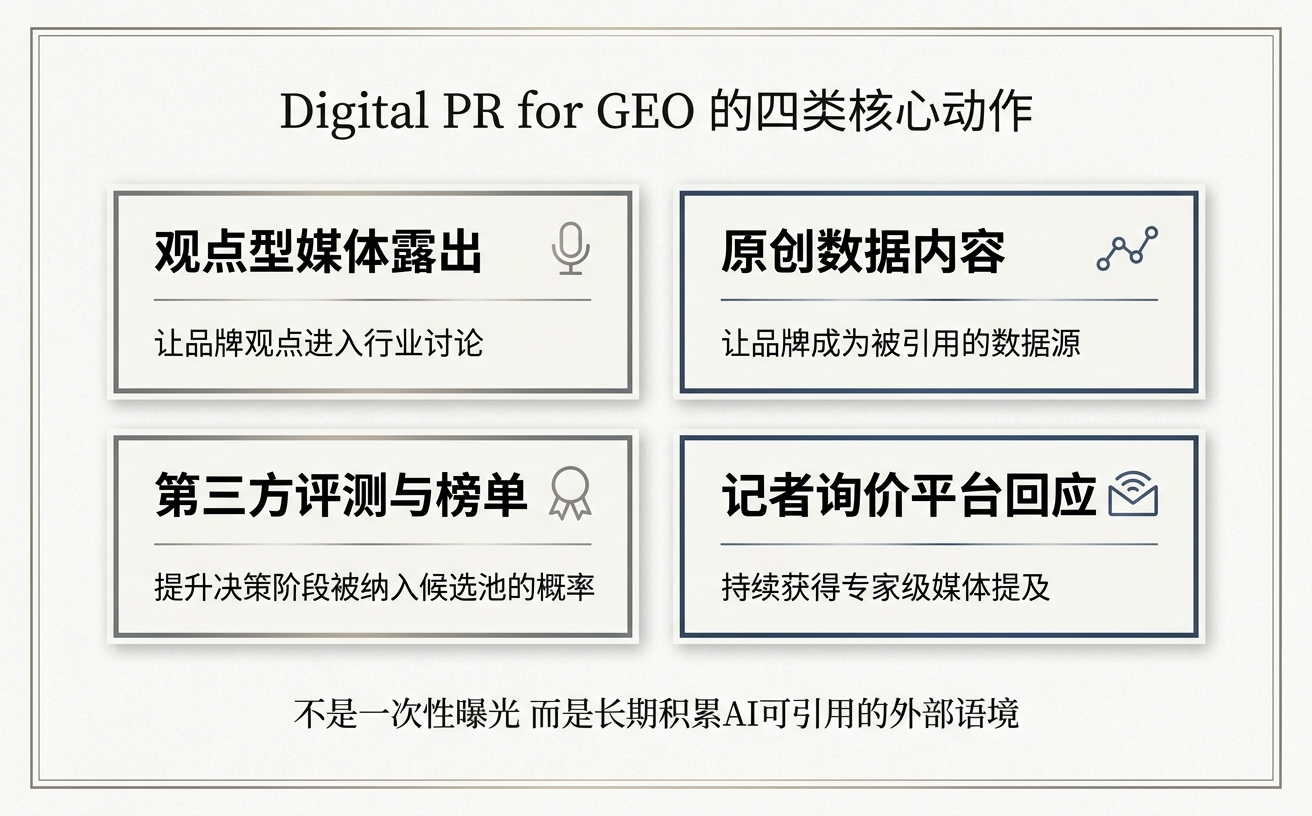
The following activities are ordered by their practical contribution to AI citations.
1. Thought Leadership: Placing Viewpoint-Led Content in the Media
AI answers to category questions rely heavily on industry analysis written by identifiable experts. This material names the author, presents a specific point of view and makes an explicit judgment. Those traits can make it more authoritative.
The practical approach is to arrange trade-media interviews for a founder or core team member, publish signed commentary in specialist outlets and offer quotable analysis when responding to current events. The viewpoint must be specific enough to cite. "We believe the future belongs to AI" provides little value. A specific example such as "For enterprises of this size, solution A produced an ROI about 30% higher than solution B because of Y" gives a system a concrete claim to extract. The source article cites research presented by Princeton and IIT Delhi at ACM KDD in 2024 and reports that comparative content had the highest citation share among content types, at about 32.5%.
This work should be coordinated with the founder's Person schema and the brand's entity development. The goal is to attribute the viewpoint to the correct person and brand rather than let the association become confused.
2. Original Data: Research, Surveys and White Papers
AI systems show a clear preference for verifiable statistics. "The average conversion rate in category X is 28%" carries more evidential value than "Category X has a high conversion rate."
Publish original industry surveys, analyses of product-usage data and white papers on emerging trends. Organize the data so that readers can trace the sample size, period and methodology, then present it proactively to industry media and journalists. "Our survey shows" is too vague. "A survey of 1,247 SaaS companies in the third quarter of 2025 found..." gives the evidence a usable frame.
Original data can compound in value. Once a major publication cites it, later secondary references can point back to the original source. The brand can become a data anchor for its category, making it harder for AI answers on that topic to ignore the source.
3. Third-Party Reviews and Best-of Lists
G2, Capterra, specialist review sites, YouTube reviews and industry best-of lists are among the sources most frequently cited for decision-stage questions such as "Which X is good?" and "Which provider should I choose?"
Work systematically to qualify for relevant best-of lists, apply for profiles on G2 or Capterra and cultivate genuine customer reviews. Give specialist reviewers and relevant industry creators a chance to try the product. Do not create a list simply to place your own brand first. The source notes that the US Federal Trade Commission and Google were both acting against self-promotional listicles in 2025, and that such pages can reduce rather than improve credibility.
This activity assumes that the brand already has a meaningful user base. An early-stage brand should usually postpone it.
4. Journalist Request Platforms Such as HARO, Qwoted and Featured
Journalists use these platforms every day to find expert sources. Consistent participation can earn named expert mentions in authoritative media, making this one of the most cost-effective PR activities.
Subscribe to relevant platforms, respond to two or three suitable requests each week and provide a complete answer that a journalist can use immediately. Include a specific viewpoint, supporting data, relevant credentials and contact details. Do not submit only contact information and wait for an interview; most journalists do not have time for that extra step.
This activity can suit brands at any stage. It requires little budget, rewards consistency over time and has a relatively low time commitment.
Beyond these four activities, reciprocal inclusion partnerships can offer a low-cost starting point for brands with modest budgets. Publish an objective category comparison or buyer's guide on your own content site; this type of material can itself become a source for AI answers. Then approach other brands in the same category with a straightforward proposal: mention them objectively in your guide and ask them to consider your brand objectively in a comparable resource. These third-party signals help AI systems see the brands within the same candidate set.
5. Should a GEO Team Run Digital PR Internally or Hire an Agency?
This decision often stalls GEO teams. The answer varies by activity.
Run HARO, Qwoted and reciprocal inclusion partnerships internally. These activities require professional knowledge and consistent responses rather than media relationships. Outsourcing HARO can even weaken the result because an agency may not understand the subject deeply enough to match the quality of a founder's own answer.
Produce original data internally because only the organization fully understands its data and insights. Distribution can be handled by an agency or a PR specialist. The agency's value is getting the research onto journalists' desks and helping it earn citations, not inventing the underlying data.
Founders or core team members should supply the ideas for thought leadership. Agency-written viewpoints can lack the specificity of direct experience and may read like promotional copy when extracted by AI. An agency can still polish the article and manage media outreach.
In-depth coverage from highly authoritative media such as Forbes, TechCrunch or leading trade publications will usually require an agency. Teams without established media relationships often cannot reach these publications, and a cold pitch may receive no response. This is also where agency fees are most likely to deliver material value.
Evaluate an agency against four questions. Can it show AI citation monitoring for clients, rather than only backlink totals or higher Domain Rating? Can it explain how different PR activities contribute differently to AI citations? Does it charge for each placement? Or does it evaluate how well the brand appears when AI answers high-priority category questions? The first reflects traditional placement thinking; the second is closer to a GEO model. Finally, will the agency say honestly when an activity is premature or a client is not ready?
6. Three Common Ways Digital PR Budgets Are Wasted in GEO
The first waste is continuing to measure PR with Domain Rating, Domain Authority and backlink totals. Nofollow links and unlinked mentions can still matter. The real questions are where the brand name appears and which topics surround it. A monthly report that says "X new backlinks and a Y-point increase in DR" gives little direction for GEO. Reporting should instead examine AI citation rates and the quality of the media context.
The second waste is publishing large volumes of advertorial-style brand exposure with little useful information. Paying lower-tier outlets to run "Company X enters Market Y" stories with no genuine news value adds little to AI citations. Worse, systems may identify the low information density and discount it. A large footprint of weak PR copy can even damage perceived credibility. In that situation, doing nothing is better than doing low-quality work.
The third waste is chasing one large burst of coverage instead of maintaining continuity. One Forbes feature may look impressive, but AI visibility depends on persistence. The source cites AirOps research reporting that only about 30% of brands appeared in two consecutive AI answers, and roughly 20% remained present across five consecutive answers. AI systems can quickly displace a single surge as they vary their sources and favor recent material. Stable, moderate coverage is often more useful than an occasional spike.
7. How to Measure Digital PR for GEO
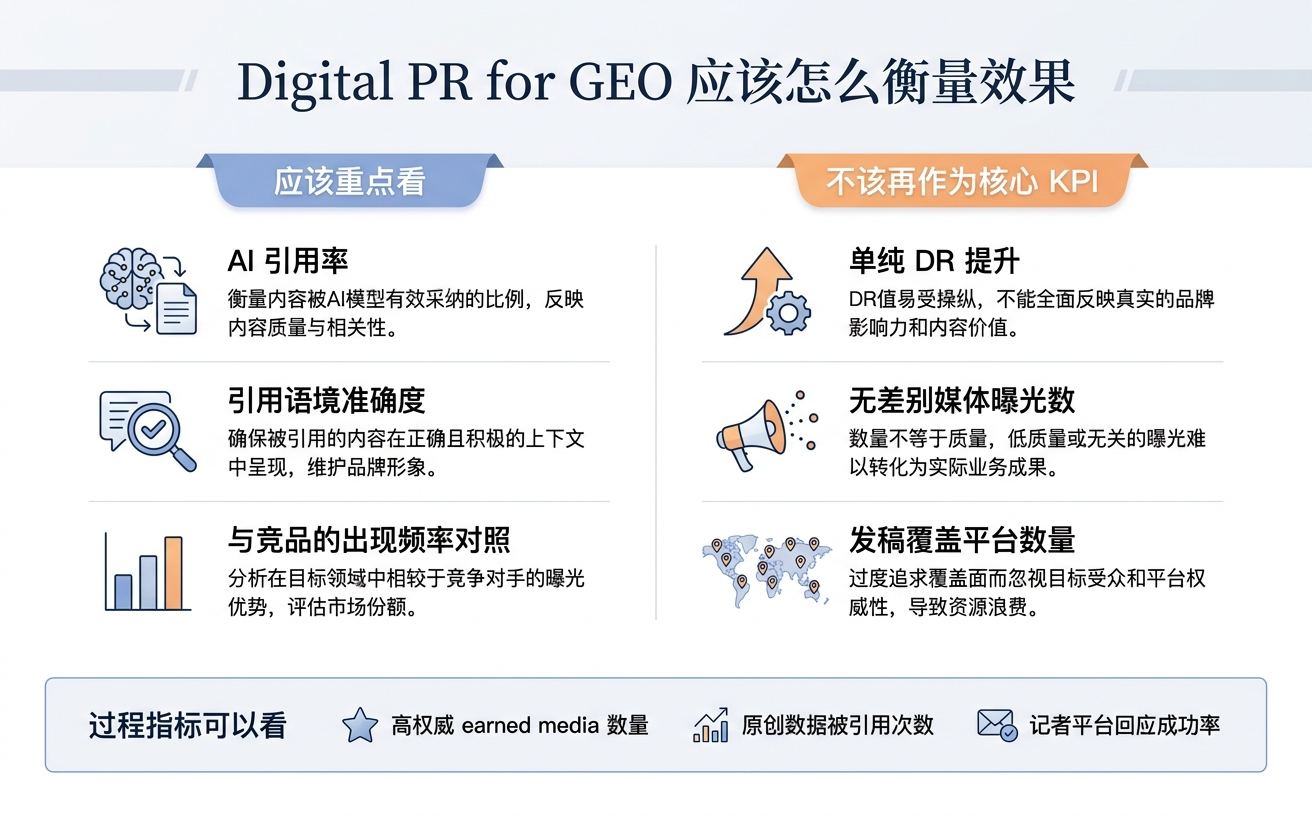
Use a new KPI framework for this work instead of relying on link totals and Domain Rating.
Core Metrics to Monitor Monthly
AI citations: count how often the brand appears when users ask the most important category questions across ChatGPT, Perplexity and Google AI Overviews. Accuracy of the cited context: record whether AI describes the brand accurately, vaguely or incorrectly; an incorrect description can be worse than no mention. Compare the brand with its main competitors across the same question set. Record who appears more often and who receives stronger treatment, such as a direct recommendation rather than a place in a broad candidate list.
Process Metrics to Monitor Quarterly
Track the number of earned features in authoritative media - not the number of distributed releases, but the in-depth stories selected by real editors - the number of third-party citations of original data, and the success rate of submissions made through HARO, Qwoted and similar platforms.
Metrics That Should No Longer Lead the Report
Do not lead with a simple increase in Domain Rating, an undifferentiated count of media mentions or the number of outlets that carried a release, unless those outlets are demonstrably sources that AI systems cite frequently.
A practical starting point is to use tools such as the Semrush AI Visibility Toolkit, Profound or AirOps regularly to monitor how often the brand and its main competitors appear in AI answers and which sources receive citations. This data creates a KPI baseline and also guides PR targeting. Once a team knows which third parties AI systems cite for category questions, it has a clearer idea of which publications belong in the PR target pool.
Digital PR cannot solve GEO independently, and it is not a suitable starting point for GEO optimization. It works best after a brand has built solid on-site content and a clear entity. It is least useful when that groundwork is missing. Understanding the brand's current stage matters more than choosing a specific PR activity.