On this pageTable of contents+
- Three Questions to Answer Before Running GEO Internally
- Which Teams Are Well Suited to In-House GEO?
- Which Teams Should Not Run the Entire GEO Program Alone?
- What Does In-House GEO Actually Involve?
- How Many Resources Does In-House GEO Require?
- A Three-Stage Checklist for Running GEO Internally
- Seven Common Mistakes in In-House GEO
- Dividing GEO Work: What to Keep In-House and What to Outsource
- Work the Internal Team Should Own
- Work an External Team Can Support
- What Is a Hybrid GEO Model?
- Frequently Asked Questions About In-House GEO
- How Long Does In-House GEO Take to Show Results?
- Can a Team Start GEO Without an SEO Foundation?
- What Is the Essential Difference Between GEO and SEO?
- Does In-House GEO Require Technical Expertise?
- Is GEO for DeepSeek and Kimi the Same as GEO for International Platforms?
- Can a Small Team Without a Dedicated SEO Specialist Still Work on GEO?
- Conclusion

You can manage GEO internally, but self-service work is best suited to building the foundations and validating a method, not delivering a complete program.
If a company is just beginning Generative Engine Optimization, it can handle several basic tasks itself: organize real user questions, improve key pages, add useful FAQs and keep brand details consistent. These steps are relatively inexpensive and help the team understand how GEO works.
If the goal is to improve brand visibility systematically across Google AI Overviews, AI Mode or major large-language models, however, occasional articles from an internal team are rarely enough. GEO involves more than content updates. It also covers Semantic SEO and entity alignment. The team must handle page structure, technical SEO, AI-search monitoring and paths that convert visitors.
A more practical model is to keep foundational work in-house and coordinate the systematic optimization with a specialist team.
Three Questions to Answer Before Running GEO Internally
Before deciding to manage GEO yourself, answer three questions.
First, what will target customers ask AI systems? Second, does the website already answer those questions? Third, can the team monitor monthly changes in how often the brand and its competitors appear for those questions?
If you can answer all three, you can begin with foundational GEO work internally. If you cannot answer any of them, the problem is not execution; the direction has not yet been defined. In that situation, begin with a GEO diagnostic.
Which Teams Are Well Suited to In-House GEO?
Managing the initial work internally is reasonable when several of the following conditions apply.
The team already has a mature SEO foundation. Crawling, indexing, page structure, internal links and the basic content workflow are stable. GEO then adds an AI-search workflow on top of established SEO operations.
Content production is consistent. The team can continue updating service pages, blog articles, FAQs, case studies or comparisons each month. GEO is not a one-time project; it requires ongoing adjustment.
The business has strong subject-matter expertise. This is especially relevant in healthcare, law, industrial technology, deep technology and B2B solutions, where an external team cannot replace the judgment of internal experts.
The company is still testing the opportunity. Select one market, one service and a small set of high-intent questions for a limited validation project instead of expanding too broadly at the start.
A newly launched website with a limited budget can also begin with foundational GEO. The priority is not content volume. It is explaining the core pages clearly and answering the questions that matter most to customers.
Which Teams Should Not Run the Entire GEO Program Alone?
The following situations make an entirely internal approach much riskier.
The SEO foundation is weak, but the team wants to skip SEO and move directly to GEO. AI search still depends on sources that can be crawled, indexed and trusted. If the pages themselves are unhealthy, GEO has little foundation on which to operate.
There is no dedicated SEO or content owner. When a marketing lead tries to manage GEO only as a secondary responsibility, the program is likely to stop and restart repeatedly. GEO requires regular records, tests and reviews; it is not suitable for an "only when there is time" workflow.
The company is launching a new product, raising capital or entering a market. When the brand needs to become visible in AI search quickly, trial and error becomes more expensive. Outside specialists can save time.
The business spans several languages, markets or product lines. Search intent, phrasing and trust signals vary between markets, and a direct translation is rarely sufficient.
Competitors already appear frequently in AI answers. Once a competitor becomes the default recommendation in those answers, catching up can become considerably more expensive.
In these situations, a collaboration between internal subject-matter experts and an external GEO team is usually more suitable. A detailed division of responsibilities appears later in this guide.
What Does In-House GEO Actually Involve?
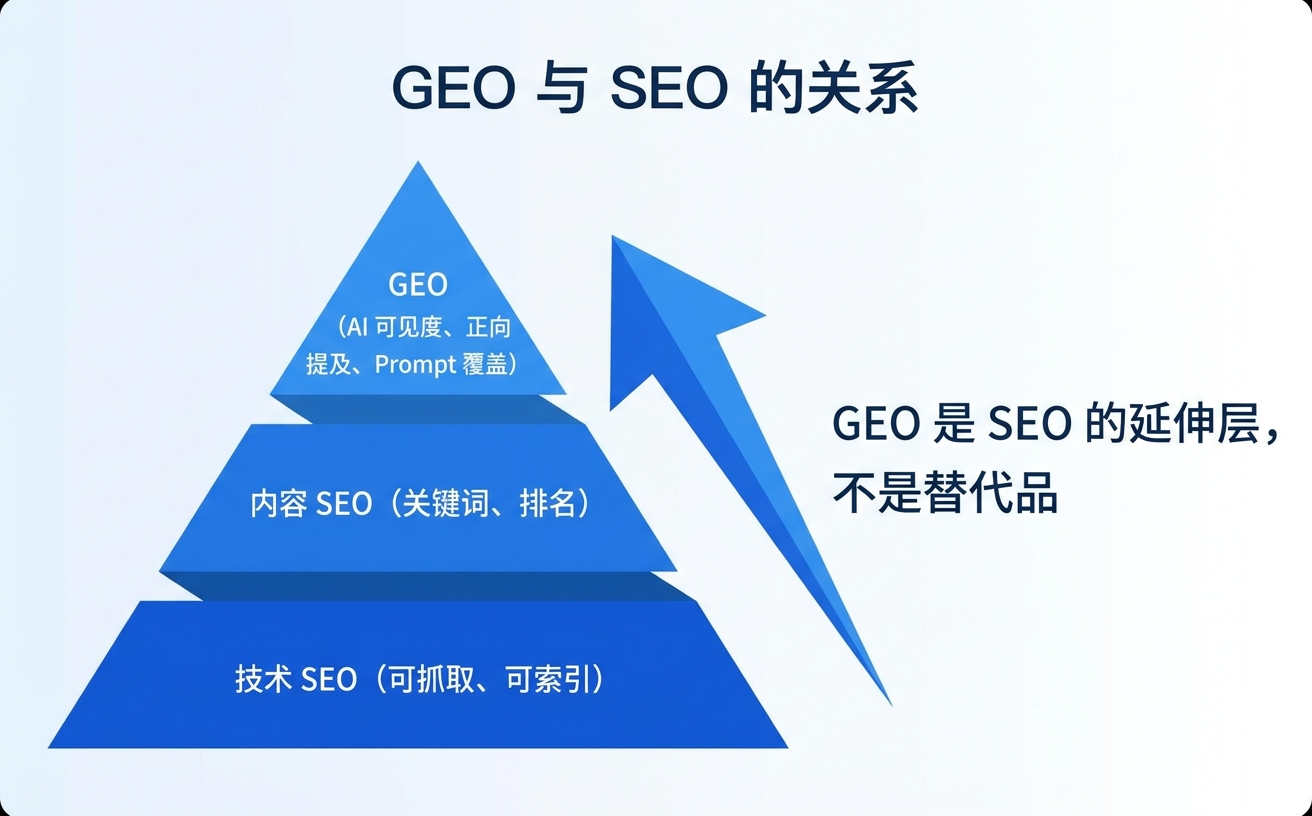
GEO does not replace SEO; it extends it. SEO addresses crawling, indexing, ranking, clicks and conversions. GEO asks whether AI can understand who the brand is, which questions it can answer and whether relevant responses are likely to mention the brand, recommend it or cite its content.
At least four areas of work are involved.
Restructure content. Make pages easier for AI systems to extract and interpret. State the central point clearly, define terms explicitly and write paragraphs that still make sense when read independently.
Develop the brand entity. Keep the company name, service scope, target markets, methodology, case-study language and author details consistent. Semantic SEO is not keyword accumulation. It creates stable semantic relationships among the brand, its services, topics, questions and pages.
Monitor AI search. The team needs to know whether the brand appears and how AI portrays it. It should also track which questions lead to competitor recommendations and where the brand could enter the answer.
Adapt across platforms. Google AI Overviews, Gemini, ChatGPT Search, Perplexity and ecosystems such as DeepSeek and Kimi draw on different sources and present information differently. One content formula cannot be applied mechanically everywhere.
In short, GEO has no stable support when SEO is weak. If pages cannot be crawled, content cannot be indexed and brand information is inconsistent, pursuing AI visibility is unrealistic.
How Many Resources Does In-House GEO Require?
The following ranges can help an international team plan an internal project, but they are not fixed standards.
People: allocate at least 0.5 to 1.0 full-time equivalent. The work typically needs one content owner who understands SEO, development support for schema and technical deployment - even if that support is part-time - and writing and editorial resources. A marketing manager trying to handle everything as a spare-time task is unlikely to sustain the program.
Tools: a starting monthly budget may allocate USD 80-200 to tools that improve content. Basic schema tools are often free. An AI-search monitoring stack covering ChatGPT, Perplexity and Google AI Overviews may cost USD 150-500. A total of roughly USD 300-800 per month can support a basic workflow. Multilingual, multi-market or enterprise-scale monitoring usually moves the monthly tool budget above USD 1,000.
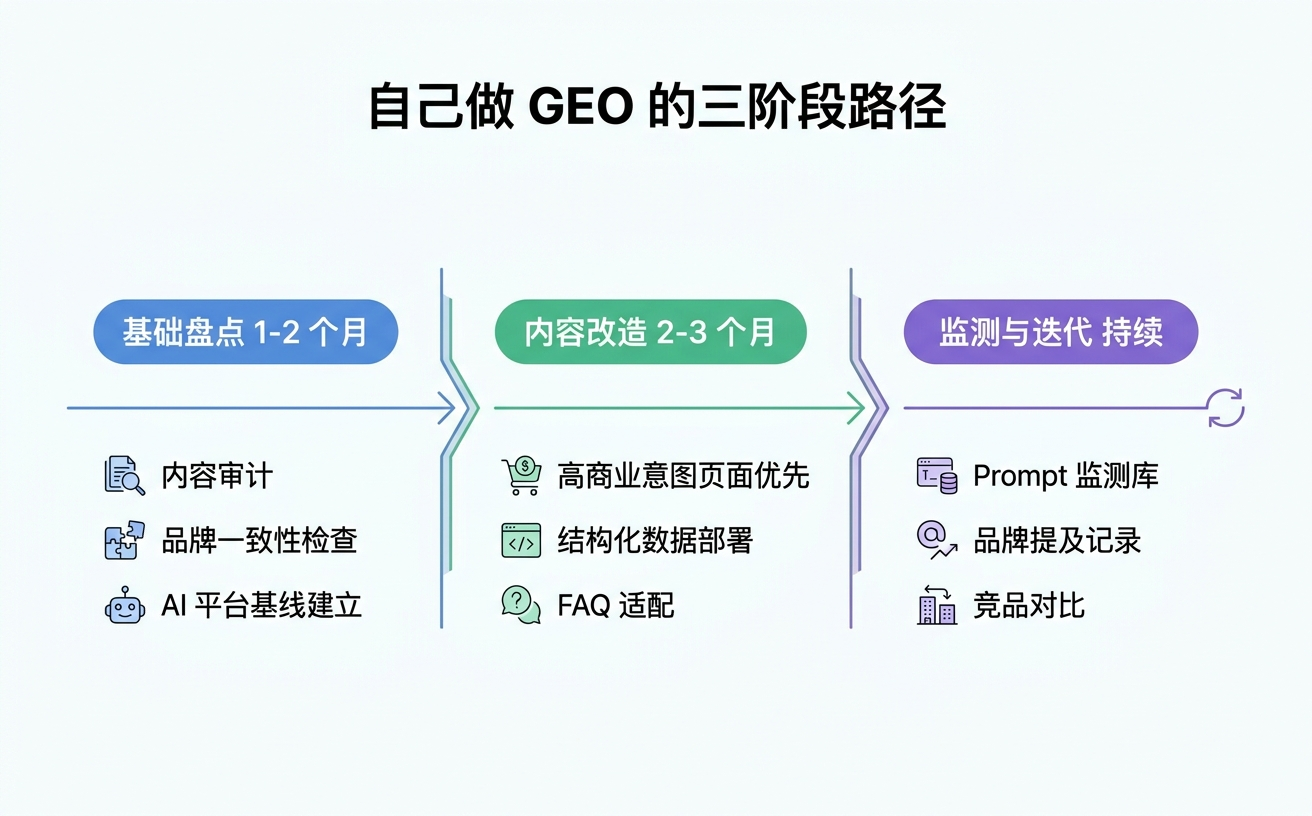
Time: use the first one or two months for inventory and improvements. Stable changes in citations may begin to appear after three to six months. Data usually becomes more dependable for iteration after six months.
An internal approach is reasonable when all three resources can be supplied consistently. If one dimension remains constrained for a long period, a hybrid model or selective outsourcing may be more economical.
A Three-Stage Checklist for Running GEO Internally
Stage one: establish the baseline. Audit existing content and mark the pages that contain clear definitions, FAQs, data explanations, methodologies and quotable passages. Check whether descriptions of the brand are consistent across the official website, industry directories, media coverage and third-party profiles. Search manually in Google, ChatGPT and Perplexity. Test the brand name, service terms and core customer questions. Save screenshots to create the initial baseline.
Stage two: improve the content. Start with pages that have strong commercial intent and can convert readers: service pages, solution pages, comparisons, pricing explanations and FAQs. Do not begin by publishing large volumes of general educational content. Add clear definitions, intended audiences and workflows. Also include FAQs, risk boundaries and verifiable evidence. Apply structured data that matches the page type, such as Article, Organization or Product. Do not add FAQPage markup mechanically; use it only when the visible page genuinely contains suitable questions and answers.
Stage three: monitor and iterate. Create a prompt library containing 50 to 100 questions that customers may ask AI systems. Begin with the questions closest to a conversion. For a dental clinic, for example, the first prompts should not be a broad term such as "dental clinic," but questions such as:
- "Which type of clinic is suitable for clear aligners?"
- "What should I consider before teeth whitening?"
- "What type of clinic should I choose for a child's first dental visit?"
Each month, record whether the brand appears, whether the mention is positive, whether competitors appear, how AI describes each brand and which pages may need improvement. Without monitoring, GEO can easily become indiscriminate publishing.
Seven Common Mistakes in In-House GEO
1. Treating GEO as a title change and an FAQ addition. Titles and FAQs can help, but they solve only part of the problem. A complete program also needs topic coverage, consistent entities and coordination among pages.
2. Pursuing only trending terms. A trend may attract traffic without producing conversions. For B2B and international brands, decision-oriented long-tail questions can be more valuable.
3. Publishing content that explains only the concept. A user who asks whether in-house GEO is feasible does not want only a definition. The user wants to know what to do, how far an internal team can go and when specialist support becomes appropriate.
4. Promising too much. GEO can improve the likelihood that a brand will be understood, retrieved and considered as a source, but it cannot guarantee a specific ranking, exposure level or number of AI citations.
5. Ignoring conversion paths. Even when AI search introduces a visitor to the brand, the website still needs clear service details, a credible methodology and coherent case evidence. It should also show team capabilities and an obvious way to request a consultation. Otherwise, traffic brought by AI will not stay.
6. Producing content without monitoring it. After publishing a group of articles without a prompt library, the team will struggle three months later to determine which content made a difference.
7. Expanding to every AI platform at once. Trying to cover Google AI Overviews, ChatGPT Search, Perplexity, Gemini, DeepSeek and Kimi simultaneously spreads the available resources too thin. A more practical approach is to focus on one or two core platforms, prove the method and then expand.
Dividing GEO Work: What to Keep In-House and What to Outsource
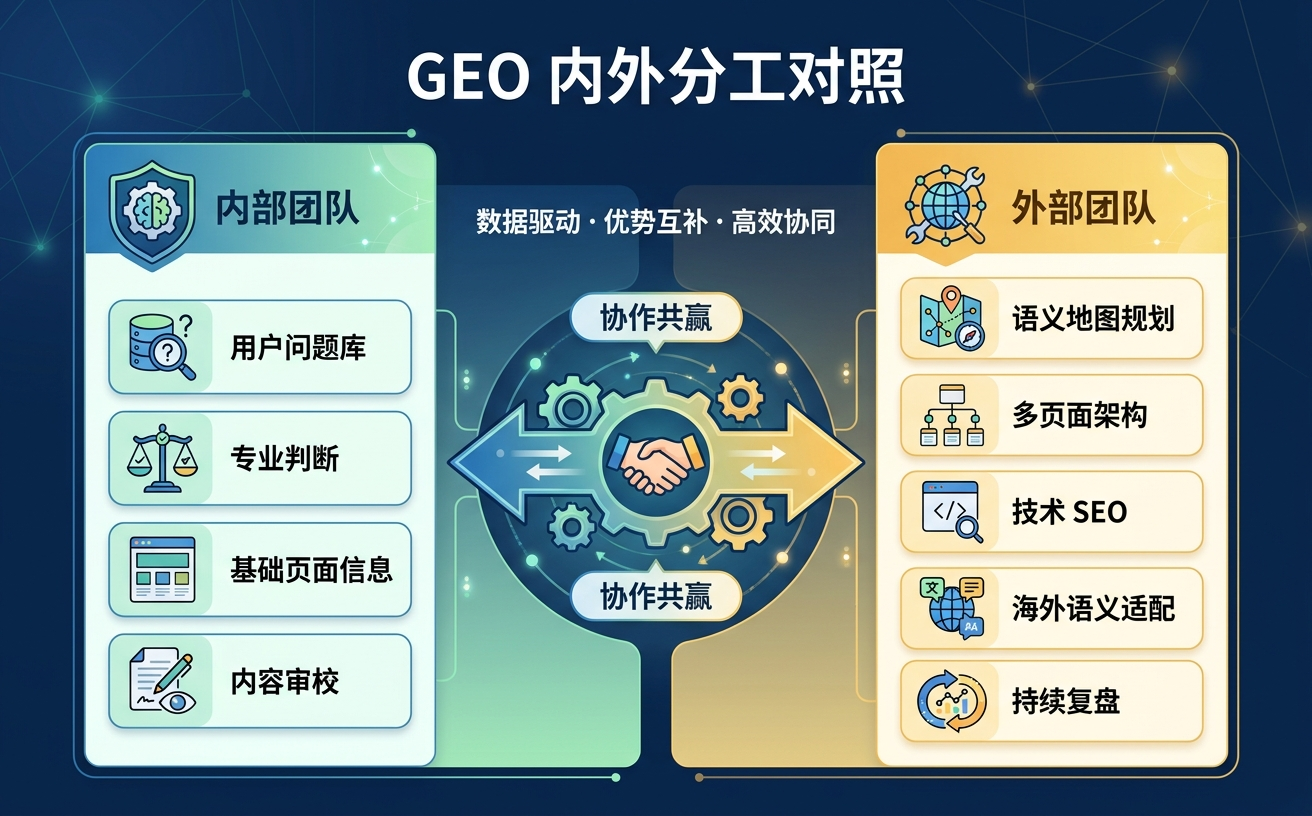
Running GEO internally does not mean every activity must remain inside the company. A better model separates internal advantages from external capabilities. The internal team is closest to the business and should supply judgment. An external team can contribute a repeatable method, tools, structure, monitoring and review.
Work the Internal Team Should Own
Build a library of real customer questions. Sales, support, customer-success and business leaders know how customers ask, compare and hesitate. The internal team should capture this knowledge before the content team turns it into pages.
Provide professional judgment. Technical, B2B, healthcare, legal and industrial content cannot be assembled responsibly from external sources alone. Internal experts need to identify accurate claims, misleading language and statements that require risk qualifications.
Complete essential page information. State the service scope, intended audience, delivery process, relevant experience, team capabilities and contact details clearly. Better source information makes later GEO improvements easier.
Participate in editorial review. GEO content should not be published immediately after drafting. Professional-service pages in particular need business experts to verify the facts, logic and boundaries of the language.
These inputs come from real operations and should not be outsourced completely.
Work an External Team Can Support
Plan the semantic map. GEO optimization does not mean writing a few isolated articles. It connects topics, entities, question chains and pages. A semantic map may cover AI search, Semantic SEO, brand entities, content structure, technical SEO and prompt monitoring. It may also cover B2B use cases and multilingual work.
Design a multi-page content architecture. AI search relies heavily on context. A single article rarely establishes complete trust, so service pages, blog posts, case studies, FAQs, comparisons and methodology pages need to reinforce one another.
Audit technical SEO and structured data. A specialist should verify that pages can be crawled and indexed, important information exists as readable text, and structured data matches the visible content.
Adapt semantics for international markets. A team targeting Google outside China should not simply translate Chinese content into English. English-speaking users phrase questions differently, follow different decision paths and rely on different trust signals. Effective international GEO content needs to be planned around English-language search intent.
Review performance and adjust the strategy continuously. GEO does not end after one optimization cycle. The team should keep refining content as search results and AI answers change. It should also respond to competitor positions and conversion paths.
Companies can perform these tasks internally, but without prior experience or an operating system, the cost of trial and error can be high.
What Is a Hybrid GEO Model?
A hybrid GEO model is not a binary choice between doing everything internally and outsourcing everything. Three common combinations are:
The company has a content team but lacks monitoring and technical capabilities. The internal team produces the content; an external team provides the framework, structure and performance reviews.
The company is beginning GEO and the internal team is still learning. An external team first proves the method. Over time, the company brings the content templates, prompt library, monitoring cadence and review process in-house.
The company serves several markets. It selects one priority market for deeper work - for example, a specialist team leads Google GEO in the United States - and extends the validated standard operating procedure to other markets later.
This model preserves the company's subject-matter expertise and reduces avoidable experimentation.
Frequently Asked Questions About In-House GEO
How Long Does In-House GEO Take to Show Results?
Do not promise a fixed period. For many projects, three to six months is a more appropriate window for observing interim changes. The early stages focus on inventory, improvements and a monitoring baseline. Later reviews can check how often the brand appears, whether the context is positive, which questions are covered and whether the path converts.
Can a Team Start GEO Without an SEO Foundation?
It is not advisable. GEO needs SEO support. If pages cannot be crawled, content cannot be indexed and brand information remains unstable, AI systems are unlikely to treat the website as a dependable source.
What Is the Essential Difference Between GEO and SEO?
SEO improves rankings and clicks in search results. GEO improves visibility, citability and brand understanding in AI answers. Both require strong content, technically healthy pages and credible signals. GEO also emphasizes how entities relate, how answers are structured and which prompts the content covers.
Does In-House GEO Require Technical Expertise?
The team needs to understand basic SEO and page structure, but not every participant needs to be a developer. At minimum, the company should confirm that pages can be crawled and indexed, important content is readable as text and priority pages have a clear structure. Multilingual sites, complex templates and structured data may require technical SEO or GEO support.
Is GEO for DeepSeek and Kimi the Same as GEO for International Platforms?
The principles overlap, but implementation differs. International Google GEO places greater emphasis on the official website, structured data, authoritative sources and the search-results ecosystem. Chinese large-language-model ecosystems rely more heavily on domestic content platforms and Chinese-language context, so their distribution and monitoring strategies need to be designed separately.
Can a Small Team Without a Dedicated SEO Specialist Still Work on GEO?
It can start with the basics, but a completely internal program is not recommended. A more realistic approach keeps the source content and expert review inside the company. An external team can support semantic planning, monitoring and technical delivery.
Conclusion
Running GEO internally is feasible, but the decision is not simply whether the budget exists. It depends on whether the team has a method, sufficient resources and the ability to work consistently.
A team with solid SEO, a steady publishing workflow and the ability to monitor results can begin internally. Start with a limited validation project. If the company lacks semantic planning, AI-mention monitoring, technical SEO or cross-market experience, it can work with GlobalBrandsDigital. We begin with search intent, Semantic SEO, content structure, brand entities and prompt monitoring to identify which activities belong inside the business and which benefit from external support. Our in-house GEO tracking platform also supports custom prompt monitoring, positive brand-mention analysis and changes in competitor recommendations.
Avoiding unnecessary detours matters more than starting in a hurry.