On this pageTable of contents+
- Why GEO Is Not the Same as AI Overviews Optimization
- Google AI Overviews Has Increased the Value of GEO
- What AI Overviews Source Selection Means for GEO
- How Companies Can Adapt to GEO and AI Overviews
- Make Content Easier for AI to Cite
- Expand From Keywords to a Network of Questions
- Keep the Brand Entity Consistent
- Build Positive Third-Party Mentions
- Use Prompt Tracking to Validate the Direction of Optimization
- Common Misconceptions About GEO and Google AI Overviews
- Is GEO the Same as AI Overviews Optimization?
- Does GEO Still Require SEO?
- Does a High Ranking Guarantee an AI Citation?
- Can GEO Guarantee That a Brand Appears in AI Answers?
- Conclusion

The relationship between GEO and Google AI Overviews can be summarized in one sentence: GEO is an optimization method, and Google AI Overviews provides AI-generated answers within Google Search.
GEO stands for Generative Engine Optimization. It focuses not on webpage rankings alone, but on whether AI-generated answers can understand, cite and describe a brand's content positively.
Google AI Overviews is an AI-generated summary module on Google search results pages. For some queries, Google may first generate a summary and provide links to relevant webpages, helping users understand the topic quickly and continue exploring.
The two are therefore not equivalent. More precisely, Google AI Overviews is one important application of GEO within the Google Search ecosystem.
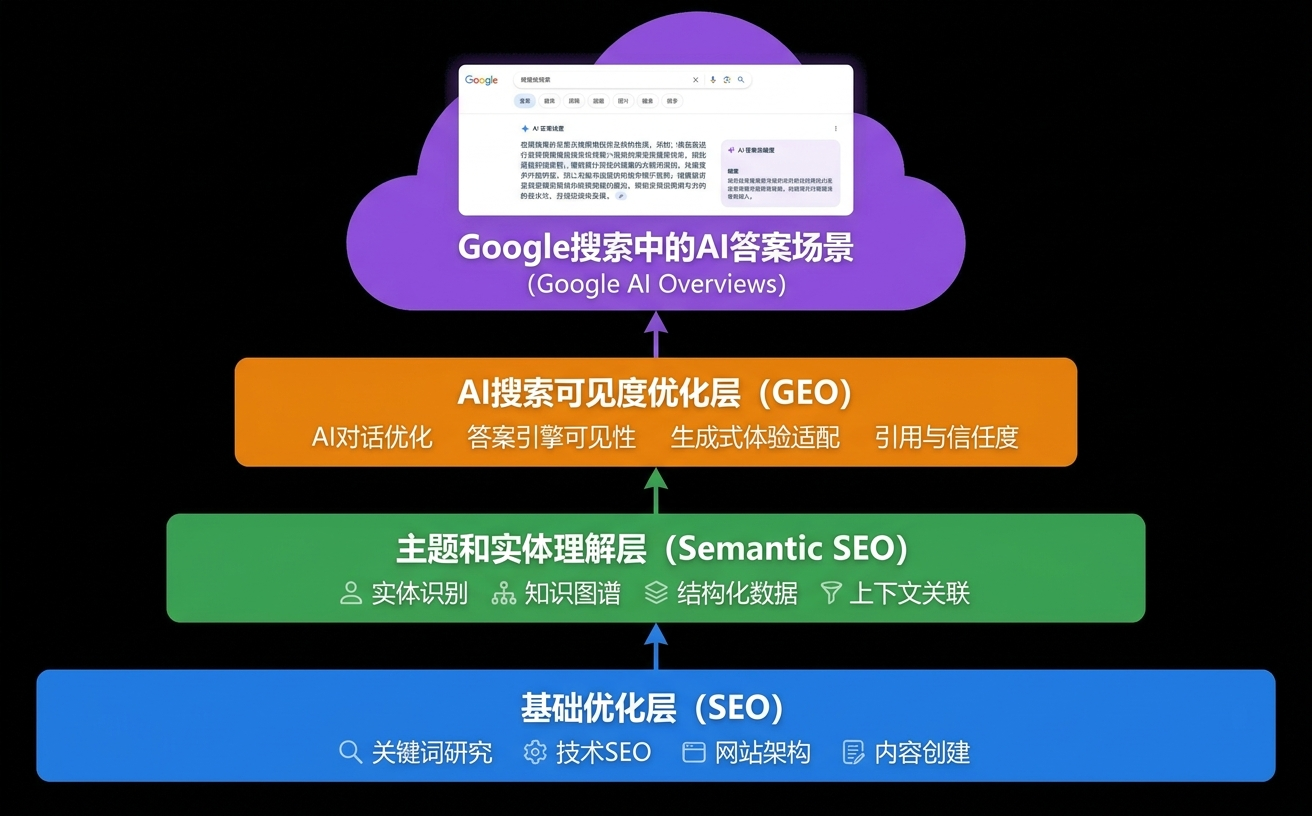
How SEO, Semantic SEO, GEO and Google AI Overviews relate to one another
Why GEO Is Not the Same as AI Overviews Optimization
Defining GEO as "optimizing Google AI Overviews" is too narrow.
GEO addresses a much broader ecosystem of generative answers. In addition to Google AI Overviews, it may cover AI Mode, Gemini, ChatGPT, Perplexity, Claude, DeepSeek, Kimi and other answer-based interfaces.
These platforms do not use exactly the same data sources, retrieval methods, citation logic or answer-stability patterns. A company pursuing GEO should therefore look beyond a single AI Overview result and assess its wider visibility in AI search.
In other words, GEO is not about capturing one position. It is about helping a brand be recognized, cited and described with reasonable accuracy and positive context across more high-value questions.
Google AI Overviews Has Increased the Value of GEO
AI Overviews has changed the order in which users encounter search results.
In the past, users generally saw webpage titles first and then decided which result to open. Now they may see an AI summary first and only then decide whether to visit a webpage.
This means that companies need to look beyond traditional rankings and ask three questions:
- Does AI mention the brand?
- When it does, is the description positive?
- Are competitors cited frequently for more important questions?
Pew Research Center's analysis of US Google search behavior in March 2025 found that users clicked a traditional search-result link on 8% of pages with an AI summary, compared with 15% of pages without one. This does not mean every industry will be affected in the same way, but it does show that AI summaries can change the path to a click.
GEO is therefore not about creating anxiety. Its value lies in helping companies understand a real change: search visibility no longer means rankings alone; it also includes a brand's presence in AI answers.
What AI Overviews Source Selection Means for GEO
Traditional SEO works more like a ranking system. A search engine judges how closely a page matches the query and how much readers can trust it. It also considers how well the page is written and works for users. It then orders webpages in a list and lets the user choose a result.
AI Overviews works more like an answer-generation system. It creates a summary around the user's question and displays supporting links. Google has explained that AI Overviews and AI Mode may use query fan-out, issuing multiple related searches across subtopics and data sources before combining the results into an answer.
This means AI Overviews does not look only at whether an entire page ranks well. It may also assess whether a specific paragraph or explanation clearly answers a particular subquestion.
Consider a user who searches for "how to choose a home coffee machine."
Traditional SEO asks whether the page can rank. GEO also asks whether the page clearly answers questions such as:
- What types of home coffee machine are available?
- Which type suits a beginner?
- Which type works in a small kitchen?
- How difficult is cleaning and maintenance?
- How should someone choose among espresso, drip and capsule machines?
If the content targets only one keyword without covering these related questions, the page may rank yet still be less likely to serve as a supporting source for an AI summary.
GEO therefore places greater emphasis on prompts, not just keywords. A keyword represents a search entry point; a prompt is closer to the user's actual question.
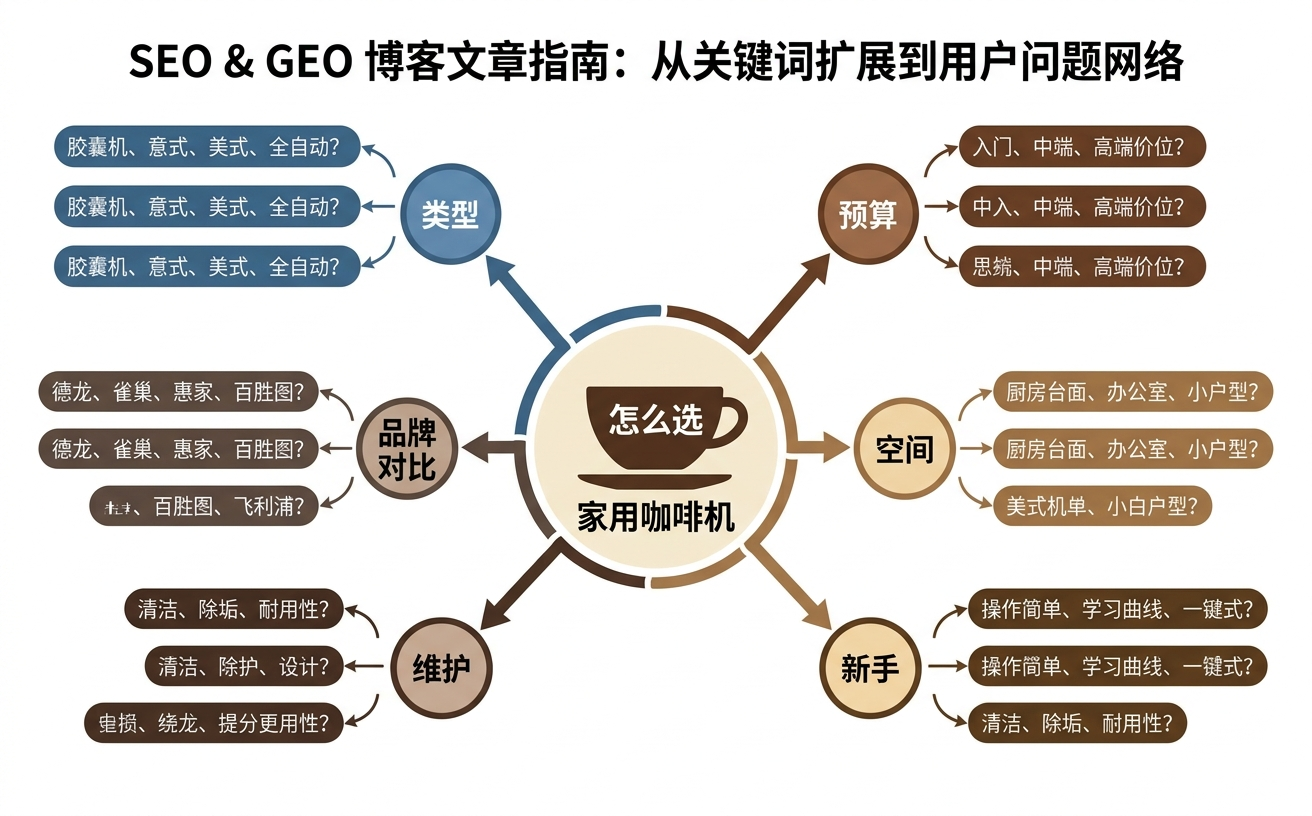
A question network that extends from keywords to prompts
How Companies Can Adapt to GEO and AI Overviews
Understanding the relationship between GEO and Google AI Overviews does not require a company to discard its existing SEO work, but several adaptations are useful.
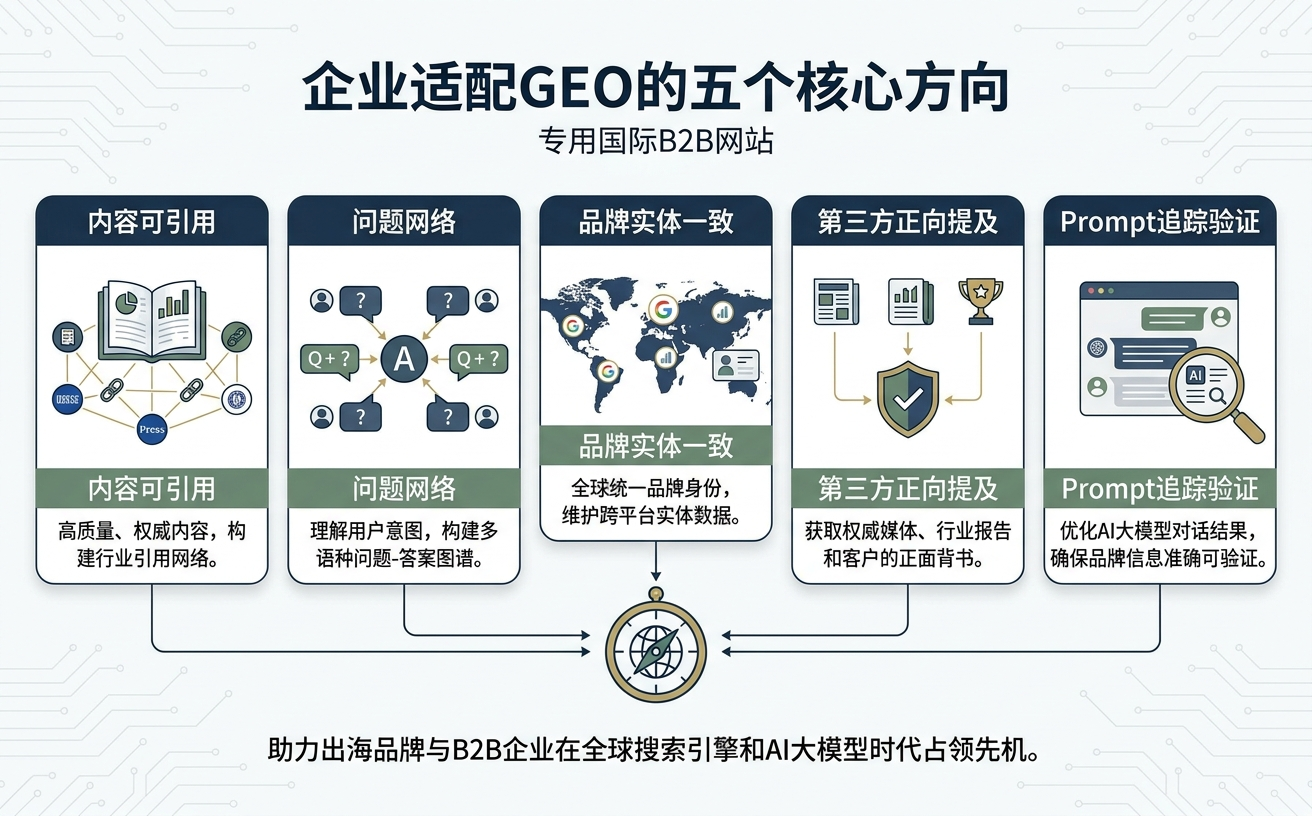
Five areas in which companies can adapt to GEO and AI Overviews
Make Content Easier for AI to Cite
Articles and landing pages should reduce lengthy preambles and present the central answer earlier.
When you define, compare, recommend or instruct, start an important paragraph with the answer and then explain it.
Instead of writing only, "There are more and more kinds of air fryer on the market, and every household has different needs..."
A clearer version would be, "For a family of three, an air fryer of about five liters is generally more practical because it has enough capacity for everyday dishes such as chicken wings, fries and simple baked foods."
This style is more direct, makes the central point clear and is easier for an AI system to extract and cite.
Expand From Keywords to a Network of Questions
In the SEO era, many pages were built around one primary keyword.
In the GEO era, it is more useful to create a complete chain of questions around a topic.
For an air-fryer page, for example, do not explain only the appliance itself. Cover the questions users actually ask:
- What household size is an air fryer suitable for?
- How should a first-time buyer choose an air fryer?
- What is the difference between an air fryer and an oven?
- What air-fryer capacity is large enough?
- Are air fryers easy to clean?
- Which foods are better suited to an air fryer?
Together, these questions form a topic network. The more completely the page covers it, the easier it is for AI to understand what problems the content solves and to treat the page as a potential information source.
Keep the Brand Entity Consistent
Before AI can cite a brand, it needs to identify that brand reliably.
Companies should therefore use the same brand name and describe the same products and services across the official website, Google Business Profile, social platforms, industry directories, media coverage, product pages and structured data.
Suppose a baby-products brand says on its website that it specializes in high-view strollers, calls itself a lightweight-stroller brand on social media, and describes itself as a baby mobility brand on a third-party platform. AI then has more difficulty recognizing that every profile refers to the same brand.
This is one connection between Semantic SEO and GEO. Semantic SEO helps search systems understand topics and entity relationships; GEO further considers whether AI answers can use that information naturally.
Build Positive Third-Party Mentions
Traditional SEO pays more attention to the number and authority of backlinks.
GEO pays more attention to whether a brand is citable within third-party context.
AI systems often consult independent sources about a brand. These can include industry media and professional reviews, as well as videos, Q&A platforms, partner pages, authoritative directories and conversations in online communities.
Being mentioned is not enough, however. What matters more is who mentions the brand, in what context, whether that context is positive and whether it relates to the brand's core use cases.
A stroller brand may appear frequently online. Yet if people mostly complain that it is difficult to fold, too heavy or too large for a car trunk, AI may not portray the brand positively.
By contrast, if third-party content consistently associates the brand with easy urban commuting, suitability for newborns, space-saving folding and small homes, AI can form a clearer and more stable impression of the brand.
Use Prompt Tracking to Validate the Direction of Optimization
GEO cannot ultimately be evaluated by intuition alone.
Some brands occasionally search a few questions to see whether AI Overviews mentions them. This can be misleading because wording, location, language, time and the surrounding search can all affect an AI answer. Seeing the brand once does not mean it is consistently visible. Failing to see it once does not mean the work failed.
A more dependable approach is to establish a set of prompts based on real user decisions and track them over time.
A stroller brand, for example, should not monitor only a keyword such as "best stroller." It should continue observing questions such as:
- Which lightweight strollers are suitable for urban commuting?
- Which type of stroller is suitable for a newborn?
- How should a family in a small home choose a folding stroller?
- Which type of stroller is more convenient for travel?
These prompts mirror how people buy. They also show more clearly whether AI answers include the brand.
Tracking should examine not only whether the brand appears but also how AI describes it: positively, neutrally or negatively. Is it included in a recommendation list? For which questions do competitors appear more often? Does the answer cite the official website, a third-party review, a community discussion or another media page?
In GlobalBrandsDigital's GEO projects, prompt tracking also guides the next step. It does not promise that a brand will enter a particular AI Overview. It shows where the brand already appears and where competitors dominate. It also reveals which pages, brand details or outside coverage still need work.
GEO then becomes a process of continuously observing and improving AI-search visibility, rather than a vague activity whose effect cannot be assessed.
Common Misconceptions About GEO and Google AI Overviews
Is GEO the Same as AI Overviews Optimization?
No. Google AI Overviews is one important GEO application, but GEO covers the wider ecosystem of generative answers. Focusing only on AI Overviews can leave visibility gaps in ChatGPT, Perplexity, Gemini, AI Mode and other interfaces.
Does GEO Still Require SEO?
Yes. SEO remains the foundation. Pages need to be crawlable and indexable, and important information needs to appear as clear text. Without that SEO foundation, GEO is unlikely to work consistently.
Does a High Ranking Guarantee an AI Citation?
No. A high ranking shows that searchers can find the page. When choosing sources, AI Overviews may also ask whether the page answers related questions, can be parsed easily, supports its claims and identifies the brand clearly. Companies therefore need to examine whether AI actually mentions, cites and describes them positively, not rankings alone.
Can GEO Guarantee That a Brand Appears in AI Answers?
No. A responsible GEO service should not promise a guaranteed appearance in a particular AI Overview or a guaranteed recommendation from ChatGPT. A more reliable approach helps AI understand and cite the brand. The work combines useful pages, consistent brand details, third-party coverage, prompt tracking and competitor research. Teams then monitor results to decide what to improve.
Conclusion
GEO is not about chasing one AI Overview position. It is about building a system of content assets around real user questions that AI can understand, verify and choose to cite.
For international brands, Google AI Overviews is an important interface, but it is not the only one. A dependable GEO strategy also keeps pages crawlable, connects topics through Semantic SEO, describes the brand consistently, earns positive third-party coverage and monitors prompts over time.
GlobalBrandsDigital recommends treating GEO as long-term work on AI-search visibility rather than a short-term ranking technique. Only by connecting content, entities, mentions and data monitoring can a company assess its position in AI answers more clearly and identify the next area to improve.