
On this pageTable of contents+
- Why GEO Content Requires More Than Good Writing
- How GEO Writing Differs From Ordinary Content Writing
- A Reference Workflow for GEO Content
- Step 1: Define the Topic Clearly
- Step 2: Research Should Support the Draft, Not Simply Accumulate
- Step 3: Build the Outline Before Drafting
- Step 4: Make the First Draft Coherent Before Making It Polished
- Step 5: Review More Than the Language
- Step 6: Publication Is Not the End, and Evaluation Should Examine the Process
- Conclusion

When teams create GEO content, the obstacle is often not an inability to write. It is having to make the same decisions again for every article: how to choose the topic, which research is missing, how to structure the piece, who should review it and how to assess it after publication. Articles still go live, but their quality varies and the process is difficult to retain.
GEO writing here means more than producing copy. It means turning content into a clearer answer to a question so that readers can understand the central information more easily and systems can retrieve, extract and reuse it more readily.
This article does not discuss the finer details of headings and page formatting. It follows the complete GEO process: choose a topic, research it, outline it, draft it, review it, publish it and assess the result. This shows how a company can turn GEO writing into an executable, reviewable and reusable standard operating procedure.
Why GEO Content Requires More Than Good Writing
When an article is considered in isolation, it is easy to conclude simply that the piece was not written well. Look instead at three months, six months or a full year of output, and the real determinant is often the process rather than the prose.
Many teams encounter similar problems.
First, a topic can appear relevant until writing begins and the direction proves unclear. A keyword has been selected, but search intent has not been understood. The reader wants an implementation method, but the article starts with a conceptual explanation and never meets that need even after the full draft is complete.
Second, the team may review plenty of material without reaching a clear judgment. It seems well prepared, but in practice it has only reread existing content. The team has not identified what others already explain well, where gaps remain or which claims are most likely to become empty statements.
Third, the outline is not settled before drafting, so the body has to do too much work. The writer researches, structures, prioritizes and plans the conclusion at the same time, steadily increasing the difficulty of drafting. Many articles fail not because the writer lacks skill, but because decisions that belonged earlier in the process were deferred until the draft.
Fourth, review addresses language but not substance. Grammar is corrected and sentences flow better, yet the article's actual answer remains unclear, as does what it adds beyond competing content.
When these problems recur, the team is not missing one writing technique. It is missing a stable content-production process.
How GEO Writing Differs From Ordinary Content Writing
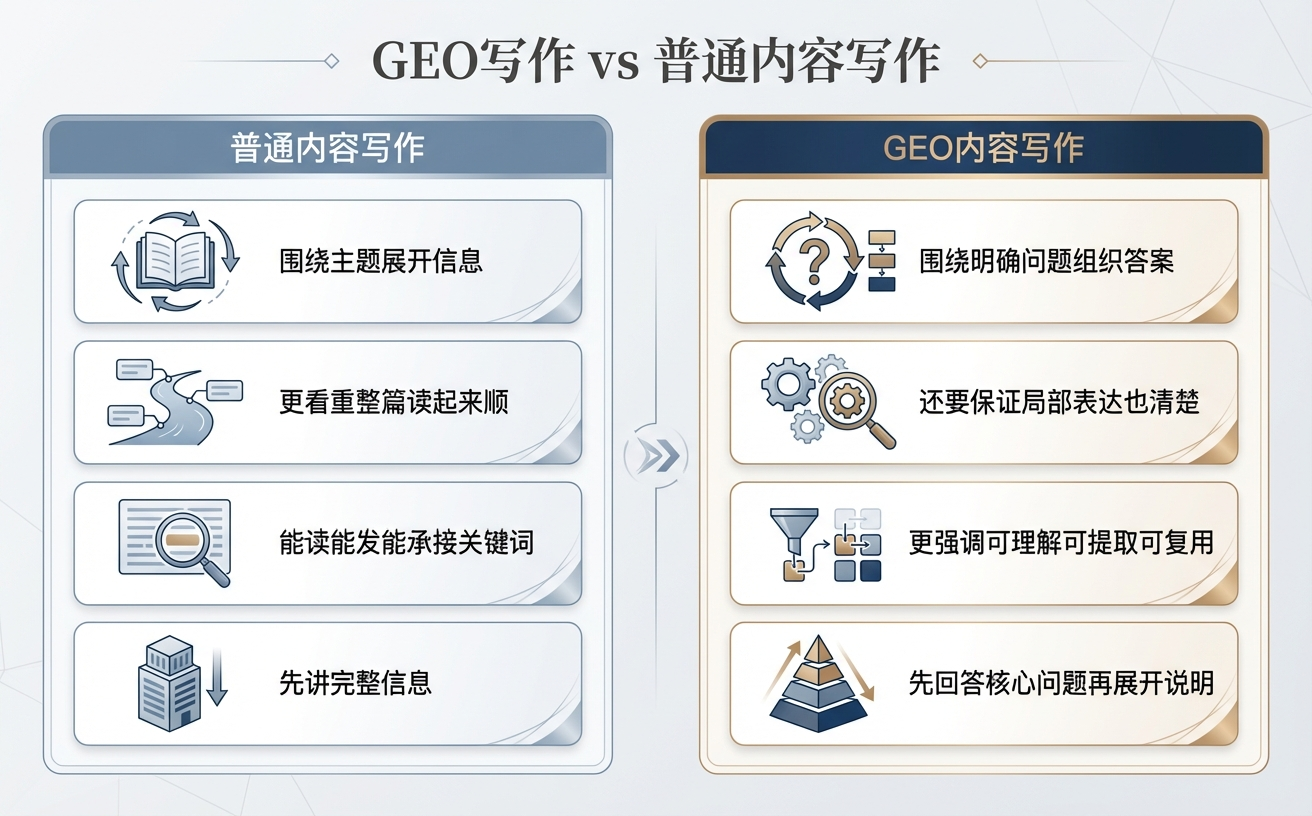
The difference between GEO writing and ordinary content writing is not a handful of new terms. It is a different way of organizing information.
Ordinary content often develops a topic and tries to cover the related information fully. GEO writing is more explicitly organized around a defined question: answer the central question first, then explain the steps, comparisons, limits and related questions.
Ordinary content is judged largely by whether the whole piece reads smoothly. GEO content must also be clear at the local level. Can a reader understand a definition, a step or a comparison when it is quoted on its own? That distinction matters.
Ordinary content may be ready once it is readable, publishable and able to support a keyword. GEO content requires another check: is the structure sufficiently clear, are the answers concentrated enough, and which passages can be understood, extracted and reused directly?
This article therefore does not describe a generic workflow. It shows how to keep every stage led by a question and structured as an answer, from choosing a topic to researching, outlining, drafting, reviewing and assessing the final article.
A Reference Workflow for GEO Content
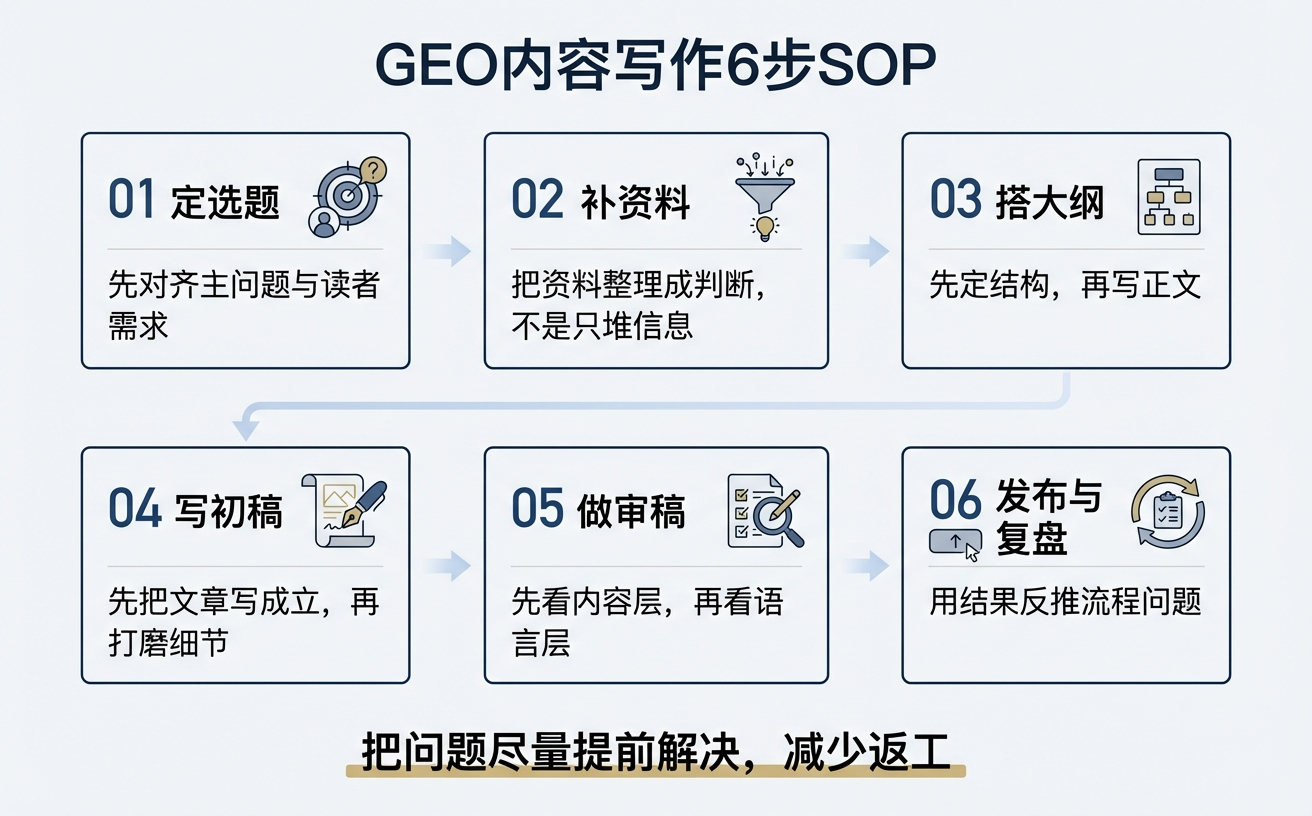
A GEO content workflow can usually be divided into six steps: define the topic, collect supporting material, build the outline, write the first draft, review the content and assess its performance after publication.
Different people do not have to own each step, but the order should remain stable. Many apparent drafting problems began earlier. An unclear topic lets the article drift. Incomplete research produces shallow copy. A weak structure causes repeated rewrites. Superficial review carries problems into production. The purpose of the workflow is not to add bureaucracy; it is to resolve problems as early as possible.
Step 1: Define the Topic Clearly
Many content projects begin with only a keyword, a word count and a deadline. That can support basic execution, but it is not enough for GEO.
GEO content is not about filling a word count around a term. It organizes an answer around a specific question. Before writing begins, establish the need the article will serve, the problem the reader is trying to solve, what existing content already covers, what the new article can add and what judgment the reader should reach by the end.
Without that clarity, the keyword may be right but the article's direction may be wrong. The draft appears to cover the topic but does not answer the reader's most important question.
A useful topic brief need not be complicated, but it should identify the target keyword, primary search intent, related questions, intended reader, gaps in existing content, the proposed angle, the judgment that will conclude the article and the subjects that the article will not attempt to cover.
For GEO content, define one more point. State the article's central question. Mark the passages that answer it directly and those that only add context. Without this distinction, it is difficult to produce a clear answer structure later.
Once the topic is defined to this level, the team has a foundation for both research and outlining.
Step 2: Research Should Support the Draft, Not Simply Accumulate
Teams often review extensive material and still find that the draft feels empty. The problem is usually not too few sources, but a failure to turn the material into a judgment.
Research needs to resolve several questions: what the reader is actually trying to solve, what existing content leaves unclear, where the draft is most likely to lapse into empty language, which points would work better as a checklist, comparison or example, and which conclusions need explicit boundaries.
Competitor content should be reviewed, but not so that it can be rewritten. The purpose is to see where most existing material stops. There is little value in repeating points others have already explained well. Gaps and vague explanations are more useful places to add substance.
GEO research should also identify information that can become a clear, self-contained answer passage. The value of content lies not only in the complete reading experience, but also in whether individual sections are clear and easy to extract and reuse.
Research should therefore end with a practical decision. Decide which points to develop and which facts serve only as background. Decide what needs a full account and what needs only a sentence. At that point, the outline becomes more than a rearrangement of source material.
Step 3: Build the Outline Before Drafting
Many articles fail because of structure rather than prose. When the structure does not work, the draft usually becomes more diffuse as it grows.
A common problem is trying to define the topic, explain causes, give methods and wrap up in one small section. Every paragraph touches the subject, but none explains it fully. Another problem is sequence: an essential point appears too late, so the article moves into implementation details before readers can follow it.
An outline should therefore do more than list section titles. Decide where to define a concept and explain steps. Also decide where to compare options, answer follow-up questions and wrap up. Giving every section a clear job prevents the draft from drifting.
From a GEO perspective, the outline also separates content that answers a question directly from supplementary explanation. This produces a more focused draft and a clearer answer structure.
Use three tests before drafting. Does each H2 answer something specific? Does the structure add something distinct? Can the ending return naturally to the central issue? If any test fails, drafting is likely to be difficult.
Step 4: Make the First Draft Coherent Before Making It Polished
The priority of a first draft is not to perfect every sentence, but to make the article work as a whole.
At minimum, the opening should answer the title directly. Every major part should move the main idea forward. Define important terms clearly, and format steps, comparisons and checklists so that readers can scan them.
Many drafts are not awkward; they are crowded and unfocused. Every paragraph seems substantive, but some merely repeat earlier points in different words. Others take a strong position without adding information.
For GEO content, the first draft should also contain passages that work independently. A reader who sees a central paragraph in isolation should still understand the question it answers. This style is easier to read, retrieve and reuse.
Do not rush to polish sentences during the first draft. First check whether the structure has drifted, whether the main points are present and whether the article continues to advance the same central question. If that foundation is unstable, editing will turn into repeated rework.
Step 5: Review More Than the Language
Many review processes concentrate on fixing grammar, smoothing sentences and standardizing terminology. Those tasks matter, but they leave many substantive quality problems untouched.
Review should ask several things. Does the article answer its title? Do polished sentences say very little? Does the draft separate facts from advice and opinion? Is the approach too similar to competing content? Are the terminology, author, update date and brand details complete?
Some articles read smoothly but leave the central conclusion unclear. Polishing cannot solve this; the substance must change.
A GEO review adds another layer: is the central information sufficiently concentrated, are key passages clear, and do any apparently complete paragraphs remain difficult to understand, extract or reuse? Reading smoothly is one standard; being understood efficiently is another. Both matter.
It is therefore useful to divide review into two stages: substance first, language second. If the substance does not pass, meticulous copyediting only makes the surface neater.
Step 6: Publication Is Not the End, and Evaluation Should Examine the Process
For many teams, the workflow stops when the article goes live. They may look at basic performance data, but rarely return to identify which stage created the problem.
A useful review does not merely label the article average or successful. It maps the result back to the workflow. If the direction was wrong, revisit how the topic was chosen. If the draft was shallow, revisit the research. If the structure was confusing, revisit the outline. If priorities were unclear, revisit the first draft. If the page attracted views but nobody acted, revisit how it ends and the final check before it went live.
Before the article goes live, check at least four things. Does it answer the main issue? Is it organized clearly? Do the page details agree? Does it end naturally? Many later problems were already visible but were missed in this final review.
A GEO evaluation should also examine two further questions: which user questions led readers to the content, and which modules actually helped? Was the definition most effective, the process, a comparison or the FAQ? This level of review provides evidence for the next revision.
A content process is not proven by the number of published articles. It works when the team can explain after each publication what succeeded, where the problem arose and which step should change next time.
Conclusion
A GEO content SOP should not simply help a team publish more articles. It should make every stage repeatable: choose the topic, research, outline, draft, review, publish and learn from the result. Without a stable process, the work will continue to vary in quality and the team will struggle to retain what it learns.
A team with modest content volume, a basic SEO capability and someone able to coordinate direction, research and review can begin by running this process internally. Set the standard first, then expand gradually; this is more dependable than trying to scale immediately.
If you are building a GEO content system, or already produce content but cannot make the workflow run smoothly, talk to GlobalBrandsDigital. We can begin with the current process and a sample of articles, identify which stage is causing the problem, and then decide what to improve.