On this pageTable of contents+
- What Should You Prepare Before Starting GEO?
- 1. Define the Objective Before Discussing Tactics
- 2. Choose Questions, Not Only Keywords
- 3. Review Existing Content Assets First
- 4. Decide Whether Your Business Should Prioritize GEO
- How to Implement GEO: A Six-Step Process
- Step 1: Research Prompts to Understand How Users Ask Questions
- Step 2: Assess Current AI Search Visibility
- Step 3: Improve On-Site GEO So the Brand Is Easier to Understand
- Step 4: Add Decision-Support Content Once the Brand Is Understood
- Step 5: Strengthen Off-Site Trust Signals
- Step 6: Monitor and Refine GEO as a Closed Loop
- Which On-Site Pages Should You Improve First?
- When Should Off-Site GEO Begin?
- Seven Common GEO Mistakes for Beginners
- A 30-Day GEO Starter Plan
- Week 1: Research Questions and Establish the Baseline
- Week 2: Improve the Core On-Site Pages
- Week 3: Add Three High-Priority Pages
- Week 4: Run the First Review and Adjust
- Frequently Asked Questions
- Should GEO and SEO Be Done Together?
- Does GEO Require a Major Technical Rebuild?
- Should a Team Start With Its Website or External Content?
- Which Pages Should Be Optimized First?
- How Long Does It Take to See Early Signals?
- Can a Small Team Run a Limited First Version?
- Conclusion

GEO, or generative engine optimization, helps brands and content become easier to find, understand and cite in AI-generated answers. It does not replace SEO. SEO supports crawling, indexing and page visibility; GEO addresses whether AI systems can recognize a source as credible.
Before beginning GEO work, complete four tasks: define the objective, map user questions, review existing content assets and decide whether the business should prioritize GEO. Then proceed through six steps: research prompts, assess current AI visibility, improve on-site messaging, build the content structure, strengthen off-site trust signals, and monitor and refine the work.
This guide explains what GEO is, which businesses may benefit from prioritizing it, how to implement it from the ground up and which mistakes beginners should avoid.
What Should You Prepare Before Starting GEO?
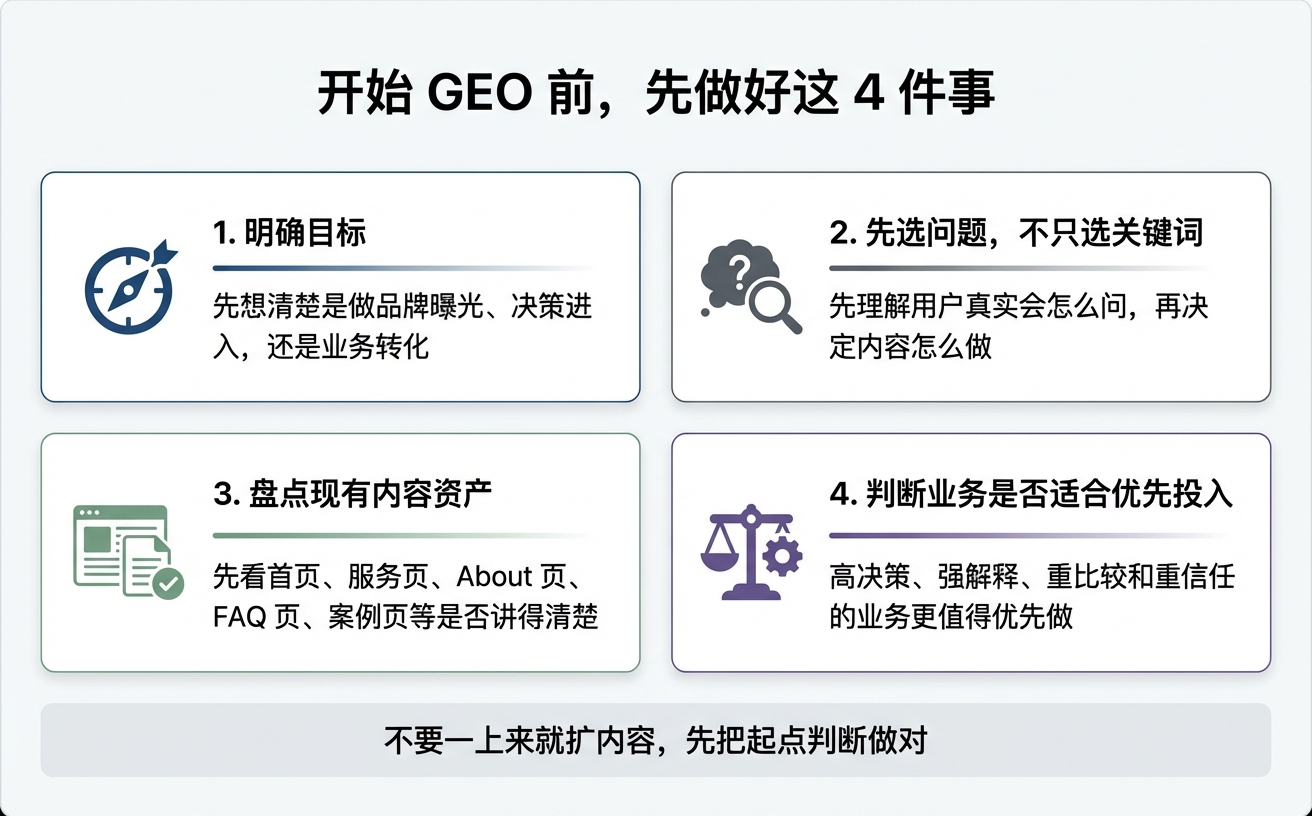
Complete these four tasks before you begin.
1. Define the Objective Before Discussing Tactics
What do you want GEO to achieve?
Objectives usually fall into three categories:
- Brand visibility: increase how often the brand is mentioned in AI results.
- Decision stage: appear when users compare options or ask what to choose.
- Business conversion: make AI search a route to enquiries, appointments, trials or lead capture.
Different objectives require different page priorities.
If brand visibility is the main goal, the homepage, About page, definition pages and brand FAQs may come first. If qualified enquiries matter more, prioritize service, comparison, case-study and decision-support pages.
2. Choose Questions, Not Only Keywords
Start with how users ask in real settings; do not choose a term alone. In search and AI conversations, people increasingly ask complete questions instead of entering only a keyword.
Clarify those questions before planning pages and deciding which content to write first.
3. Review Existing Content Assets First
Do not rush to add content before understanding what the site already contains. Review all of these page types:
- Homepage
- Service pages
- Product pages
- About page
- FAQ page
- Case-study pages
- Blog articles
- Author and team pages
The important question is not whether these pages exist, but whether they explain the business clearly.
If the homepage does not explain who you are, service pages do not explain what you provide, the About page does not distinguish the business and the FAQ misses common customer questions, adding more articles is unlikely to produce consistent results.
4. Decide Whether Your Business Should Prioritize GEO
Not every industry needs an immediate GEO overhaul, but the following business types often have a stronger reason to invest early:
- B2B companies
- SaaS products
- Professional-services firms
- Cross-border and export brands
- High-value, considered purchases that require explanation and comparison
Customers in these categories are more likely to ask AI questions such as:
- Which company is the better fit?
- Is this solution worth pursuing?
- What is the difference between option A and option B?
- How should I choose?
- Which provider is better suited to my needs?
If a purchase depends on explanation, comparison, trust and judgment, GEO is likely to become increasingly relevant.
For products people buy on impulse and without much explanation, foundational SEO and paid search will usually come first. Improve conversion pages before treating GEO as the short-term priority.
Related reading:
Which Companies Should Prioritize GEO?
Is GEO Worth the Investment?
How to Implement GEO: A Six-Step Process
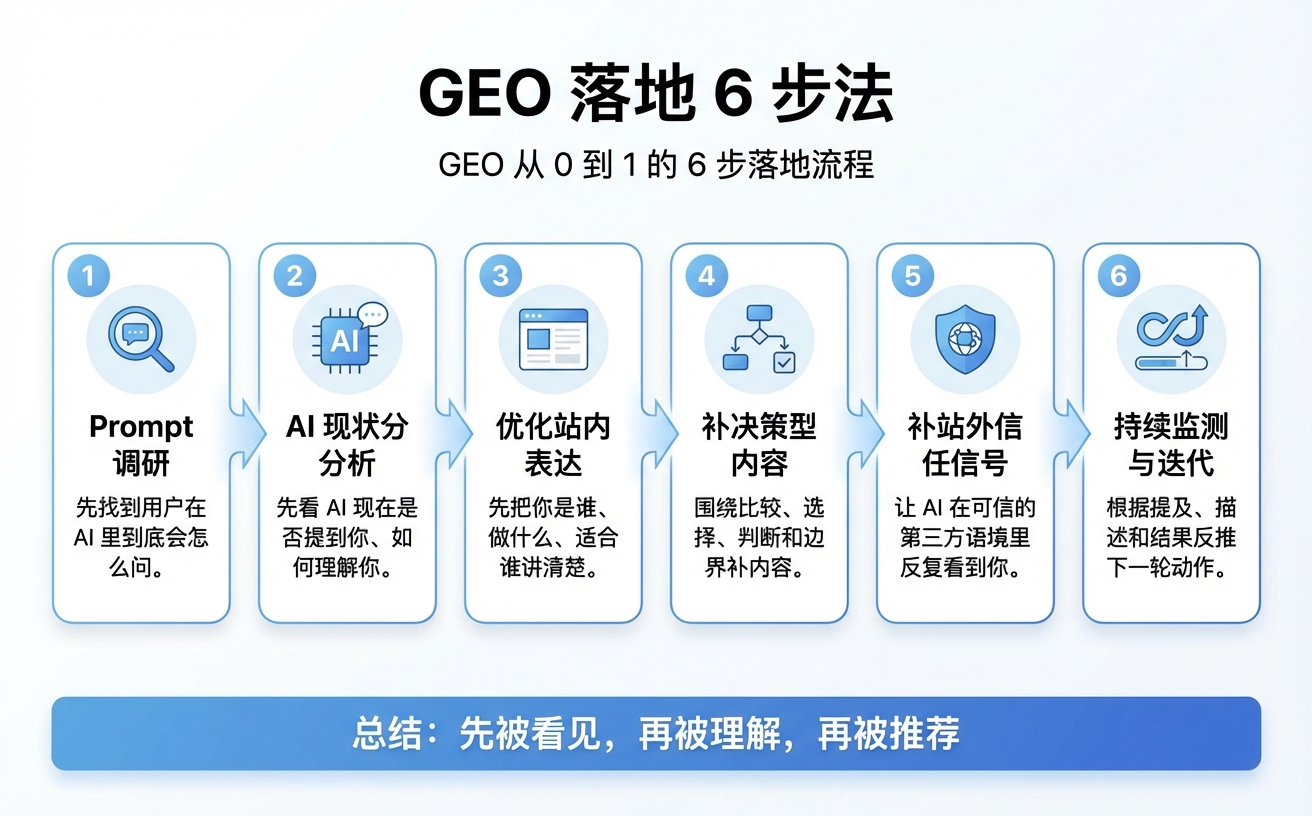
Step 1: Research Prompts to Understand How Users Ask Questions
Prompt research means systematically collecting, grouping and prioritizing the questions users may enter into systems such as ChatGPT, Gemini and Google AI experiences.
Someone considering a robot vacuum, for example, may not search only for the term "robot vacuum." They are more likely to ask:
- Do I really need a robot vacuum?
- Which type of robot vacuum suits a home with cats?
- What is the difference between a vacuum-and-mop model and a vacuum-only model?
- Is a more expensive model worthwhile for a small home?
- What should a first-time buyer look for?
These questions reflect real needs and are closer to the way people interact with AI systems.
Begin by grouping questions into four types:
- Definitions: what something is or whether it is necessary, such as "What is a robot vacuum?" or "Is it worth buying?"
- Comparisons: how option A differs from option B, such as "What is the difference between a vacuum-and-mop model and a vacuum-only model?"
- Selections: which option fits and whether to choose it, such as "Which model suits a home with cats?" or "What should I choose for a small home?"
- Instructions: how to complete a task, such as "How should a first-time buyer choose?" or "How can I use it with less effort?"
Once the questions are grouped, it becomes easier to decide what to write first, what belongs in an FAQ and what is better suited to a comparison page or practical guide.
Produce at least two deliverables at this stage:
- A question inventory that captures as many genuine questions as possible.
- A prioritization table showing which questions should be addressed first.
The first version does not need a complex scoring model. Consider four points:
- How frequently does the question arise?
- How close is it to a decision?
- Can an existing page answer it?
- Can the resulting content remain useful over time?
Without this step, a team may publish a large amount of content that does not answer what users actually ask.
Step 2: Assess Current AI Search Visibility
Many teams skip this assessment and begin producing content without a baseline. GEO should start by examining how AI systems currently understand the brand. Review at least four areas:
1. Whether the brand is mentioned: test brand, product and service terms across relevant AI scenarios.
2. How AI describes the brand: a mention does not mean the brand is understood. It may appear with a vague description or in the wrong category.
3. Which questions surface competitors: record where rivals appear and your brand does not. Repeated rival mentions provide more useful direction than knowing only that your brand was absent.
4. Which questions are closest to business outcomes: not every mention matters equally. Prioritize enquiries and price comparisons; also track how users choose and assess a solution.
The assessment usually reveals one of three conditions, each requiring a different response:
1. The brand is outside the AI system's apparent awareness: first establish the basics - who you are, what you do and whom you serve - before expanding the content library.
2. The brand appears but is described inaccurately: align on-site language about the brand, services, audience and differentiators before publishing more articles.
3. The brand appears for basic questions but not when users are deciding: strengthen content that compares options, guides a choice or supports conversion.
Step 3: Improve On-Site GEO So the Brand Is Easier to Understand
If the brand is not visible, or is mentioned but repeatedly misunderstood, clarify the site's core information before expanding the content library.
The issue often arises because foundational information is incomplete, not because too little content exists: who you are, what you offer, whom you serve and how you differ have not been stated consistently and clearly.
On-site GEO work should create clarity at three levels.
1. Brand Clarity
Keep the brand name, service names, value proposition and intended audience as consistent as possible across the homepage, About, service, case-study and author pages. If one page says "AI search growth," another says "GEO services" and a third says "generative engine marketing," the site may appear to describe different businesses.
AI systems can process large amounts of information, but conflicting core concepts make a stable interpretation more difficult.
2. Relationship Clarity
Do not scatter the answers to five basic questions - who you are, what you sell, whom you serve, how you differ and why you may be worth recommending - across many pages and expect systems to infer the relationships. State them explicitly and connect the core pages.
The homepage establishes the baseline; service or product pages explain the offer; case studies provide evidence; and About and author pages add credibility. Together, the pages should explain the same business.
3. Clarity of Expression
Use an answer-first structure. Give a concise definition before adding context; state the sequence before explaining the rationale; and identify the difference before discussing its cause. Express core information in text rather than relying only on images, video or vague copy.
Many sites do not lack information; their answers are buried, fragmented or inconsistent. That makes the main point harder for readers to find and for AI systems to extract reliably.
Step 4: Add Decision-Support Content Once the Brand Is Understood
If AI systems appear to understand who you are and what you do but the brand remains absent when users choose or convert, add content that supports their decision. Another basic introduction may not address the gap.
Buyers usually ask how one solution differs from another and which option fits their needs. They also need to know when to choose it and when not to. Descriptive content alone offers too little basis for a high-value recommendation.
For a robot-vacuum purchase, users may ask:
- Which robot vacuum suits a home with cats?
- What is the difference between a vacuum-and-mop model and a vacuum-only model?
- Is an expensive model worthwhile for a small home?
- What should a first-time buyer choose?
The same principle applies to B2B products, SaaS and professional services. Help users compare, choose and judge trade-offs rather than offering only broad descriptions.
Return to the inventory from Step 1 and select the prompts closest to a purchase. Focus on what users repeatedly ask and what arises before an enquiry or trial.
Then determine what is missing:
- No one answers the question.
- An existing answer gives a conclusion without evidence.
- The answer is present but does not explain conditions or limits.
A practical approach is to give each central buying question its own page. Lead with the answer and identify the intended audience. Then explain how to decide, what differs and when the offer does not fit.
The aim is not simply to produce more content. It is to move from introducing the business to explaining why and under which conditions it may be a suitable choice.
Step 5: Strengthen Off-Site Trust Signals
Teams often stop after on-site work, but external signals may be important in competitive markets.
Off-site GEO is not simply about publishing more material. Its purpose is to place consistent brand information in relevant, credible contexts.
Whether an AI system cites a brand may depend not only on the company's website, but also on the availability of corroborating external information.
Begin with three activities.
1. Identify the Most Relevant Third-Party Contexts
Avoid indiscriminate press-release distribution. Look for places that intended users genuinely visit, trust and use when evaluating options.
For international markets, Reddit can provide discussions about real-world use, alternatives, problems and comparisons. For SaaS, relevant contexts may include G2, Capterra, industry blogs, review sites and specialist communities. For consumer products, forums, YouTube reviews, Q&A communities and review publications may be more useful than general press-release coverage.
2. Align External Messaging
Before increasing volume, align external descriptions with the website. If the website describes the company as A, an article calls it B and a community post presents it as C, the inconsistency works against recognition. More external content is not automatically better; consistency matters.
3. Connect First-Party Claims With External Corroboration
The website provides the primary account; third parties may provide corroboration. If the site says a service suits a customer type or solves a problem, relevant external discussions, reviews, cases or comparisons can support that claim. When first-party and external descriptions broadly agree, the brand is easier to assess as a stable source.
Most teams do not need a large off-site program at the outset. They should, however, recognize that its purpose is to strengthen trust rather than inflate volume.
Step 6: Monitor and Refine GEO as a Closed Loop
GEO programs often stall when treated as one-off content projects. In practice, GEO requires ongoing correction. Monitor three layers:
Layer 1 - mentions: whether the brand appears and for which questions.
Layer 2 - descriptions: how AI systems define and compare the brand, including its strengths and limits.
Layer 3 - outcomes: whether visits produce better clicks and deeper engagement. Also check whether users move closer to an enquiry or sale.
Monitoring should inform the next round of work, not exist only to fill a report.
- If mentions increase but descriptions remain inaccurate, improve on-site messaging.
- If the brand is described more accurately but remains absent when users are deciding, improve external trust or buyer guidance.
- If the brand appears more often without producing clicks or sales, the selected prompts or landing pages may be a poor fit.
Effective GEO connects questions, expression, trust and outcomes through repeated cycles.
Which On-Site Pages Should You Improve First?
If you are ready to begin, review these five page types first:
- Homepage
- Service pages
- About page
- FAQ page
- Core blog articles
Check five points on every page:
- Does it clearly answer who you are?
- Does it state what you provide?
- Does it identify whom the offer suits?
- Does it explain how the offer differs?
- Does it provide evidence for why it may be recommended?
Then align the presentation:
- Lead with the answer.
- Use subheadings to separate the logic.
- Use steps, lists, comparisons and FAQs where they fit the information.
- Use one consistent definition for each concept.
- State limits at the end rather than making absolute claims.
The purpose is not to cater to AI at the reader's expense. It is to make the page easier for people and systems to understand accurately.
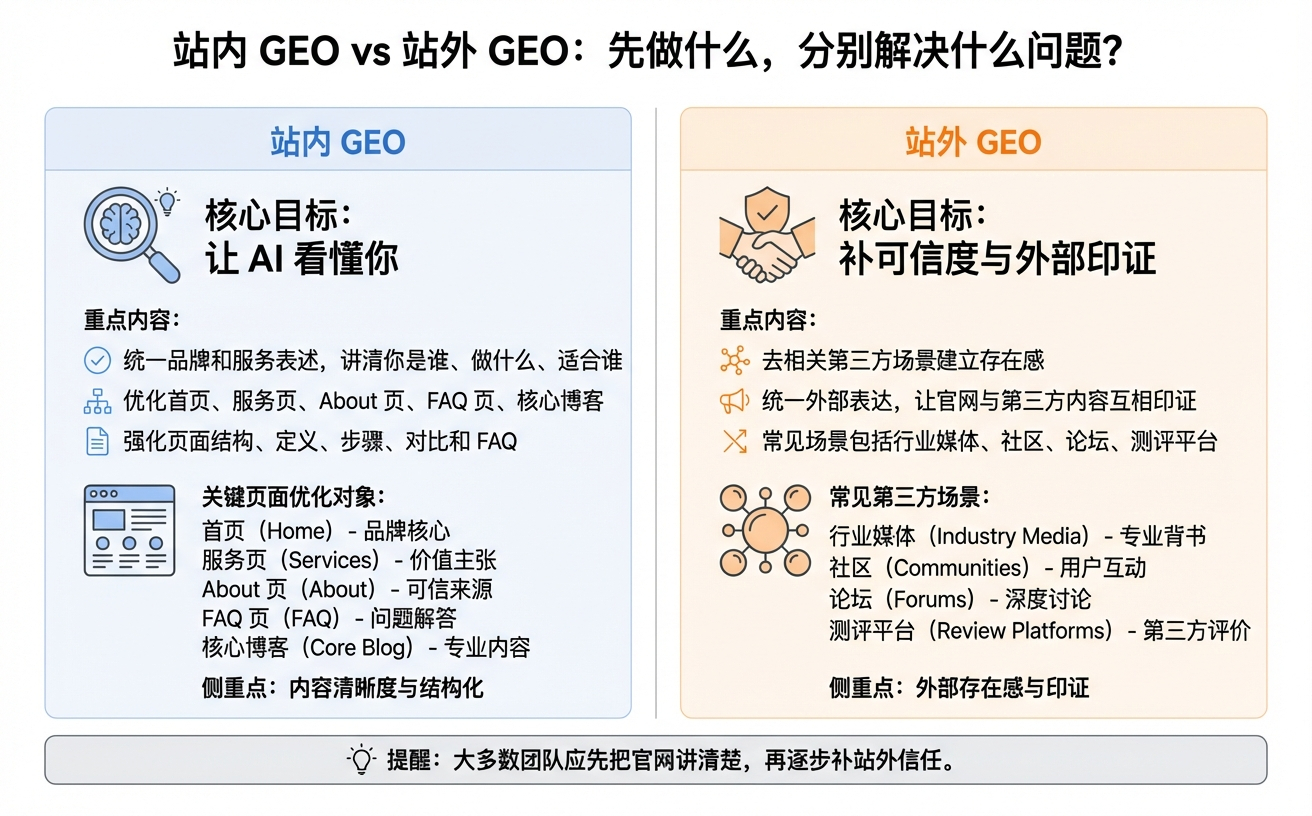
When Should Off-Site GEO Begin?
Consider adding off-site work when three signals appear:
1. Competition is increasing and competitors appear more often in AI answers.
2. The website alone is insufficient to establish trust, particularly for high-value decisions where users and systems are unlikely to rely solely on first-party claims.
3. The on-site foundation is substantially complete and further internal changes produce diminishing returns.
Common starting points for off-site GEO include:
- Industry publications
- Specialist communities
- Forums
- Q&A platforms
- Content associated with brand searches
Continue to test two things:
- Does the placement provide a credible context?
- Is the external description consistent with the website?
Off-site work becomes useful when credible context and consistent messaging begin to reinforce one another.
Seven Common GEO Mistakes for Beginners
- Publishing articles immediately and at scale: without a question inventory or baseline assessment, more content can create more drift.
- Tracking keywords but not real questions: the resulting content is often mechanical, generic and weak at supporting decisions.
- Working only on the website and ignoring external trust: in competitive categories, first-party claims alone may not establish a durable advantage.
- Using inconsistent descriptions of the brand, services and products: this common problem can be difficult to detect.
- Treating GEO as a new name for SEO: the disciplines overlap substantially, but they are not identical.
- Overestimating special technical labels: before seeking "AI-only" tactics, most teams should address crawlability, page structure and clarity.
- Stopping without monitoring: without measurement, teams cannot tell which actions contributed to a result.
A 30-Day GEO Starter Plan
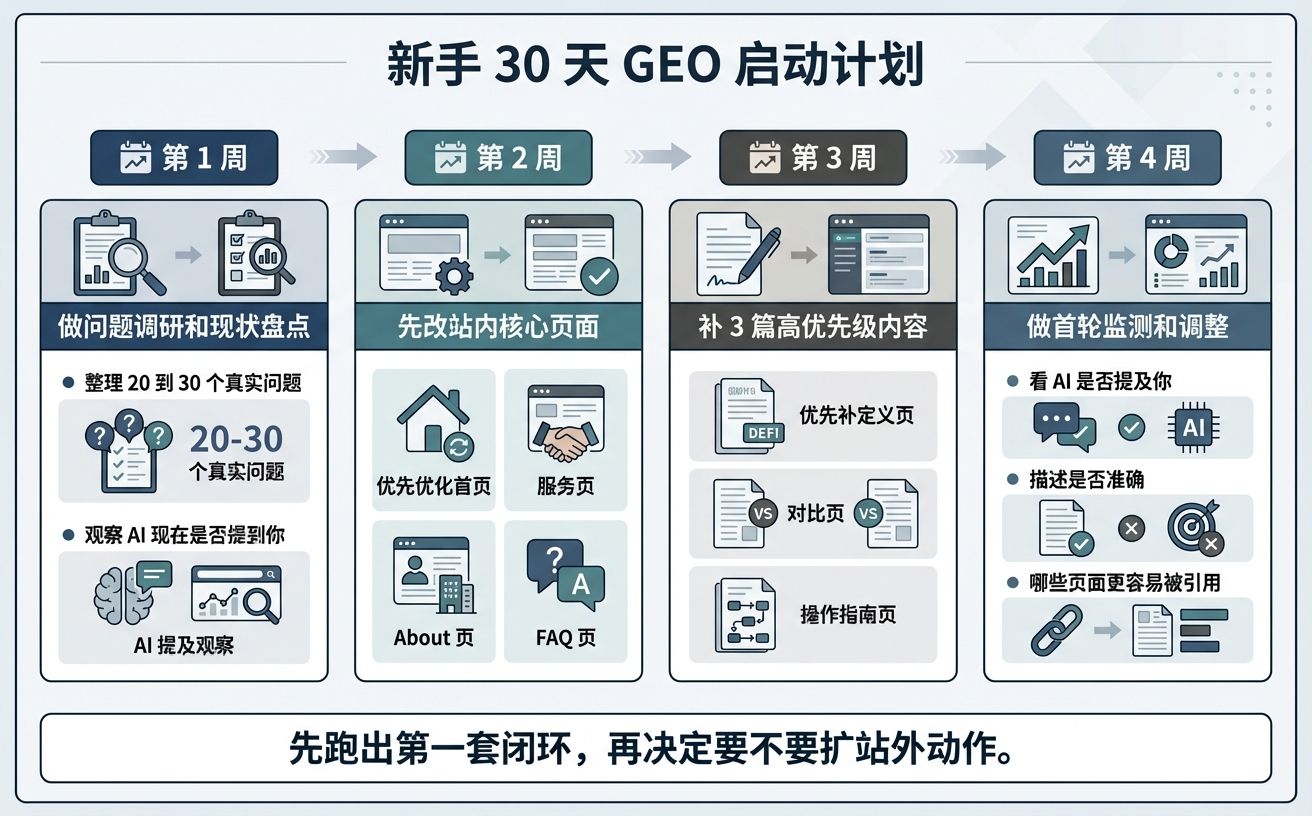
Use this schedule to run a limited first version.
Week 1: Research Questions and Establish the Baseline
List 20 to 30 genuine questions. Sort them by whether they define, compare, select or instruct. At the same time, observe whether AI systems mention the brand, how they describe it and which competitors appear.
Week 2: Improve the Core On-Site Pages
Start with the homepage, service, About and FAQ pages. Clarify the brand, services, intended audience, differentiators and supporting evidence.
Week 3: Add Three High-Priority Pages
Begin with:
- One definition page
- One comparison page
- One practical guide
Do not publish three arbitrary blog posts merely to meet a volume target.
Week 4: Run the First Review and Adjust
Review whether the brand appears, whether descriptions are more accurate and which pages are cited. Use the result to decide whether the next cycle should emphasize on-site work or external trust.
This approach avoids an unnecessarily broad launch and establishes the first complete feedback loop.
Frequently Asked Questions
Should GEO and SEO Be Done Together?
In most cases, yes. GEO does not operate independently of SEO. Crawlability, indexing, internal links, visible text and page structure still depend on a sound SEO foundation.
Does GEO Require a Major Technical Rebuild?
It depends on the site's condition, but avoid treating technical complexity as the objective. For most teams, crawlability, clear page language and a coherent content structure should come first.
Should a Team Start With Its Website or External Content?
Most teams should start with the website. If the company's own site is unclear, distributing more external content only amplifies the inconsistency.
Which Pages Should Be Optimized First?
A common order is:
- Homepage
- Service pages
- FAQ page
- Definition pages
- Comparison pages
- Practical guides
How Long Does It Take to See Early Signals?
There is no universal timeline. First review mentions and how the brand is described. Then check citations and click quality; assess business results last. GEO does not provide immediate feedback and should be assessed in stages.
Can a Small Team Run a Limited First Version?
Yes. Begin with a short cycle of question research, on-site clarity, content gap filling and initial monitoring. Then decide whether to add off-site work.
Conclusion
The differentiator in GEO is often not speed or volume, but sequence: understand how users ask questions, assess how AI systems describe the brand, clarify the website, and then add decision-support content and external trust. The result should be a repeatable capability rather than a handful of articles.
This is the focus of GlobalBrandsDigital's GEO work. We help brands connect visibility, accurate understanding and consideration. If you want to develop GEO systematically but are unsure whether to begin with the website, content or external trust, start with a review of the current position or explore our GEO services before deciding where to invest.