
On this pageTable of contents+
- The Foundation of GEO Reporting: Is the Prompt Sample Reliable?
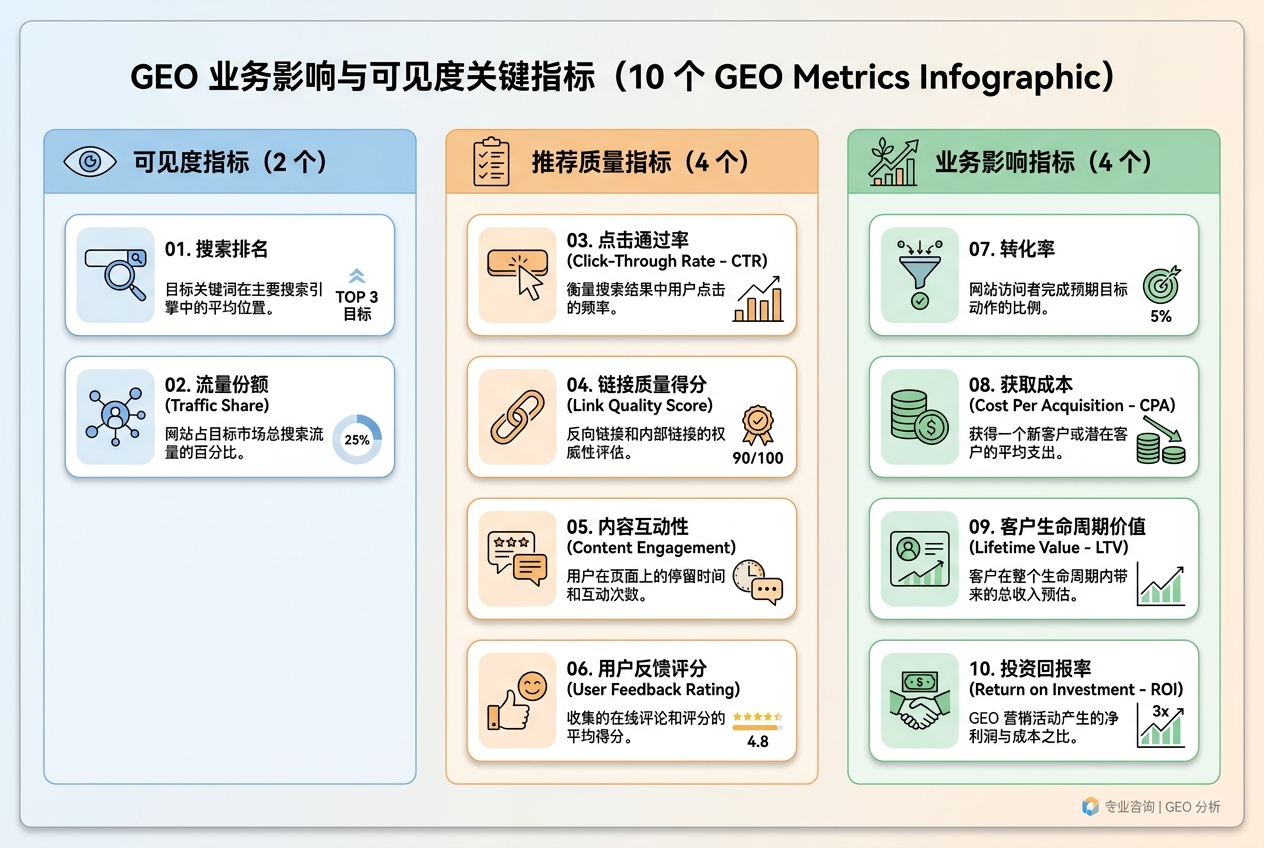
- Group One: AI Visibility Metrics
- Metric 1 | Prompt Coverage: Does the Brand Appear in AI Answers?
- Metric 2 | Source-Ecosystem Visibility: Which Third-Party Sources Does AI Trust?
- Group Two: AI Recommendation-Quality Metrics
- Metric 3 | AI Recommendation Rate: Recommended or Merely Listed?
- Metric 4 | Link Citation Rate: Does an AI Mention Include a Link?
- Metric 5 | Comparison Win Rate: How Often Does the Brand Win a Comparison?
- Metric 6 | Brand-Description Accuracy: Does AI Describe the Brand Correctly?
- Group Three: GEO Business-Impact Metrics
- Metric 7 | AI Referral Traffic and Conversions: The Observable Portion
- Metric 8 | Change in Branded Search: An Indirect Signal of AI Influence
- Metric 9 | Enquiry or Registration Source Feedback: Ask the User Directly
- Metric 10 | Estimated AI-Influenced Business Value: For Planning, Not Attribution
- What to Improve When GEO Metrics Are Low
- Conclusion
- Frequently Asked Questions
- Can AI Mention Count Be a Core GEO KPI?
- How Often Should a GEO Report Be Produced?
- Must a Company Monitor Every AI Platform?
- Can a Company Produce Its Own GEO Report?

A useful GEO report should not consist only of screenshots of AI answers, nor should it provide only an "AI visibility score."
A genuinely useful GEO report should answer three questions: Can AI systems see your brand? Why do they recommend it, or why do they not? Has being seen produced any signs of commercial value? A sound report uses ten core metrics. Two cover whether the brand appears, four examine how AI recommends it and four examine what happens afterwards. The sections below explain each one.
The Foundation of GEO Reporting: Is the Prompt Sample Reliable?
Every GEO metric is built on a sample of prompts. If a report does not disclose which prompts were monitored or why they were selected, its coverage, recommendation and comparison-win rates lack a reliable basis for interpretation.
When companies test AI search themselves, the main problem is often not an inability to ask questions, but an arbitrary sample.
Testing only a few questions that come to mind can easily distort the result. Real users do not ask only basic questions such as "What is an air purifier?" or "What is a robot vacuum?" They are more likely to ask, "Which robot vacuum is better for picking up cat hair?", "Should I use a dehumidifier or a fresh-air system in a small flat?", "Which children's desk is more durable on a limited budget?" or "Which massage-chair brand provides more reliable after-sales service for my parents?" Such questions add a real setting, budget and need, making them closer to real AI-search journeys.
A suitable prompt sample should not simply turn SEO keywords into questions. Draw it from genuine customer needs found in sales calls, enquiries and long-tail Search Console queries. Competitor comparisons, industry forums, Reddit and social posts can add further questions that arise before a purchase.
A better approach is to organize prompts by stage of the customer journey: awareness prompts ask "what" and "why"; evaluation prompts ask "how" and "how to choose"; decision prompts ask "which provider is a better fit" and "Brand A vs Brand B."
A GEO report should also present each platform separately. Google AI Overviews are closer to search. ChatGPT is more conversational and tends to recommend options. Perplexity emphasizes cited sources, and Gemini is more closely connected to Google. Combining every platform into a single "AI visibility score" can hide the real issue. If a brand remains strong in Perplexity but declines in ChatGPT, an aggregate score may conceal that signal.
Group One: AI Visibility Metrics
The first step in a GEO report is to determine whether the brand appears in AI answers.
Metric 1 | Prompt Coverage: Does the Brand Appear in AI Answers?
Prompt coverage is the most basic metric. It measures how often the brand appears across a set of important questions and answers the first question: Can AI systems see the brand?
Do not read this metric only as a total. It becomes more useful when broken down by platform, market, product line and journey stage. If coverage for a market segment remains below 20% for two consecutive months, the source argues that the issue is usually a serious gap in that segment's content assets rather than a GEO tactic; the content gap should be addressed first.
Metric 2 | Source-Ecosystem Visibility: Which Third-Party Sources Does AI Trust?
This metric identifies the third-party sites that AI systems frequently cite for relevant questions. It also checks whether those sites mention your brand.
This differs from traditional SEO. SEO asks, "Where does my page rank?" GEO must also ask, "Which sources does AI trust, and how do those sources describe my brand?"
The sources may include industry publications, review sites, ranked lists and customer-review platforms. Partner pages, LinkedIn company pages, business profiles and Reddit can also contribute. Together, these sites provide external evidence that helps AI systems interpret a brand.
If the sources that AI systems cite frequently do not mention the brand over time, comprehensive on-site content alone may not be enough to enter a recommendation set. A useful GEO report should list the ten to twenty domains most often cited in the category and note how many mention the brand. The uncovered domains then become a priority list for digital PR and link-earning work.
Group Two: AI Recommendation-Quality Metrics
Presence alone is not enough; the quality of that presence also matters.
Metric 3 | AI Recommendation Rate: Recommended or Merely Listed?
This metric shows whether AI recommends a brand or merely includes it in a list.
Being listed and being recommended do not have the same commercial value. A place in a long list may have little effect. A clear statement that the brand suits a particular company or need can matter more. For B2B service providers, SaaS companies and high-value purchases, how often AI recommends the brand is often more useful than the number of mentions.
Recommendation rate also involves judgement, so the scoring criteria must be explicit. Each prompt should be sampled at least five to seven times and reviewers should calibrate their decisions. Reporting a number from a single run is not reliable.
Metric 4 | Link Citation Rate: Does an AI Mention Include a Link?
Link citation rate measures whether a brand mention includes a link to the official site, service page, case study or content page.
If the brand is mentioned frequently without a link, its visibility may remain at the level of general awareness. Users must either search for the brand again or may leave the journey entirely.
When link citation is low, check whether the page is easy to cite: whether headings are clear, key answers stand on their own, FAQs are complete, structured data is appropriate and internal links help systems understand the relationship between topics.
Metric 5 | Comparison Win Rate: How Often Does the Brand Win a Comparison?
Comparison win rate is the proportion of comparative prompts, such as "A vs B" or "best stainless-steel manufacturer," in which the AI system selects the brand as the more suitable option.
These prompts matter because the user is close to a decision. The answer may directly influence which provider they contact, compare or trust.
If a brand repeatedly loses to the same competitors, the prompt may not be the problem. More common causes include unclear differentiation, insufficient third-party reviews, weak case-study evidence or inconsistent positioning across external sources.
In the source team's experience, a comparison win rate that remains below 30% is often a sign of positioning or third-party review coverage gaps rather than a GEO tactic. In that situation, it advises pausing additional GEO investment, improving coverage on G2, Capterra and relevant industry lists, and then returning to GEO.
Metric 6 | Brand-Description Accuracy: Does AI Describe the Brand Correctly?
Brand-description accuracy measures whether AI systems correctly describe the business, service scope, target customers, advantages and suitable use cases.
This metric is easy to overlook but critical. An incorrect description can sometimes be more damaging than no mention at all.
A supplier of heavy-duty warehouse racking, for example, might be described as a domestic storage brand; a team serving export-focused B2B companies might be described as a local-services marketing agency. This exposure has little value and may mislead potential customers.
A GEO report therefore needs to examine semantic SEO. AI systems do not use page keywords alone. They connect entities, assess topic coverage and compare external sources across platforms to interpret who a brand is and what it does well. In practice, describe the company's position, core products, category and intended customers consistently. Keep those facts aligned across Organization markup, legitimate Wikipedia or Wikidata pages, LinkedIn and media coverage. The source treats this as work that continues for one or two quarters, not as a one-off task.
Group Three: GEO Business-Impact Metrics
The effect of AI search cannot always be tracked directly. A user may see a brand in an AI answer without clicking, search for it later, visit the site directly or submit an enquiry several days afterwards.
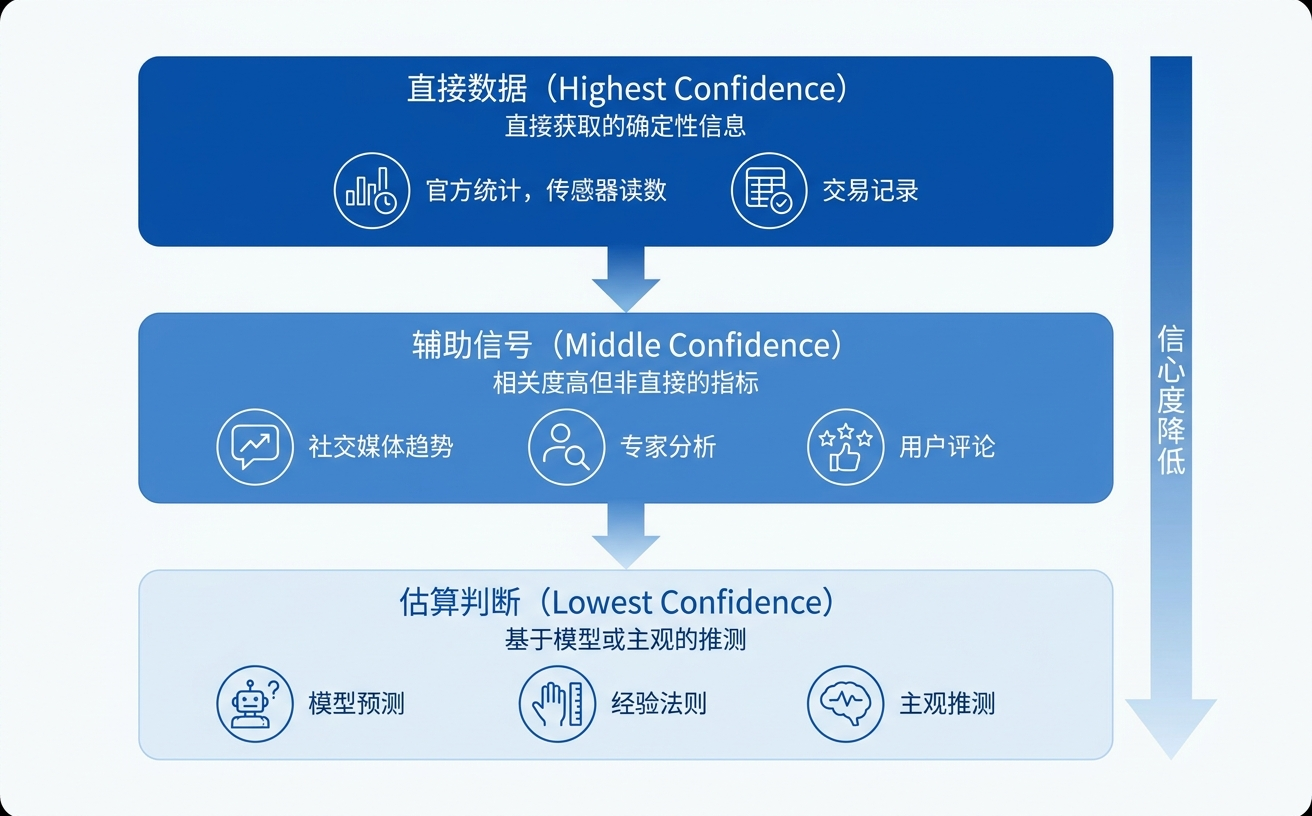
A GEO report should therefore not rely only on AI referral traffic. The next four metrics are arranged from higher to lower confidence and address the same question from different angles: Has this visibility contributed to business outcomes?
Metric 7 | AI Referral Traffic and Conversions: The Observable Portion
This is the highest-confidence data and normally comes from GA4 or another analytics platform. Review visits from AI platforms and how their landing pages perform. Then compare how often those visitors convert and whether they assist later conversions.
The report should create a dedicated custom channel group for AI platforms and break the data down by platform, landing page and conversion event. Otherwise, sources such as ChatGPT, Perplexity, Gemini and Copilot may be mixed into Referral or Direct, making the result harder to interpret.
This data is still incomplete. Visits from in-app clicks, mobile transitions and copied URLs can be classified as Direct rather than Referral. AI referral traffic therefore represents only the observable portion, not the full value of GEO.
Metric 8 | Change in Branded Search: An Indirect Signal of AI Influence
Changes in branded search are supporting signals.
If someone first sees a brand in an AI answer and later searches for it on Google, that visit is normally attributed to organic search rather than an AI source.
The report should monitor branded-query impressions, clicks, search volume and related brand queries. When branded search and Direct traffic change alongside AI visibility, the pattern warrants further analysis.
Growth in branded search cannot, however, be attributed directly to GEO. Advertising, public relations, events, product launches and social activity can all affect branded demand, and the report should disclose these confounding factors.
Metric 9 | Enquiry or Registration Source Feedback: Ask the User Directly
Source feedback is particularly useful for B2B companies, service businesses and high-value purchases.
Ask one simple question when someone requests a demo, sends an enquiry, registers or speaks with sales:
Before today, had you seen us in an AI search tool or assistant such as ChatGPT, Google AI Overviews, Perplexity, Gemini or Copilot?
The options need only be Yes, No and Unsure.
This helps identify people who were influenced by AI without arriving through an AI link. If leads attributed to branded search or Direct repeatedly say they encountered the brand in an AI tool, conventional attribution may be understating AI's influence.
Metric 10 | Estimated AI-Influenced Business Value: For Planning, Not Attribution
An estimate of AI-influenced business value should be used only for planning, not as strict attribution.
Teams can combine changes in branded search and Direct traffic with form feedback, AI referral traffic and historical conversion rates to estimate a range of leads or pipeline value that AI search may have influenced.
The report should meet three conditions: present a range, state every assumption clearly and place the estimate below direct data and supporting signals.
If an estimate is presented as definitive attribution, the credibility of the entire report declines. A professional report separates direct data, supporting signals and estimates so that the business can see both the opportunity and its limits.
What to Improve When GEO Metrics Are Low
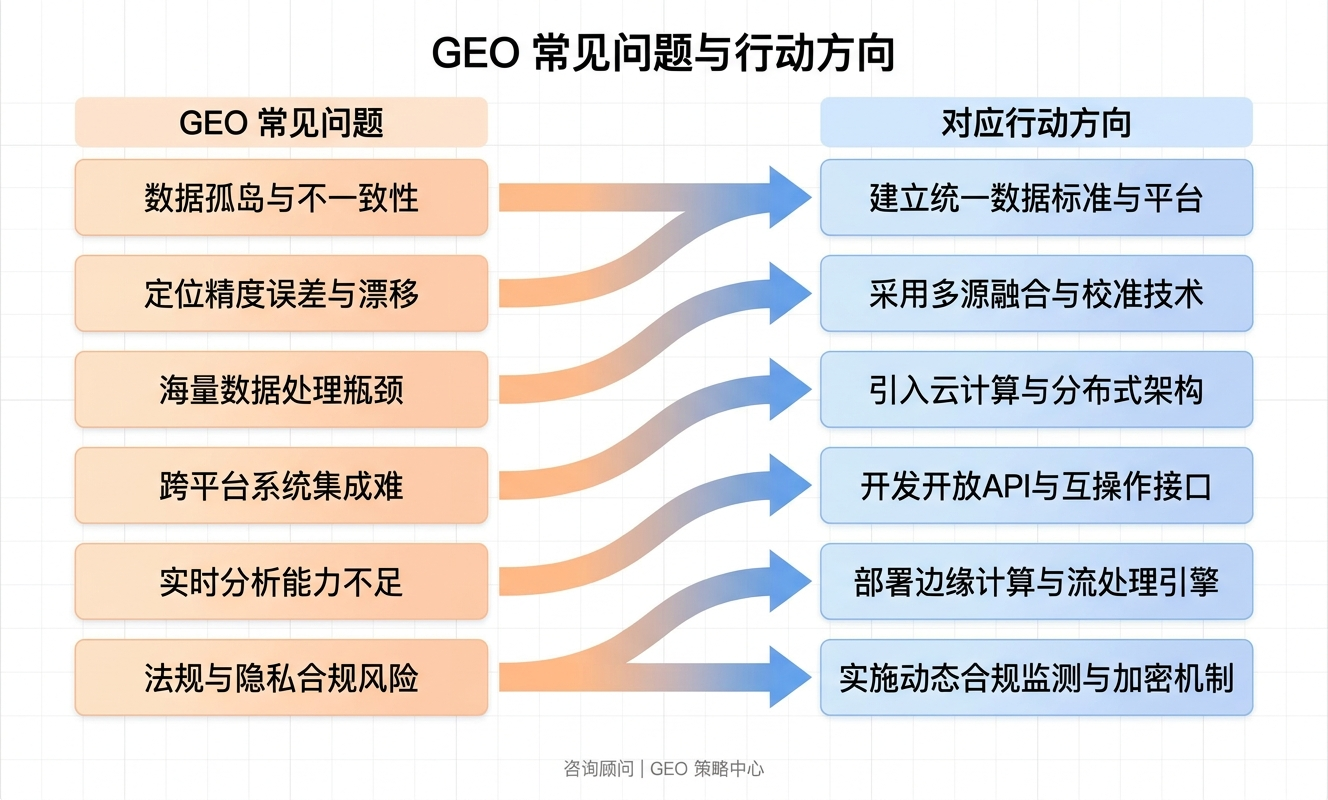
A good GEO report should guide action, not merely present numbers.
When prompt coverage is low, expand the relevant topic content, service pages and external sources so that AI systems have more evidence with which to understand the brand.
When AI rarely recommends the brand, do not simply publish more generic content. Explain how the offer differs and whom it suits. Add case-study proof and genuine support from third parties.
When link citation rate is low, review the page structure, standalone answer passages, FAQs, structured data, internal links and the quality of citeable pages. In the source team's experience, when link citation remains below 20%, reviewing the structure of existing high-value pages first - including heading hierarchy, whether key facts stand alone and whether structured data is complete - can often raise the rate above 35%. Treat these thresholds as project experience rather than universal benchmarks.
When comparison win rate is low, return to product positioning and third-party reviews. Improve G2, Capterra and relevant industry-list coverage before resuming GEO work. Sometimes the right decision is to pause.
When AI describes the brand inaccurately, keep its core facts consistent across the official site, social profiles, third-party directories and other external sources.
If AI referral traffic grows but conversions remain low, prompt intent and the landing page may be mismatched. Improve the page rather than pursuing exposure alone.
Tools tell you what happened; a report should explain why it happened and what to do first.
Conclusion
A suitable GEO report should at minimum disclose the platforms monitored, the prompt sample, the competitors compared, the questions on which the brand appeared or did not appear, and how AI systems described the brand. It should also diagnose likely causes and recommend the next action.
A report that contains only screenshots, mention counts and a total score offers little help. Without a documented sample, a diagnosis and a next step, it cannot guide meaningful GEO work.
In GlobalBrandsDigital's Google GEO service, we build prompts around the company's industry, markets, product lines and competitors. We report each platform separately and assess whether AI can see the brand and recommend it accurately. We also review semantic SEO, entity consistency, third-party trust and signs of commercial value.
The result is not a handful of screenshots but a clearer sequence of actions: what content to add, which structures to repair, which external signals to develop and which metrics require continued monitoring.
If you are assessing a GEO provider, or have received a GEO report but are unsure how to interpret it, begin with a report review. Share a redacted copy and we can help identify which metrics are useful, which figures require caution and where the next stage of GEO work should begin.
Frequently Asked Questions
Can AI Mention Count Be a Core GEO KPI?
Do not use it as the main KPI. A mention count cannot distinguish a clear recommendation from a simple listing. It also hides incorrect descriptions and irrelevant exposure. Use it as supporting evidence, not as a standalone measure of GEO performance.
How Often Should a GEO Report Be Produced?
Review how often the brand appears and how AI recommends it each month. Review commercial results quarterly because branded searches, enquiry responses and conversions need more time to show a trend.
Must a Company Monitor Every AI Platform?
No. A more practical approach is to begin with the two or three platforms most relevant to the target customer. Google AI Overviews, ChatGPT, Perplexity and Gemini may be priorities for many international businesses, but the choice should still reflect the industry and customer behaviour.
Can a Company Produce Its Own GEO Report?
It can run an initial test, but decisions should not rely on random questions. AI answers can vary with prompt wording, language, location, time and context. The more important parts of a professional report are sample design, a fixed cadence, consistent scoring and diagnosis.