
On this pageTable of contents+
- 1. Three Roles of Structured Data in AI Search
- 2. Structured Data Is Not a Cure-All
- 3. Which Schema Types Support GEO?
- P0: Foundations for Every GEO Site
- P1: Add Types According to the Business Case
- P2 and Types Not Worth Prioritizing
- 4. Three Engineering Priorities
- 1. Property Completeness Matters More Than the Number of Types
- 2. Use @id to Connect Entities Into a Graph
- 3. Do Not Rely on Client-Side JavaScript for Core-Page Structured Data
- 5. Validation and Common Risks
- Conclusion

For most sites working on generative engine optimization, the source recommends the following priority order:
- Organization for the brand entity, WebSite, WebPage, Article or BlogPosting, and Person are P0 types that every site should have.
- FAQPage, Product with Offer, HowTo, and Service or SoftwareApplication are P1 types to use where the business case requires them.
- BreadcrumbList and Review or AggregateRating are P2 enhancements.
The source groups Book Actions, Course Info, Claim Review, Estimated Salary, Learning Video, Special Announcement, Vehicle Listing and Sitelinks Search Box as types not to prioritize. Google's official timeline is more specific: six of those types were phased out of Search beginning in June 2025, Sitelinks Search Box had already been removed in November 2024, and Book Actions remains documented for eligible book providers. Check the current documentation for each type before removing valid markup.
Below, we explain why each item matters, how to add it and what to avoid.
1. Three Roles of Structured Data in AI Search
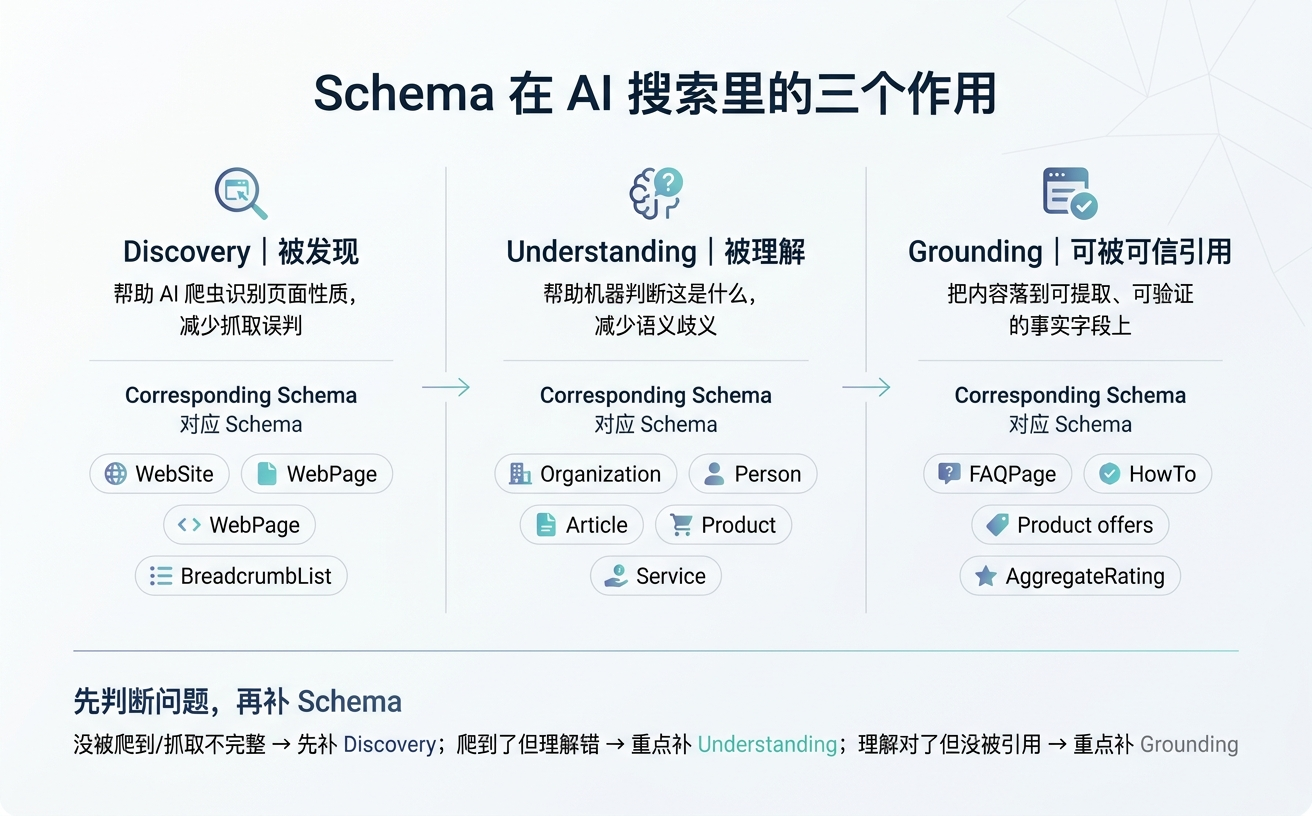
Structured data can serve three roles in generative search, each associated with a group of types.
Discovery: help AI crawlers recognize the nature of a page during retrieval and reduce misclassification. WebSite, WebPage and BreadcrumbList belong to this layer.
Understanding: remove ambiguity by telling a system, for example, "This is a product, not a review," "This is the author, not a quoted person," and "This is a service, not a blog post." Organization, Person, Article, Product and Service belong to this layer. The source treats this as structured data's most distinctive contribution because semantic HTML alone does not express all of these relationships.
Grounding: give an AI system extractable, verifiable fact fields when it assembles an answer. FAQPage question-and-answer pairs, Product price and aggregateRating fields, and HowTo steps provide structured passages that may be reused.
Compare these roles with the problem on your own site: was the page not crawled, was it crawled but misunderstood, or was it understood but not cited? Each condition calls for a different structured-data response.
If the page was not crawled or was only partly crawled, begin with the Discovery layer. Check WebSite, WebPage and BreadcrumbList, and confirm that sitemap.xml and robots.txt permit the intended crawlers.
If the page was crawled but the brand or product was described inaccurately, focus on the Understanding layer: Organization sameAs links and the central Product or Service properties.
If the brand is described accurately but is not selected in comparison or recommendation answers, review the Grounding layer. Add valid FAQPage or HowTo markup and complete relevant Product fields such as aggregateRating and offers. Also assess whether the visible content itself is strong enough to cite.
2. Structured Data Is Not a Cure-All
The source notes that Reddit has relatively little structured-data markup yet is widely cited by Google AI Overviews and Perplexity, and cites a reported 4.5-fold increase in AI Overview citations during one quarter of 2025. It also refers to a late-2024 Search Atlas analysis that did not observe a stable relationship between structured-data coverage and AI citation rate. These observations are contextual, not proof that markup has no value.
Conversely, the source cites remarks by Microsoft's Fabrice Canel at SMX Munich in March 2025 that Bing's large language models use structured data to understand pages, and an April 2025 statement from Google's search team about the value of structured data in search results.
Taken together, these observations suggest that systems favor expert content that draws on first-hand work, provides specific facts and has support from third parties. Structured data cannot rescue a thin page. When a useful page is near the selection threshold, accurate markup can make it easier to interpret and reuse as a factual source. It is an aid, not the deciding factor.
3. Which Schema Types Support GEO?
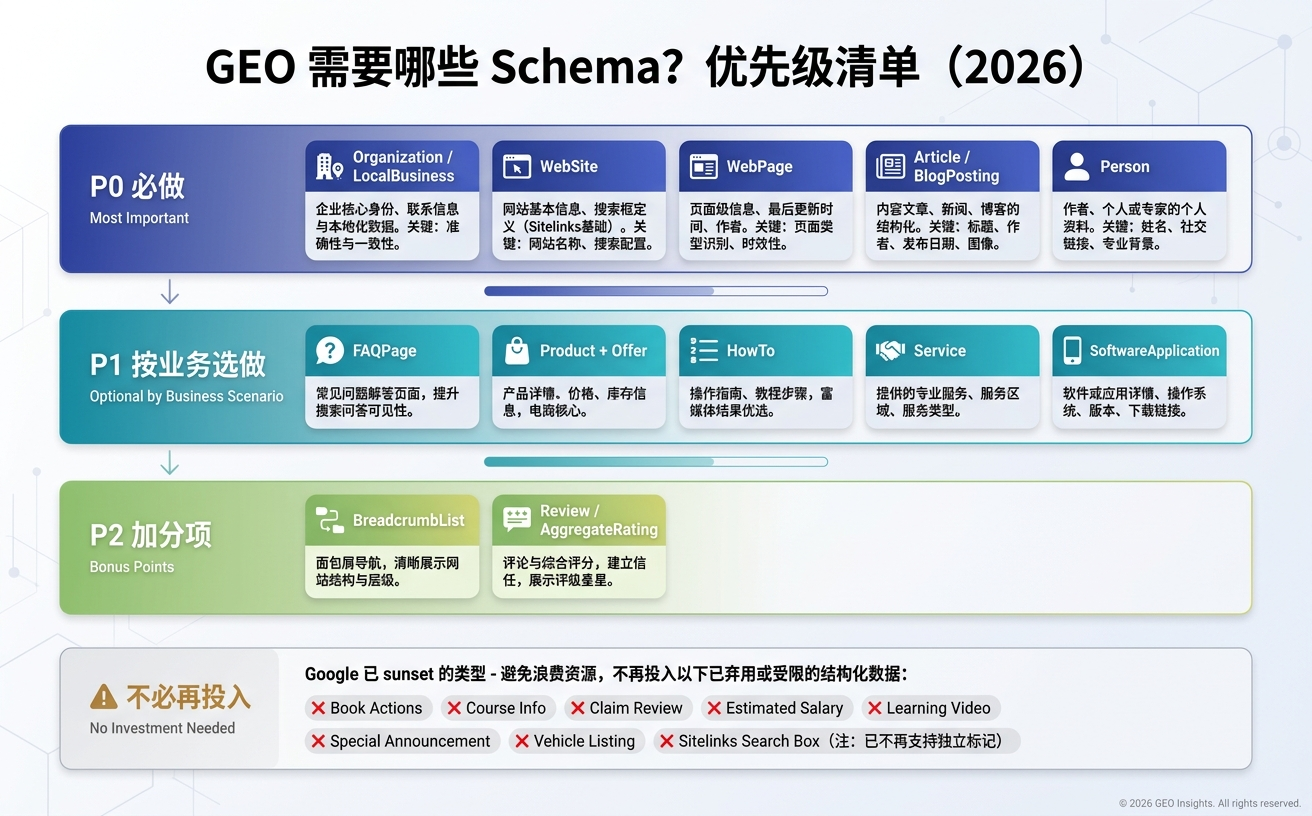
P0: Foundations for Every GEO Site
Use Organization, or LocalBusiness where appropriate, to identify the brand and start the site's structured-data system. Do not ask merely whether the type is present. Check whether sameAs connects the site to genuine profiles such as Wikidata, LinkedIn and official social accounts. Include Wikipedia only when a legitimate page already exists; do not create or imply one solely for markup. A minimal example follows:
JSON
{
"@context": "https://schema.org",
"@type": "Organization",
"@id": "https://yourdomain.com/#organization",
"name": "Your Brand Name",
"url": "https://yourdomain.com",
"logo": "https://yourdomain.com/logo.png",
"sameAs": [
"https://www.linkedin.com/company/yourbrand",
"https://www.wikidata.org/wiki/Qxxxxx",
"https://en.wikipedia.org/wiki/Your_Brand"
]
}
Use a site-wide unique URI for @id. Other structured-data objects can then refer to this entity.
WebSite and WebPage define the semantic boundary of the site and each individual page. Place WebSite on the homepage and WebPage on each specific page, connecting them with isPartOf.
Article or BlogPosting describes content authorship. Include author, using a Person object, plus datePublished and dateModified when those values are accurate and visible or otherwise supported by the page. The source recommends a real author rather than using the brand name as the author, with a reference to the P0 Person entity. In this example, author and publisher both use @id to refer to entities defined elsewhere:
JSON
{
"@context": "https://schema.org",
"@type": "Article",
"@id": "https://yourdomain.com/blog/geo-schema-guide/#article",
"headline": "Which Schema Types Support GEO? A Priority List",
"datePublished": "2026-04-17",
"dateModified": "2026-04-17",
"author": {
"@type": "Person",
"@id": "https://yourdomain.com/team/author-name/#person"
},
"publisher": {
"@id": "https://yourdomain.com/#organization"
},
"mainEntityOfPage": {
"@id": "https://yourdomain.com/blog/geo-schema-guide/#webpage"
}
}
The publisher object does not repeat the Organization details; it refers to the existing @id. Define the Organization once and refer back to it elsewhere. This connects the records into a graph instead of creating multiple, potentially conflicting copies.
Person can express an author's expertise and authority. Use it on genuine author, team and About pages. Useful properties include jobTitle, worksFor pointing to the Organization @id, and sameAs links to the author's real LinkedIn or academic profile. For example:
JSON
{
"@context": "https://schema.org",
"@type": "Person",
"@id": "https://yourdomain.com/team/author-name/#person",
"name": "Author Name",
"jobTitle": "Senior GEO Strategist",
"worksFor": {
"@id": "https://yourdomain.com/#organization"
},
"sameAs": [
"https://www.linkedin.com/in/authorname",
"https://scholar.google.com/citations?user=xxx"
]
}
Consider the Organization, Article and Person objects together. An Article is written by a Person and published by an Organization; the Person works for that Organization. These relationships use @id references rather than repeating every field. A system that retrieves one object can follow the references to the others, producing the beginnings of an entity graph. The main value of the P0 layer lies not only in each object's fields, but in the accurate connections among them.
P1: Add Types According to the Business Case
FAQPage fits a page with a genuine, visible question-and-answer structure. Google narrowed FAQ rich results in August 2023 and stopped showing the feature in May 2026. That search-result change did not remove FAQPage from the Schema.org vocabulary. Use the type only to describe visible FAQs accurately, not as a promise of an AI citation or a Google rich result.
Product with Offer and AggregateRating suits commerce and some product-led software pages when the visible content and underlying data support the fields. Beyond name and price, relevant properties may include brand, sku, image, offers.availability and offers.priceCurrency. Add aggregateRating.ratingValue and aggregateRating.reviewCount only when genuine reviews support them. More complete product details can make comparison easier, but no field guarantees that AI will recommend the product.
HowTo can describe genuine step-by-step instructions. Google has narrowed or retired some HowTo search-result treatments, but the type can still express the structure of an actual instructional page. Do not force a conventional article into HowTo markup.
Service and SoftwareApplication correspond to service businesses and software products. Product defaults to a product entity and includes properties such as sku, gtin and mpn that may not suit a service. Service offers fields such as serviceType, areaServed, provider and hasOfferCatalog; SoftwareApplication includes applicationCategory, operatingSystem and offers. Choose the type that accurately describes the visible offer so that systems do not place it in the wrong category.
P2 and Types Not Worth Prioritizing
BreadcrumbList can support hierarchy. Review and AggregateRating can add genuine social proof. They are lower priorities than the first two groups and should be used only when the page supports them.
The source advises against investing in two groups of markup.
The first contains search-result features that the source groups together. Google phased out Course Info, Claim Review, Estimated Salary, Learning Video, Special Announcement and Vehicle Listing beginning in June 2025. Sitelinks Search Box was removed in November 2024. Book Actions remains documented for participating book providers, so treat it according to the current use case rather than the source's blanket list.
The second is markup for content that users cannot see, such as a rating, FAQ item or author absent from the page. Both schema.org guidance and Google's structured-data policies require markup to represent the page accurately; misleading markup can make a page ineligible for rich results or lead to a manual action.
4. Three Engineering Priorities
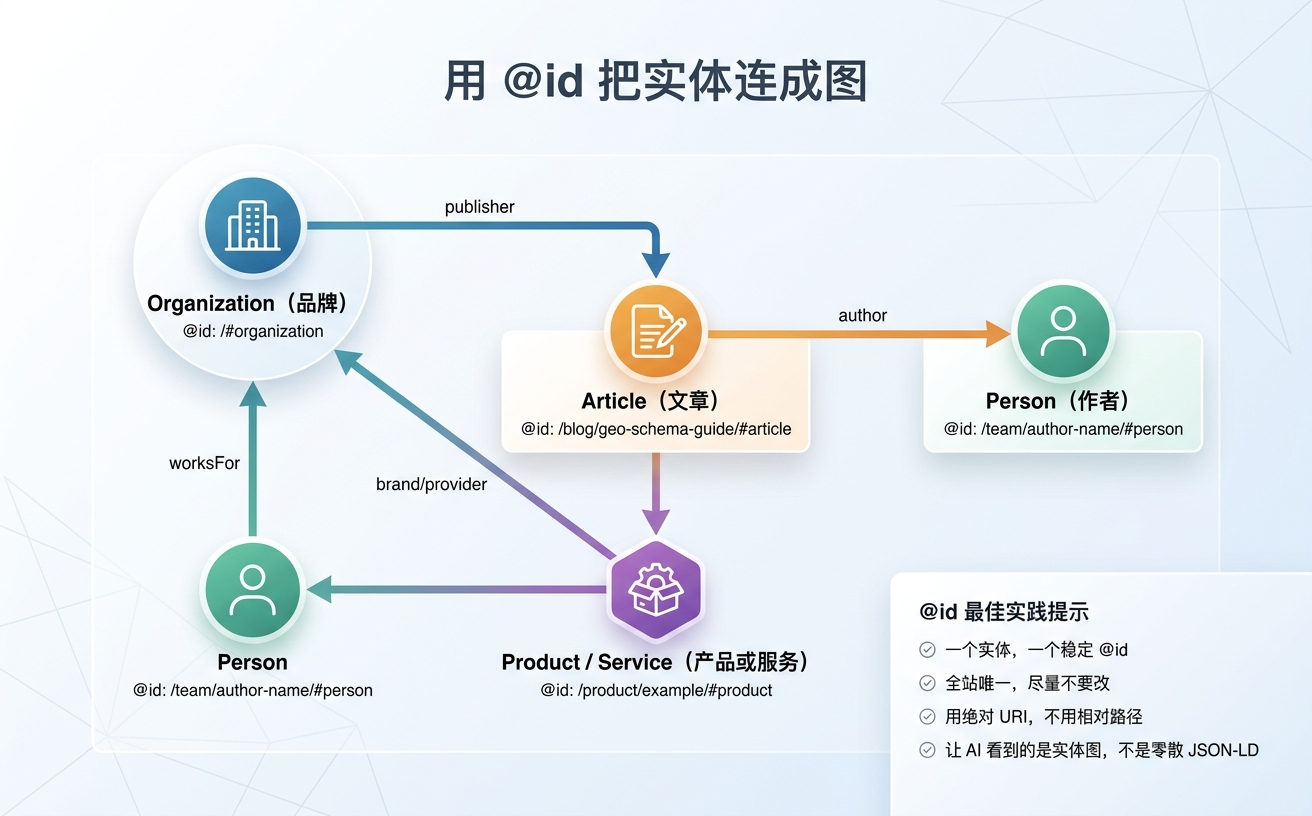
1. Property Completeness Matters More Than the Number of Types
The source states that schema.org defines 806 types and more than 1,400 properties. Whatever the current totals, the practical differentiator is the completeness and accuracy of important properties, not the number of types installed. A Product object with only name and price may be less useful than one carefully completed object, even if ten other types are also present.
A practical approach is to create a required-and-recommended property checklist for every core type and use it as the handoff standard between content and development teams instead of accepting a CMS plugin's defaults. For Product, a useful checklist might look like this:
- This publishing standard requires name, image, description, brand and sku. Point brand to the Organization @id. Include price, priceCurrency, availability and url inside offers.
- Recommended where genuine data exists: aggregateRating with ratingValue and reviewCount, one to three real reviews, gtin or mpn for a physical product, category, and category-relevant fields such as material, color or size.
- Use when relevant: hasMerchantReturnPolicy and shippingDetails for merchant-listing use cases, plus isRelatedTo when a product relationship is meaningful.
Create a similar checklist for every core type and make it part of the pre-publication review. One accurate, complete object is more valuable than many incomplete ones.
2. Use @id to Connect Entities Into a Graph
Many teams add an isolated JSON-LD block to each page without references between them. A system then sees disconnected nodes.
Instead, assign one site-wide unique URI to each brand, author and product, and use it as @id. Refer to those IDs from Article.author, Article.publisher and Product.brand. The result is a graph that systems can navigate instead of isolated labels. This helps systems identify the same brand consistently.
Follow several simple @id conventions. Use an absolute URI rather than a relative path. A common format is https://yourdomain.com/path/#type. The fragment can name the type, for example #organization, #person, #article or #product. Give each item one stable, unique ID across the site. Use one Organization ID for the brand and one Person ID for each author. Once assigned, avoid changing an @id without a migration plan because a new identifier may describe a different item.
3. Do Not Rely on Client-Side JavaScript for Core-Page Structured Data
The public information cited by the source suggests that some AI crawlers, including ChatGPT-User in some contexts, may favor static HTML. JSON-LD inserted only by client-side JavaScript may not always be processed. Google's Rich Results Test can render JavaScript, but other generative-search retrieval pipelines may not have equivalent rendering support.
Render structured data for core pages on the server or include it directly in the generated HTML instead of relying solely on client-side injection. WordPress, Shopify and similar systems often output plugin-generated JSON-LD in the server response. Single-page applications built with React or Vue require closer review: confirm that structured data is included through server-side rendering or static generation rather than appearing only after client JavaScript runs.
5. Validation and Common Risks
Validate structured data at different stages and use each tool for its intended purpose.
Before launch, use Google's Rich Results Test at search.google.com/test/rich-results. Submit the URL or a JSON-LD snippet to see whether Google can parse the markup and whether required fields or formats are invalid. Errors must be resolved; warnings should be reviewed in context. The tool covers rich-result types supported by Google, not every schema.org type.
Also before launch, use Schema.org Validator at validator.schema.org. It checks vocabulary use across schema.org types and properties, including types outside Google's rich-result support. Use the tools together: Rich Results Test assesses eligibility for supported Google treatments; Schema.org Validator assesses conformance with the vocabulary. Resolve substantive issues before publishing.
After launch, monitor the relevant rich-result reports in Google Search Console. Available reports vary by the markup Google currently supports and detects. Review valid items, warnings and errors after new pages or template changes; a sudden rise in errors can indicate a template regression that needs prompt investigation.
After launch, perform spot checks in the AI products relevant to the business. Validation tools can confirm syntax and eligibility, but not whether a particular AI answer used the markup. Test representative questions and record whether names, authors and product details are correct. Agreement does not by itself prove that structured data caused the result; disagreement can indicate a wider content, retrieval or entity-consistency issue.
Three risks deserve attention.
- First, missing required fields can make an item ineligible for a Google rich result. This is why errors in Rich Results Test need to be resolved.
- Second, false ratings, prices or authors that conflict with the visible page can violate Google's structured-data policies, causing a manual action or loss of rich-result eligibility. Recovery can require a formal reconsideration process.
- Third, publishing LLM-generated markup without review creates a high risk of invalid, hallucinated or non-compliant fields. The source cites a 2025 Semantic Web Journal study by Dang and colleagues that reported problems in roughly 40% to 50% of unreviewed LLM-generated schema. Treat that figure as study-specific; AI tools can accelerate drafting but cannot replace human verification of every field.
Conclusion
Structured data alone does not produce AI citations, but accurate markup can make other GEO work easier to interpret. Complete the P0 foundation, connect stable @id references and fill the important properties accurately; only then does the priority list become useful.
If you are unsure whether structured data is the current bottleneck, begin by identifying the actual failure: the page is not being retrieved, the brand is being misunderstood, or the content is understood but not cited. GlobalBrandsDigital's GEO service can then help determine whether structured data deserves investment now or whether another constraint should come first.