
On this pageTable of contents+
- 1. Why Hire a Google SEO Specialist?
- 2. Why Are Google SEO Specialists Hard to Hire?
- The domestic talent market
- The domestic business environment
- 3. How Should You Hire?
- Hiring priorities
- Hiring an SEO specialist
- For Recent Graduates or Applicants Without Experience
- What If You Cannot Hire an SEO Specialist?
- Final Thoughts


I finally finished the SEO hiring article that I promised last month.
If you are struggling to judge an SEO operator's ability, or if you are preparing to interview for a Google SEO role and do not know what to expect, these experiences may give you a useful starting point.
1. Why Hire a Google SEO Specialist?
When this article was written in 2022, the author saw China's cross-border ecommerce market moving from broad general stores toward more focused vertical sites.
For those independent vertical sites, two of the most important Google acquisition channels were Google Ads and Google SEO.


These were recruitment notices shared in the author's professional group.
The author treats paid and organic acquisition as complementary and says that SEO could reach about two-thirds of users without charging for each click. The article provides no measurement for the two-thirds figure, so do not use it as a current market-share estimate. Organic traffic is not cost-free either: it still requires research, content, engineering, links, tools and sustained work. Google also states that advertising spend does not affect organic ranking.
What does that mean in practice?
The author's argument was that advertising could become more expensive, so a brand that invests in organic visibility early may later earn visits that competitors must continue buying. The article uses a hypothetical example of traffic that might cost another business US$100,000 to purchase. That amount is not a forecast, and SEO results depend on the site, market and execution, but the channel can support durable discovery and brand recognition.
That reasoning was leading more brands to recruit people who understood Google traffic, especially SEO.
The author cited the salary report referenced in the original Chinese article as another sign of demand. It is a 2022 Chinese-market reference, not a current global salary benchmark.

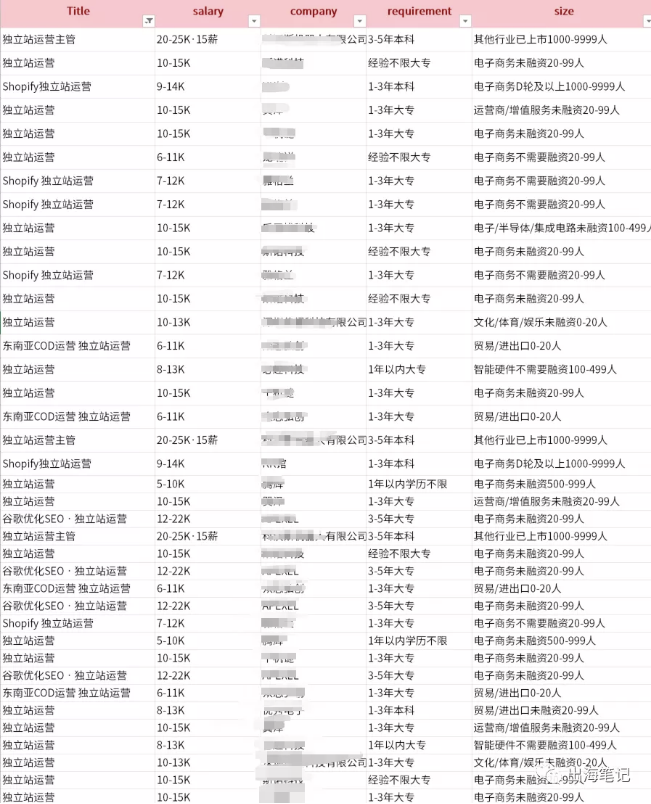
The author reads these screenshots as evidence that independent-site operators earned roughly 10% more than Amazon operators, and that Google SEO roles demanded more. Treat that comparison only as a reading of a dated snapshot; employers should use current, role-specific market data.
2. Why Are Google SEO Specialists Hard to Hire?
To answer that question, the author reviews who was available in China and how Chinese businesses were changing at the time.
The domestic talent market
Google SEO was a relatively small profession in China. Leaving aside the reasons for Google's departure from the mainland search market, the author focuses here on how the work develops.
Legitimate SEO is often slow. The original article attributes a fixed three-to-six-month delay to a Google "sandbox," but Google does not publish that as a universal rule. Its current guidance says that changes may take anywhere from hours to several months to appear, and that no improvement is guaranteed.
The early months can also contain the greatest amount of foundational work. When effort and visible results seem out of balance, teams are more likely to abandon the program before it has had a fair evaluation period.
As a result, relatively few candidates had experienced a complete strategy, implementation and measurement cycle.
The author also observed that some of the strongest practitioners left employment to build their own businesses.
Together, those conditions made experienced candidates scarce in the author's market.
The domestic business environment

In the period before publication, external market changes and account suspensions affected some advertisers and Amazon sellers, pushing them to look for other sources of traffic.
The author also saw merchants moving from general stores to focused sites and believed user experience was one reason. That is a market observation, not a published Google or Facebook policy against every general store. What matters operationally is whether a site offers a coherent product, useful experience and compliant implementation.
Demand for Google SEO rose faster than the available pool of experienced people, creating the hiring difficulty described above.
Even so, suitable people existed. The practical task was to become better at recognizing evidence of capability.
3. How Should You Hire?

"Google SEO operators are extremely difficult to hire. Even a very high salary has not produced a satisfactory candidate."
That pressure was real in the author's environment, and some teams also faced pressure from investors. Urgency, however, should not replace a defined role and a defensible selection process.
If a company starts without the right person or a clear direction, it can end just as blindly as it began.
So what should the company do?
Hiring priorities
Hiring an SEO lead

In the author's experience, this was one of the hardest roles to fill in cross-border operations.
As an enterprise consultant, the author sometimes helped client companies evaluate SEO candidates. Among those assignments, hiring an SEO lead was consistently the most difficult.
Some companies therefore used executive search firms. The author recalls salary discussions ranging from RMB 30,000 to RMB 100,000; that is historical anecdotal context, not a present-day compensation recommendation.
How, then, should an employer decide whether a candidate fits the SEO-lead role?
Common questions included:
- How long have you worked in SEO?
- What case studies can you share?
- What do you think about the product we are working on?
- Do you have a TEM-8 English certificate?
- Can you handle technical work?
- Why did you leave your previous employer?
And so on.
Do these look familiar?
They are not useless, but asked without a scoring rubric in a first interview, they reveal much less than many employers expect.
Question 1: How Long Have You Worked in SEO?

The purpose of this question is to infer experience from years in the field.
That may be informative in some industries, but years alone are a weak measure of SEO capability.
A long tenure does not prove that someone can respond to current search changes. A shorter tenure does not rule out strategic thinking.
To evaluate experience, ask the candidate to explain a brand-oriented SEO approach and show how the parts of an SEO system fit together.
A rehearsed answer is possible, so follow up with a work sample: ask what evidence changed the decision, what tradeoffs were rejected and how the result was checked. Score the content of the answer rather than confidence, accent or presentation style.
If the reasoning is strong but mostly theoretical, that is not automatically disqualifying. A scoped exercise, references and an appropriate level of responsibility can show whether the candidate is ready to operate.
When the hiring team lacks experience, use a structured live interview with the same core questions and rubric for comparable candidates. It can be conducted onsite or remotely; the format itself should not become an unrelated barrier.
If the company finds a suitable SEO lead, discuss the organization's values, decision rights and the autonomy attached to the role. Those conditions can matter greatly to an in-house practitioner.
Question 2: What Case Studies Can You Share?

This is a reasonable way to learn about a candidate's work, provided the employer asks for evidence the candidate is allowed to share.
If a candidate says that a nondisclosure agreement prevents detailed disclosure, do not treat that as suspicious. Confidentiality is common.
Respect the restriction. Ask for the high-level problem, the candidate's role, the process, the alternatives considered and the type of evidence used, without requesting client secrets.
Some employers ask for enough detail to copy a previous brand's plan. That is both unfair and of limited value because an SEO strategy depends on the sector, site and constraints.
Specific methods such as keyword research and competitor analysis can transfer, but the complete implementation cannot be learned from a short interview answer.
A visually impressive case also does not prove that the candidate alone produced the outcome.
Each company starts with a different site, budget, team, content base and link profile. These differences shape the results.
Do not over-weight the number of case studies. Examine what the person actually decided and delivered.
How can you do that?
Ask whether the candidate can describe, redact or recreate parts of a management method, an operating procedure or an SEO workflow that they personally used.
A sound procedure can improve efficiency and consistency, but documentation alone is not proof. Ask how it changed after an error or new evidence.
Use the explanation to evaluate whether the candidate's operating principles fit the role and whether the procedure is clear, lawful, efficient and testable.
Question 3: What Do You Think About Our Product?

You can ask this question, but an open-ended request for a complete strategy is not especially useful. A capable candidate may reasonably suspect that the employer wants free consulting rather than a fair assessment.
Do not dismiss that concern. Experienced operators may have been asked to deliver unpaid plans in previous hiring processes. Employers also need evidence, so the answer is a limited, transparent and proportionate work sample.
If the first interview is promising, invite the candidate to a second stage.
At that point, explain exactly what you want to learn from the product exercise.
For example: "In the second interview, please share an initial view of our product, the questions you would investigate before forecasting a timeline, and the budget and team inputs you would need. We will assess the exercise against a disclosed rubric. We will not use your work as an implementation plan without your agreement."
The author suggests mentioning independent expert review to show that the exercise is genuine. That can help, but a clear scope, reasonable time limit, consistent scoring and appropriate payment for substantial work are stronger safeguards.
Question 4: Do You Have a TEM-8 English Certificate?

Language requirements differ by company. If the role involves frequent professional communication in English, testing the relevant reading, writing or speaking task can be reasonable.
If the role does not require that level of English, an advanced certificate may screen out capable people without improving job performance.
You are hiring an SEO lead, not necessarily an English copywriter. SEO practitioners research, coordinate technical work, make content choices, measure results and manage people; writing is only one part.
The broader lesson is to define the actual language tasks and assess them directly instead of using a certificate as a convenient proxy.
Question 5: Did You Study IT, and Can You Handle Technical Work?

A practitioner who understands both IT and SEO can be very effective. Why, then, did the author encounter relatively few SEO candidates with an IT background?
The author's answer is that SEO depends more on operating a program than on implementing technology alone.
The author illustrates this with an attempted collaboration and summarizes a technical friend's view: "Why write down all those details? If the function works, isn't that enough?" The friend prioritized delivering the requested function; the author prioritized the operating details and the reasoning behind them.
Do not overvalue an IT degree. Define the technical tasks the role actually owns, such as diagnosing rendering, writing requirements, inspecting HTML or working with developers, and assess those tasks directly.
Technical skills can strengthen an operator's work, but code cannot replace knowing the market, judging content, setting priorities and measuring results.
Question 6: Why Did You Leave Your Previous Employer?

A brief, job-related question can clarify what the candidate wants next, but it rarely gives a complete or verifiable account of why the previous job ended.
The author proposes asking whether the candidate has considered starting a business.
It treats that as a difficult question from which an employer can infer ambition.
It even suggests treating an applicant who does not have capital as more or less capable. That inference is unreliable and intrusive. Ask instead about the scope, decision rights and growth path the candidate wants, and ask about outside commitments only when they create a genuine, lawful conflict with the role.
If a new hire performs strongly over a documented review period, the author suggests offering a longer-term stake in the business.
It also treats interest in entrepreneurship as a management signal, but someone can be an excellent manager without wanting to found a company.
Similarly, an active side business should not trigger automatic acceptance. Evaluate conflicts, confidentiality, availability and demonstrated work under the same policy applied to comparable candidates.
The durable point is to value talented people and create a fair path for them to grow.
What if you cannot recruit an SEO lead but can recruit an SEO specialist?
One option is to combine an external SEO consultant with an internal specialist.
Many companies use this arrangement, and it may cost less than hiring a senior in-house lead, depending on scope and market.
Do not assume that anyone using the title "consultant" is competent. Review references, methods, conflicts, access needs, deliverables and willingness to work with the internal team.
A suitable consultant can help the specialist build capability, but there is no guaranteed maximum return. Set outcomes, boundaries, review points and an exit path before the engagement begins.
Hiring an SEO specialist

Once the consulting or leadership need is covered, how should you recruit the specialist who will execute the work?
The author usually favored two groups: people already interested in SEO and recent graduates.
Genuine interest matters because an engaged person is more likely to keep learning without constant prompting.
SEO changes continuously, so every practitioner needs a method for checking current primary guidance and updating obsolete assumptions.
The other group he preferred was recent graduates.
It characterizes them as hard-working, willing to learn and adaptable. Those qualities are useful, but graduation date and age are not evidence of them; assess the qualities directly in applicants at any career stage.
The author remembers taking on nearly everything in the company after graduation, resting at the desk when exhausted and leaving last in order to learn more.
That story expresses commitment, but excessive hours should not be a hiring standard. Give a promising hire time, instruction, feedback and a realistic growth path.
An SEO specialist also needs execution and judgment.
The original article assumes that accepting a task without objection means it will be completed on time. A healthier standard is explicit: the specialist confirms the scope and deadline, raises risks early, documents dependencies and renegotiates responsibly when evidence changes.
4. How Should You Apply for an SEO Role?

For applicants with relevant experience
Be ready at the agreed time and follow the practical instructions for the interview. Professionalism should be judged in context, with reasonable accommodation and without turning clothing, accent or cultural style into a proxy for ability.
Bring a laptop or prepare redacted operating documents and other material that you are allowed to share.
The interviewer needs to understand your knowledge and how you organize it. The expected depth will differ between a specialist and a lead.
Understand the company's need. Before the interview, investigate why it is recruiting for SEO.
Some companies are still at the "let's try it" stage. Consider whether the authority, resources and learning opportunity justify your time, and whether you can help the company define a realistic plan.
If the company has a serious brand strategy and a mature plan, explain how your experience could contribute rather than merely expressing enthusiasm.
Learn what you reasonably can about company size, the independent-site team and the product. The author places particular weight on team capacity and product-market conditions.
SEO potential depends partly on the product and existing demand. A genuinely new category or a product poorly suited to search may need a longer research and demand-creation horizon, so clarify what success means before accepting the role.
During the interview, speak truthfully, prepare carefully and explain why the role interests you. A clear and courteous exchange helps, but the employer should decide from job-related evidence rather than a preferred personality style.

The author places special emphasis on humility.
Its principle is that every colleague can teach you something. You can pursue ambitious work and remain open to evidence, feedback and other people's expertise.
The author jokes that a different preference might simply mean that times have changed.
Answer those six opening questions honestly, protect confidential material and explain when one is not relevant to the role.
For Recent Graduates or Applicants Without Experience

If you are starting from zero, prepare for repetitive foundational work, especially in an execution-focused role.
If you are the company's only specialist, with no one to assign priorities or discuss decisions, it can be harder to persist and to learn safely.
Set realistic expectations and build a support system so you can continue developing in the field.
The author sees SEO as a field with strong learning and earning potential because practitioners continually build new knowledge. Neither outcome is automatic, but the learning can transfer across many digital roles.
Once that expectation is clear, what else should employers and applicants examine?

The author describes a personal preference for quiet, polite and flexible graduates.
Why?
The intended concern is patience: SEO can involve slow, detailed work.

Do not treat quietness as evidence that someone will work patiently or well. Test the behavior instead: give every comparable candidate the same realistic detail-review task and examine accuracy, persistence and the questions they ask.
Courtesy can help a team, but it does not prove character. Describe how people must work together, make reasonable adjustments for applicants and do not score cultural style, behavior linked to a disability or how much someone resembles the interviewer.
Flexibility should mean responding thoughtfully to new evidence, not simply being outgoing or agreeable. Any applicant can demonstrate it.
The author therefore uses interview scenarios to examine adaptability.
For example: "SEO work contains uncertain factors. If those factors mean you cannot meet a target, how would you explain the situation to your manager?" Ask the same scenario of comparable applicants and score whether they identify evidence, communicate early, propose options and own the next step.

What If You Cannot Hire an SEO Specialist?
- Ask in a relevant professional community and request evidence-based referrals.
- Hire a qualified SEO consultant to help correct the structure and develop internal capability.
- Learn enough of the work to define, interview and support the role responsibly.
Final Thoughts

Employers and applicants both want to create better results. Those results require shared effort, realistic authority, honest communication and mutual understanding.
I hope every reader can find a capable colleague or a satisfying role. Before using this process, have qualified HR or employment counsel review it for the applicable jurisdiction. As one concrete reference point rather than global legal advice, the U.S. EEOC recommends job-related selection procedures and warns against stereotypes and irrelevant pre-employment inquiries. Google also publishes a current SEO hiring checklist covering interviews, references, realistic estimates and risky guarantees.