
On this pageTable of contents+


Google released search algorithm updates with increasing frequency in the period when this article was written.
Because I was managing projects for many companies, I needed to follow those updates closely. Large companies in particular had to reduce the risk that an algorithm change could create, so checking Google's algorithm news became the first thing I did each day.
On July 26, 2021, Google announced an update aimed at link spam.
This was an important update, and website owners needed to examine it carefully.
What would it change about the way we built links, and which risks did we need to avoid?
1. Google's Position on Backlinks
Google expects links to be earned naturally and to be relevant. Its current spam policies define link spam more precisely as creating links to or from a site primarily to manipulate search rankings.
Google lists the following practices among attempts to manipulate ranking signals such as PageRank:
- Buying or selling links for ranking purposes. This includes paying for links or posts containing links, exchanging goods or services for links, or sending someone a free product in return for a review that includes a link.
- Excessive link exchanges.
- Large-scale guest-post campaigns that use optimized anchor text.
- Using automated programs or services to create links to a site.
- Requiring a link through terms of service, a contract or a similar arrangement without allowing the third-party publisher to qualify the outbound link with an appropriate attribute.
Google also gives these examples of unnatural links:
- Text advertisements or text links that pass ranking credit.
- Advertorials or native advertising in which payment is received for an article containing links that pass ranking credit.
- Links with optimized anchor text in articles, guest posts or press releases distributed on other sites.
- Low-quality directory or bookmark-site links.
- Keyword-rich, hidden or low-quality links embedded in widgets distributed across sites.
- Links distributed widely in the footers or templates of many sites.
- Forum comments with optimized links in the post or signature.
Google encourages sites to earn links naturally by publishing useful, high-quality content.
That list covers almost every common link-building method. Does it mean that a business cannot promote its content or build any links at all?
We should start with the underlying question: why does Google set so many rules?
The concern is not that every individual placement produces a predictable ranking change. It is that buying links, excessive exchanges and large-scale exact-anchor guest posting are designed to influence ranking signals rather than serve users.
When those practices distort rankings, they can undermine the quality of search results.
Google aims to show users relevant, useful content. Because no team could review every page and link manually, Google relies on automated systems as well as human review where needed.
The policies are therefore a clear warning not to use manipulative link practices.
The source suggested that controlling the quantity or ratio of questionable links was generally safe unless a human reviewer found them. That is not a reliable safeguard: Google's current guidance says it detects violations through automated systems and, when needed, human review. Intent and practice matter; a smaller volume does not make a manipulative link compliant. The author's accompanying warning still stands: well-funded English-market brand sites should comply fully with the rules rather than focus only on the short term.
If a competitor is using paid links that appear to violate Google's policies, the source pointed readers to Google's paid-links reporting form. The destination currently requires a Google sign-in.
2. Interpreting the Link Spam Update
On July 26, 2021, Google announced the link spam update and said that it would roll out over the following two weeks.
Google said that more site owners were monetizing their sites by selling links or accepting guest posts without qualifying the commercial links correctly. That practice could violate the rules summarized above.
The Key Point Google Emphasized
1. Affiliate links
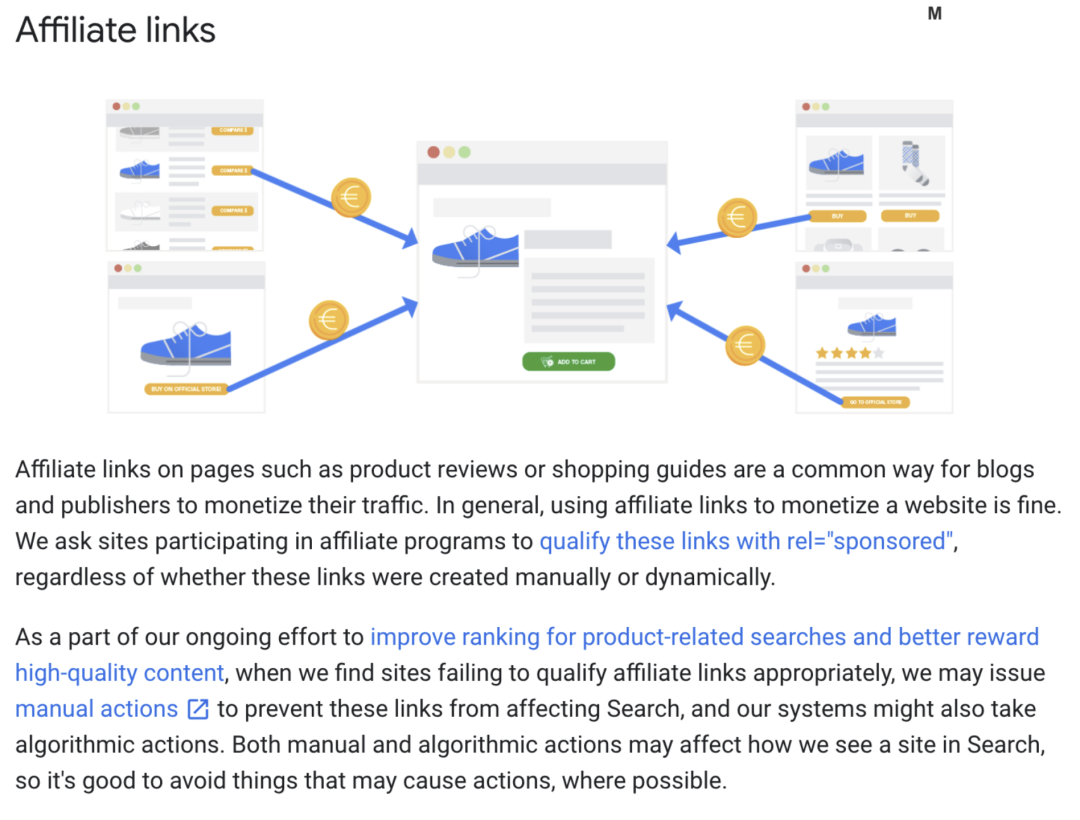
Affiliate links in product reviews or buying guides should be qualified. Google's current outbound-link guidance recommends rel="sponsored" for ads and other paid links; nofollow remains acceptable.
If a product-review site publishes many unqualified commercial links that pass ranking credit, treat that as a warning sign rather than assuming every dofollow link automatically triggers a manual action. Google says that unqualified affiliate links may lead to algorithmic or manual action.
Note: Before this update, I had recommended that companies pursue this kind of link because I believed it converted well. After the announcement, I advised much greater caution. This illustrates a routine SEO risk: a tactic can become harder to defend as Google's systems and published policies evolve.
2. Sponsored posts and guest posts
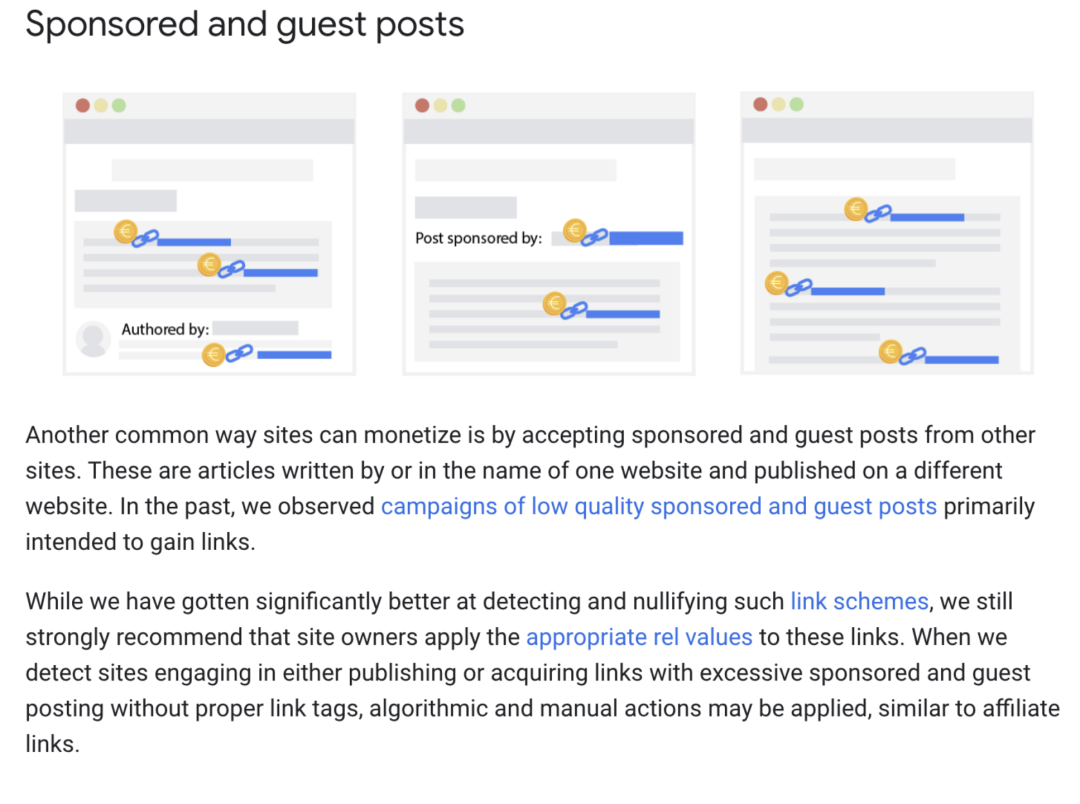
Google observed that selling guest-post placements had become a common way for websites to make money.
A guest article can still have a legitimate purpose when it informs users, educates another site's audience or builds awareness of a company.
The risk arises when guest posting becomes a large-scale method of acquiring links to manipulate rankings, especially when commercial links are not qualified correctly.
If guest posting is part of your strategy, watch for the following patterns:
(1) The article contains many exact-match or otherwise optimized anchor-text links to third-party sites.
(2) The same campaign publishes large numbers of articles across different sites or concentrates many placements on several large publishers.
(3) The writers are unfamiliar with the subject they are covering. Specialist topics should be assigned to writers who understand the subject.
(4) The same article is reused across guest-post placements without appropriate link qualification or canonical handling.
If you sell link placements on your own site, repeated publication of articles containing link spam can put the site at risk. Google's documented outcomes include lower visibility or exclusion from results; specific cases can also involve algorithmic or manual action.
Google also said that its continually changing ranking and spam-detection systems could already identify and neutralize much link spam automatically.
Some site owners nevertheless continued to use deceptive methods to manipulate rankings.
Google presented the 2021 update as another step in detecting and neutralizing those links more broadly.
At the time, I expected sites built around exact-anchor guest posts to be affected substantially. That was my prediction, not a measured outcome reported in the source.
Google described the update as global and said it would operate across multiple languages.
Link spam had sometimes been promoted as an easy way to rank in smaller-language markets; a multilingual rollout made that approach even less defensible.
Final Thoughts
In my view, Google is a company that cares about user experience. The source joked that its "new CEO," Sundar Pichai, was more focused on profit but could not change Google's core values; Larry Page would not let him. That was personal commentary, not evidence about how the ranking systems work.
Build pages and promotion that genuinely help users, and qualify commercial links appropriately. That is a more durable basis for SEO than trying to outlast the next spam update.