
On this pageTable of contents+
- 1. What Is Parasite SEO?
- Why Has Parasite SEO Become Popular?
- Is Parasite SEO a Loophole or Only a Short-Term Strategy?
- 2. Breaking Down the Core Parasite SEO Framework
- 1) Select Opportunity Keywords, Not Only the Hardest Head Terms
- 2) Find Suitable Platforms by Reverse-Engineering the SERP Environment
- 3) Earn Platform Access Through Media Relationships
- 4) Produce a Crawlable Knowledge Structure, Not Merely an Article
- 5) Initial Distribution and Launch: Publication Alone Rarely Creates Momentum
- 6) Links and Signal Amplification: Use Restraint Instead of High-Risk Tactics
- 7) International and Multi-Region Testing: Extend One Content System Across GEOs
- 3. Advanced Parasite SEO Techniques
- (1) CTR Tactics: Launch Content at the Right Time
- (2) Online Reputation Management: Increase the Visibility of Positive Information
- (3) YouTube Connections: Use a Third-Party Page to Support Video Discovery
- (4) Paid Placements and Free Platforms: How the Strategies Differ
- 4. Risks and Limits: Where Parasite SEO Cannot Be the Foundation
- (1) Platform Rules Can Change at Any Time
- (2) The Risk of Being Labeled "Sponsored" by Google
- 5. Three Constructive Uses of Parasite SEO in Real Businesses
- Validate a New Site or Market Quickly
- Online Reputation Management
- Validate GEO Traffic and Prioritize Countries
- 6. Turn Short-Term Parasite SEO Traffic into Long-Term Assets
- Create a Traffic and Conversion Path
- Apply Test Results to the Owned Site
- Add Strong GEO Markets to Long-Term Planning
- 7. Summary

In the current AI-search environment, it is harder than before for a new site to earn meaningful visibility in Google. That does not mean there are no opportunities; it means those opportunities no longer depend entirely on building and optimizing an owned website.
At the Chiang Mai SEO Conference, James Oliver shared how a strategy commonly called Parasite SEO uses external platforms to seek rankings quickly and, in some cases, generate traffic and revenue. He presented the method as particularly useful for new sites, brand protection and companies entering new markets.
James used several representative cases to illustrate the potential he saw in Parasite SEO:
- Generating revenue in several countries through third-party platforms without an owned website.
- Reaching the first page for competitive keywords within weeks despite starting with a site that had no authority.
- Using third-party pages to try to push negative material lower in the results.
The method sounds attractive, but that does not make it suitable for every situation. It may give a new site a short-term opening, yet its essence is still borrowed leverage. This article discusses:
- The definition and boundaries of Parasite SEO.
- The core methods James shared and where they may apply.
- How international brands, factories and export teams can evaluate the strategy rationally.
The goal is not only to explain how Parasite SEO works. It is to help you judge whether and how it belongs in your business without letting a short-term tool displace long-term brand building.
1. What Is Parasite SEO?
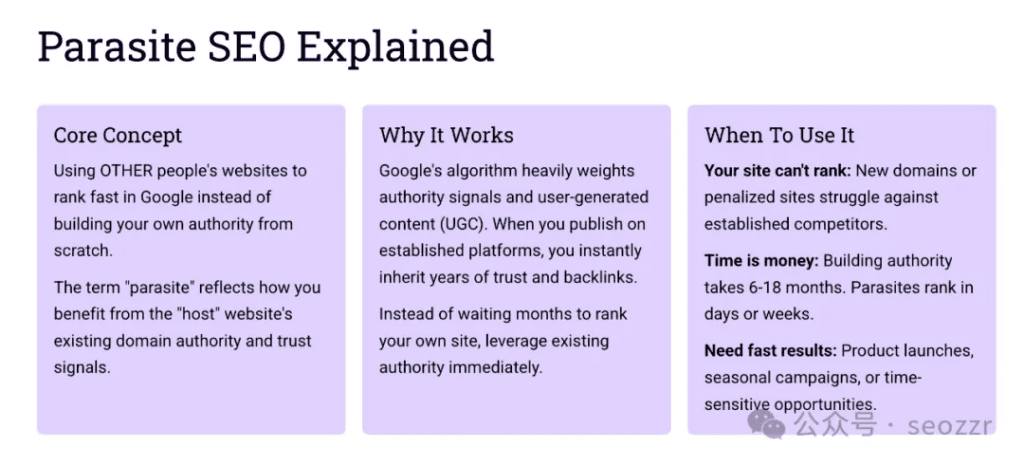
In the source's simplest definition, Parasite SEO means publishing content on a platform Google already trusts in order to seek traffic and rankings more quickly. Current Google policy draws an important boundary: publishing third-party pages mainly to exploit a host site's ranking signals is site reputation abuse. Third-party content itself is not automatically a violation; purpose and implementation matter.
Instead of building a new site from zero, the approach selects an established platform, publishes content there, attracts visitors and tries to generate conversions. Because such platforms may already rank well, the source argues that a contributor can gain exposure faster and use that exposure to support the business. This is an attributed description of the tactic, not a ranking guarantee.
Platforms James mentioned at the event included the following, although suitability varies by industry, region and each platform's current terms:
- Medium.com: one of the early, widely used third-party publishing platforms, supporting many kinds of content.
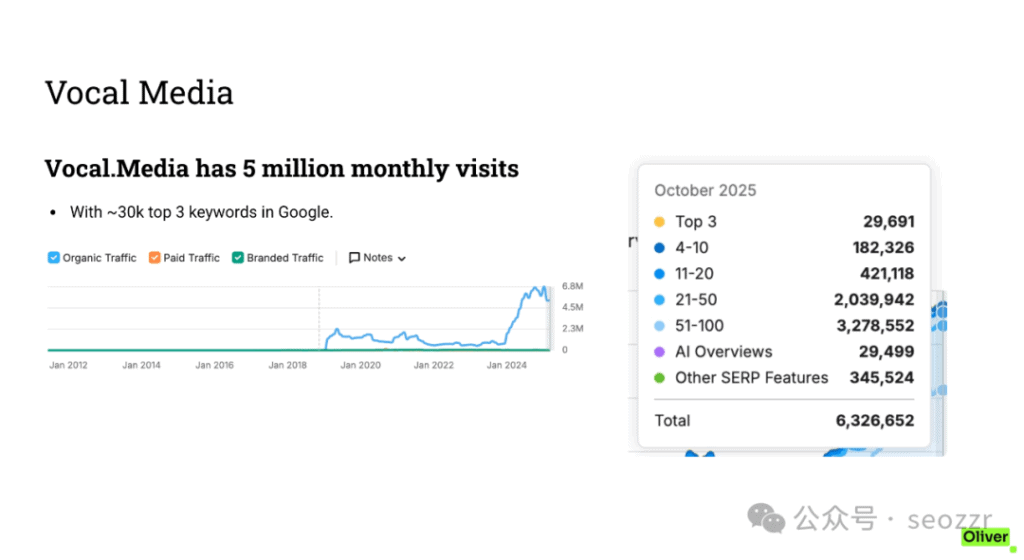
- Vocal.media: a platform he considered effective at the time, particularly for acquiring traffic quickly.
- Reddit: a community platform with strong social traffic, provided participation follows subreddit and platform rules.
- Local news websites: for example, state or regional news outlets in the United States that can reach a local audience.
- LinkedIn: a business-content platform that the source said continued to appear in Google's AI-influenced recommendations.
Why Has Parasite SEO Become Popular?
In simple terms, the source attributes several obvious advantages to it:
- Avoid starting authority from zero: a new site generally needs sustained work before third-party tools show a stronger domain-authority score. Those scores are not Google metrics, but the practical appeal is avoiding a long wait as a new domain and a large content library develop.
- Useful for new sites and cold starts: an independent site or a company testing a new market may use established distribution to seek traffic before its owned site has matured.
- A possible route into difficult queries: competing directly for a high-value term may be unrealistic for a new site. A relevant third-party publication may reach that audience sooner, but exploiting the host's ranking signals is precisely where current policy risk begins.
- Brand defense and reputation work: when negative material appears, the source recommends publishing positive reports, reviews or interviews so more information is visible. Ethical reputation work must remain accurate, attributable and transparent; it must not fabricate endorsements or conceal legitimate criticism.
Is Parasite SEO a Loophole or Only a Short-Term Strategy?
At this point, readers may reasonably ask whether this is a gray tactic or a way of gaming the system, and whether it can be used over the long term.
James stated in his presentation that Parasite SEO was a viable long-term strategy, although the platforms carrying it would change. That was his conference position. Google's current policy means the label cannot make a policy-violating implementation durable or acceptable.
Platforms change and search rules evolve. James believed that the idea of ranking on domains Google already trusted would persist. Today, the safer durable principle is legitimate audience distribution: content should serve the host's readers, disclose the relationship and stand on its own merits rather than exist primarily to borrow ranking signals.
2. Breaking Down the Core Parasite SEO Framework
In a real business, Parasite SEO is better treated as a tool for validating a market, supplementing traffic and shortening the learning cycle than as the company's main SEO system. The following section explains the source's core method without providing black-hat operating details.
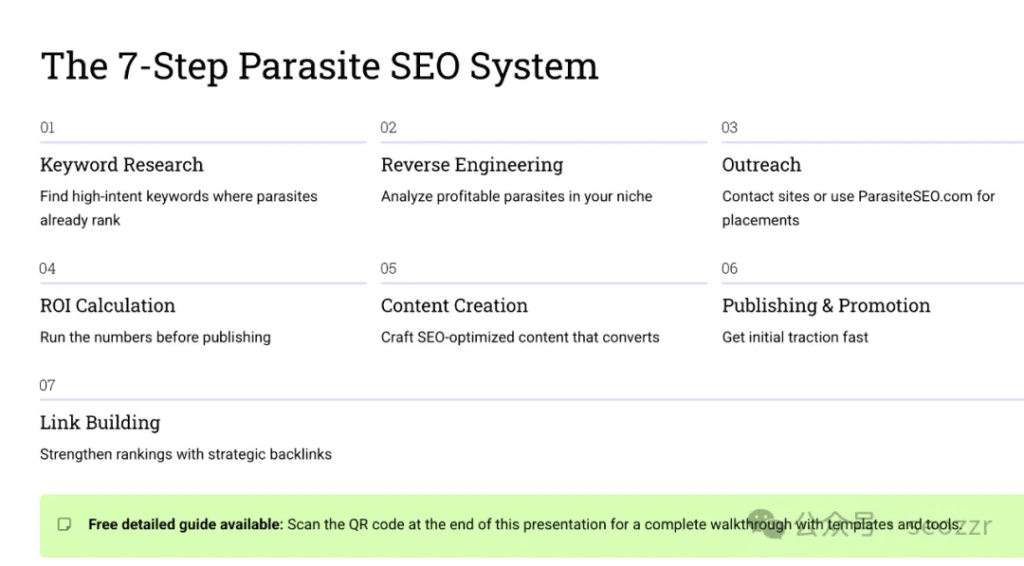
1) Select Opportunity Keywords, Not Only the Hardest Head Terms
James used a clear filter: prioritize decision-stage search terms instead of competing immediately for the hardest head terms. Examples include:
- Best X alternatives
- X vs Y
- Best X for Y
- Top X in 2025
These keywords generally have two characteristics:
- The intent is clear: the user is comparing or filtering options and may be closer to a decision.
- The competitive environment may be more manageable because the page does not have to challenge the industry's largest brands for the broadest term.
The source recommends combining several inputs during keyword selection:
- Ahrefs: review search volume, keyword difficulty, result-page types and related evidence.
- Google Trends: examine changes in interest and seasonal patterns.
- Question tools: tools such as AnswerThePublic can prompt long-tail queries and regional differences; validate suggestions in the live results.
2) Find Suitable Platforms by Reverse-Engineering the SERP Environment
At this stage, James did not merely list platforms. He analyzed whether a platform appeared suitable for third-party publishing. By studying successful pages already in the results, a team can understand their structure and how the host operates. The source describes the following process.
A. Search the Target Keyword in Google and Record the First-Page Structure
Pay particular attention to:
- The share of results that are not official brand websites.
- Whether media and review sites dominate the top ten.
- Whether contribution platforms such as LinkedIn, Medium or Reddit appear.
- Whether the results contain many sponsored-content layouts or affiliate redirects.
B. Open the Pages and Assess the Publishing Environment
- Whether the platform accepts contributions.
- Whether it has clearly labeled partner-content or sponsored-content sections.
- Whether pages contain tracking parameters, affiliate IDs or redirects, indicating monetized content.
- Whether content structure and editorial presentation are standardized, suggesting a repeatable publishing workflow.
The source offers one practical question: does Google currently rank this kind of platform for the query?
A positive answer shows that the result environment currently includes such pages, but it is not permission to violate platform or search policies. The useful skill here is SERP-ecosystem analysis: understanding what users are being shown, how publishers participate and where a legitimate contribution might add value.
3) Earn Platform Access Through Media Relationships
James emphasized that most platforms will not respond well to a request framed as, I want to publish a parasite article.
The source therefore advises approaching media as a content agency rather than as an individual contributor. That positioning must be truthful. Do not conceal who is paying, who created the content, what commercial interest exists or why the contribution is being proposed.
The source's outreach suggestions include:
- Contact the publisher in the name of a real brand or organization.
- Propose a content collaboration or a useful industry-insight contribution.
- Do not lead the pitch with labels such as
parasite
,SEO operation
orguest post
; nevertheless, disclose the actual relationship and intent whenever material. - Explain that you can provide high-quality material that meets the publisher's editorial requirements.
Many local outlets, regional news sites and specialist blogs are open to collaborative content but wary of obvious ranking manipulation. That makes editorial fit and honest disclosure more important, not less.
A legitimate relationship may provide:
- Permission to contribute.
- An opportunity to work with an editor.
- Access to an appropriate partner or contributed-content section.
- In some cases, an ongoing contributor relationship with greater long-term value.
The core is not to publish anywhere that will accept an article. It is to find a platform that reaches the right audience and that the contributor can enter lawfully and transparently. That standard separates a real media relationship from disguised site-reputation abuse.
4) Produce a Crawlable Knowledge Structure, Not Merely an Article
James presented content production as an engineering process rather than a matter of inspiration. The source summarizes his scalable workflow in three technical steps.
A. Extract Structural Signals from the Top Ten Results
Using a tool such as the source's NAN example, examine leading pages and extract:
- Heading and paragraph structure, including H2 and H3 sections.
- Keyword variants.
- Product and brand entities.
- The sentiment or stance expressed in the content.
- Frequently asked questions.
- The media formats used on the page.
The purpose is to identify patterns that appear to meet the current query. These patterns are evidence about the result set, not a disclosed Google template or a guarantee of ranking.
B. Reconstruct the Structure
The emphasis is not on paraphrasing another page. It is on:
- Preserving every necessary information point.
- Reordering the material so its logic is clearer.
- Adapting the angle for a different country, industry or audience.
- Adding high-quality data, comparisons and independent judgment.
The substance of this step is to make the page easier to understand without losing information value. It should produce original work, not a disguised copy of the leading results.
C. Optimize the Featured-Snippet Structure
The source argues that future AI search experiences, including the product then called Google SGE and systems such as ChatGPT, evaluate whether:
- The conclusion appears early.
- The information can be divided into useful passages.
- The page has a clear logical structure.
- The information is easy for a system to reuse.
James emphasized aligning content structure with the formats often seen in featured snippets and AI-generated answers. Clear structure can improve comprehension, but it does not guarantee inclusion or exposure.
Common techniques include:
- Summarizing key information with bullet points.
- Using a table when a real comparison benefits from rows and columns.
- Embedding a relevant YouTube video when it helps explain the topic.
- Giving a direct answer near the beginning of the article.
The benefit is that readers, Google and AI systems can understand well-organized information more quickly, without having to infer the page's basic answer from an unnecessarily tangled structure.
Put simply, the goal is not to write more for its own sake. It is to make a page easier to crawl and understand and still serve the target audience. Study the structures currently succeeding for the query, then create an original version for your users and market; do not mistake structural similarity for a ranking formula.
Remember: analyze first, then write. Do not write with your eyes closed.
5) Initial Distribution and Launch: Publication Alone Rarely Creates Momentum
Many people assume that an article on an authoritative platform will rank naturally as soon as it is published. James rejected that assumption and said the content needed legitimate early distribution, including the following.
1. Seek an internal feature or a social share from the platform.
For example, the publisher might feature the article once or share it through its social account. This can introduce the page to intended readers early, but it cannot guarantee that the page will perform in search.
2. Use a small budget for initial traffic.
James described this standard practice:
- Spend about $10 on Facebook or Reddit.
- Use the campaign to obtain the first real visits to the content.
The source claimed that these clicks would feed a CTR signal back to Google and help establish early rankings. That causal claim is unsupported. Paid visits can test whether real people engage with an article, but they should not be bought or engineered as a ranking signal.
3. Use the timing window around Google News.
Publishing around a relevant event, holiday or news cycle may attract more genuine interest, especially when the content is truly newsworthy. The outcome depends heavily on timing and demand; it is not uniformly effective.
6) Links and Signal Amplification: Use Restraint Instead of High-Risk Tactics
In black-hat circles, this stage may involve:
- PBNs, or private blog networks.
- Various Web 2.0 links.
- Links generated by automation tools, including GSA or PDF-site networks.
This article does not explain those techniques because:
- Google increasingly detects and acts against many of them.
- Without long-term maintenance and risk controls, a team can lose the apparent gains overnight.
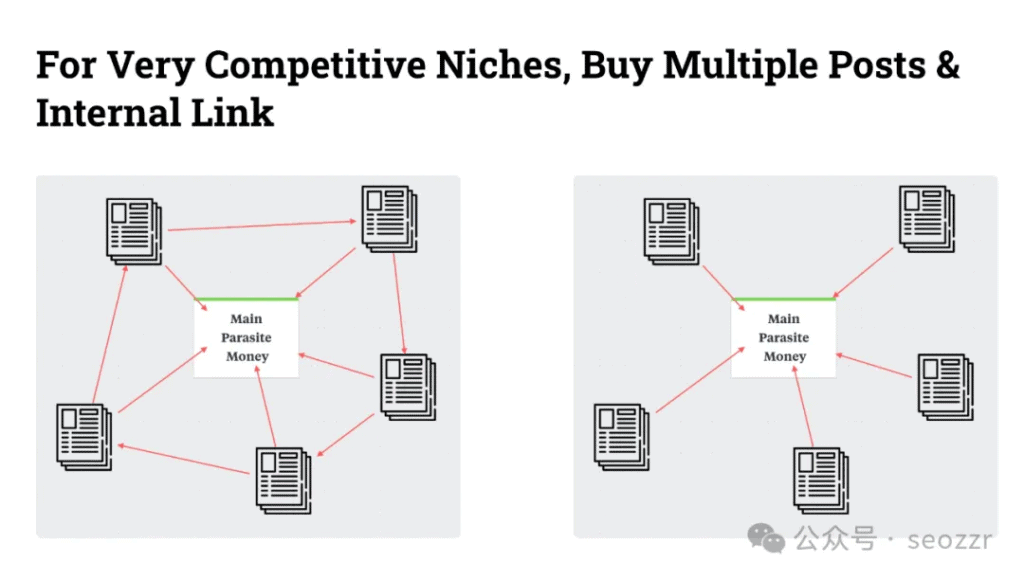
The source preferred another idea James mentioned: allowing related third-party pages to link to one another as a parasite matrix
. It described the concept as follows:
- Distribute content on the same subject across different platforms.
- Use restrained, natural links between those pages.
- Make each link a reasonable recommendation for the user and a meaningful topical connection.
The source considered this more durable than indiscriminate link building. Current Google spam policy, however, defines links created primarily to manipulate rankings as link spam. Interlink pages only when the references genuinely help readers, disclose paid relationships and apply rel="sponsored" or nofollow where required.
7) International and Multi-Region Testing: Extend One Content System Across GEOs
This part is particularly relevant to teams developing international markets:
- Translate English content into languages such as Spanish or German.
- Publish through appropriate local news sites, regional media or specialist blogs in the target country.
- Some markets are less competitive than the United States or United Kingdom, creating different opportunities to establish useful information.
James said his team would:
- Use a small Fiverr budget to have a native speaker polish the language.
- Pay particular attention to the performance of local news sites in GEOs such as South Africa, India and Australia.
For an international business, this can mean:
- Not starting immediately in highly competitive markets such as the United States or United Kingdom.
- Beginning with markets such as South Africa, India or Australia.
- Testing inquiry quality and product acceptance first.
- Then directing resources toward the most important markets.
This can reduce the cost of learning and relieve some pressure at the start, provided every localized placement is useful, accurate and compliant with the host's rules.
3. Advanced Parasite SEO Techniques
After understanding the basic process, it is important to know which amplification methods the source describes and where their boundaries lie. James shared several specific practices at the event. Some may fit ordinary business activity; others belong only in limited or non-manipulative contexts.
(1) CTR Tactics: Launch Content at the Right Time
Early attention can matter for some content. James's approach was to coordinate publication with a relevant Google News cycle so the article entered the market when interest was concentrated. Examples include:
- Major holidays.
- Sporting events.
- A new product receiving substantial podcast or media coverage.
- A sudden trend or news event in an industry.
Search demand and genuine click-through rates may rise during those periods, which can give a timely page more opportunity to be discovered. The source reported strong effects for reviews, trends and seasonal consumer topics, but timing is not a ranking guarantee and does not justify manufactured clicks.
(2) Online Reputation Management: Increase the Visibility of Positive Information
Parasite SEO is not discussed only as a traffic method. In some markets it is also used for online reputation management. The source points to the United States, where public litigation records can place negative information prominently in brand searches.
James described the following approach:
- Publish positive, truthful content on several suitable third-party platforms.
- Structure the information clearly so the pages are eligible to be understood and ranked on their own merits.
- Continue monitoring changes in the SERPs for brand-related queries.
For a brand, more accurate and useful sources can give users a fuller view. Reputation work should correct material errors through documented channels and add attributable information; it should never rely on fabricated praise, misleading ownership or suppression of legitimate criticism.
(3) YouTube Connections: Use a Third-Party Page to Support Video Discovery
Many products are easier to explain through video, which makes YouTube an important channel.
The source says a third-party page can support a video by:
- Embedding the relevant video in the article.
- Giving readers a useful reason to watch it.
- Creating another discovery path from Google to the video.
For tutorials, product demonstrations and reviews, this can be a cost-effective way to connect complementary formats, as long as the page and video each provide genuine value.
(4) Paid Placements and Free Platforms: How the Strategies Differ
James said the market offered two broad kinds of third-party placement:
Paid Placements
- The historical prices he cited ranged from $100 to $20,000.
- He characterized them as more predictable and faster to publish.
- He associated them with high-value products and commission-based businesses.
The source considered paid placement suitable when the business needed traffic quickly and the margin could cover the cost. Any current price or performance claim requires direct verification, and paid links must be disclosed and qualified appropriately.
Free Platforms
Examples in the source include Medium, Vocal and Reddit.
- The publication cost is low.
- Performance depends more on content structure and legitimate distribution.
- They may be more accessible to new sites, cold starts and content-intensive businesses.
A company can mix these options according to product margin, budget and test length. It must also follow the platform's rules and behave as its community expects.
4. Risks and Limits: Where Parasite SEO Cannot Be the Foundation
Every strategy has limits. James highlighted risks that beginners often overlook even though they can directly affect execution.
(1) Platform Rules Can Change at Any Time
Platform content policies are not fixed. Medium, for example, has changed its rules several times, and the source says those changes affected the ranking performance of third-party content. If a company depends on one platform, a policy change can immediately affect its traffic.
(2) The Risk of Being Labeled "Sponsored" by Google
The source says an advertising page may lose visibility or indexing. The current distinction is more precise: sponsored content is not automatically excluded, but commercial relationships and links must be disclosed. A page designed to exploit a host's ranking signals may violate site-reputation-abuse policy. There is no technical workaround for a compliance problem.
(3) Traffic May Be Seasonal
Trending, event-led and news content naturally has a short cycle. Traffic can fall after the relevant period, so a third-party page does not provide inherent long-term stability and is often better suited to testing or a temporary growth opportunity.
(4) Account Risk, Especially on Reddit
Reddit is sensitive to abusive multi-account behavior and repeated links. If an account is banned, the whole route to readers can stop. Losing a branded account costs a business time and money, so participate genuinely and follow the platform's rules.
5. Three Constructive Uses of Parasite SEO in Real Businesses
For DTC brands, factories and export teams, the source positions Parasite SEO as a lower-risk, testable growth method rather than a short-term trick. It is lower risk only when the placement is transparent, serves the host's audience and does not depend on exploiting ranking signals.
Validate a New Site or Market Quickly
When launching an independent site or entering a new market, the central questions often include:
- Whether the product has real search demand.
- Which countries are more likely to generate clicks and conversions.
- Which keywords and content directions deserve long-term investment.
A common workflow described in the source is:
- Test three to five core keywords through relevant established platforms where the contribution is legitimate.
- Compare click and conversion data across countries and languages.
- Use the results to shape the owned site's categories, content and media plan.
Online Reputation Management
In markets such as the United States, Canada and Australia, third-party material may occupy brand-related results for a long time. The source proposes using third-party publishing to:
- Increase the visibility of accurate, high-quality third-party content for brand queries.
- Increase the share of positive but supportable information.
- Reduce the degree to which one negative result defines the entire SERP, without obscuring legitimate information.
The goal is to improve the distribution of information in the result set, not to tamper with the original material.
Validate GEO Traffic and Prioritize Countries
Factories, solo export businesses and cross-border teams do not always need to enter the United States or United Kingdom first. The source says this approach can help:
- Test search and inquiry responses across countries and languages.
- Identify markets with stronger conversion potential.
- Help the team decide which markets come first and where to invest resources.
The method may be especially relevant to clearly defined product categories with a high average order value.
6. Turn Short-Term Parasite SEO Traffic into Long-Term Assets
Parasite SEO needs to work with owned-site SEO and brand building rather than operate in isolation.
Create a Traffic and Conversion Path
Without a way to serve and measure referred visitors, third-party traffic has little value. The source suggests the following destinations and response paths:
- A landing page on the owned website.
- Natural brand-name exposure that may prompt brand searches.
- Lead collection through a form, email, WhatsApp or WeChat, with appropriate consent and privacy handling.
Apply Test Results to the Owned Site
Data from third-party content can inform:
- Which keywords earn high click-through and conversion rates.
- How to improve content structure and page formats.
- Which countries and language markets deserve priority.
Add Strong GEO Markets to Long-Term Planning
Third-party platforms can reveal unexpected market potential. The source gives examples such as inexpensive clicks in Australia or a high inquiry-to-sale rate in Latin America. Treat those as illustrative observations, not benchmarks; verify them with dated market and conversion data.
Parasite SEO is better used as a validation and transition stage than as the core of long-term growth. Used carefully, the learning can guide resource allocation and reduce wasted budget.
7. Summary
Parasite SEO is better suited to testing than to serving as the core of long-term growth. During a new-site cold start, an international market test or work on brand searches, transparent third-party pages may help a team collect useful data sooner and make early choices with less uncertainty.
The questions to consider include:
- Whether Parasite SEO suits the business's current stage.
- Which keywords or country markets should be validated first.
- How a short-term search opportunity can contribute to the owned site and the brand's long-term assets.
Those questions are often more important than simply asking whether to do parasite SEO.
We will continue sharing practical SEO, GEO and international-search cases, focusing on reusable methods and decision logic. If you are already applying the ideas in a project, evaluate them against the real market, the host platform's rules and your long-term international search plan.