
On this pageTable of contents+
- 1. Philips and Philips Hue: A Global Technology and Smart-Lighting Brand
- Website Profile
- Historical SEO Snapshot
- 2. Content Analysis
- Blog Analysis
- Category-Page Analysis
- Product-Page Analysis
- 3. Backlink Analysis
- How Can a Smaller Brand Build Links at This Scale?
- 4. E-A-T
- 5. Social Media
- 6. Technical SEO
- 7. Why Traffic Rose So Quickly
- Final Thoughts


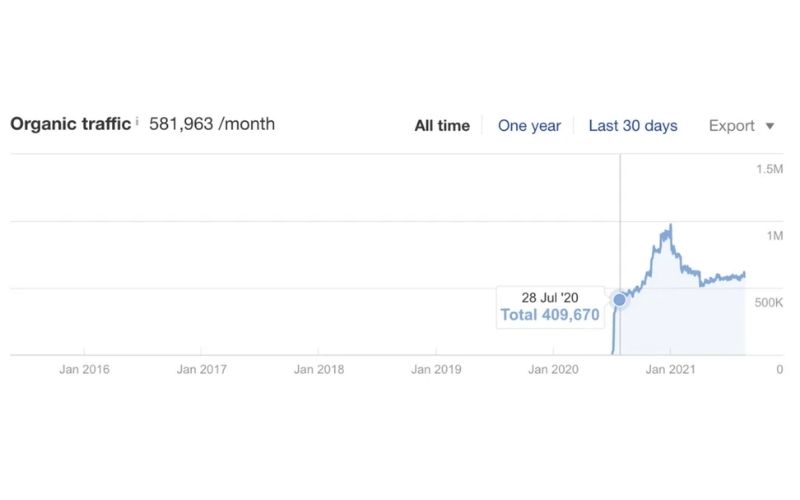
In the source snapshot, Philips Hue moved beyond roughly 400,000 monthly organic visits and continued growing until it exceeded one million. A curve like that is unusual in SEO.
When people see that kind of growth, their first question may be whether black-hat or grey-hat tactics were involved.
This case concerns Philips Hue, the smart-lighting brand. The source argues that a global brand of this kind had little reason to rely on tactics that violated search guidelines.
According to the source analysis, Philips Hue used a compliant, white-hat SEO strategy to grow from almost no organic traffic to more than one million monthly visits.
How did it do that?
Which elements of its content, technology, backlinks and product experience can other teams learn from?
This article examines the historical case across seven dimensions and asks how an established brand built a durable organic-search advantage.
1. Philips and Philips Hue: A Global Technology and Smart-Lighting Brand
People encountering Philips Hue for the first time might assume it is a local brand. The source treats that assumption as a sign that Philips localised the brand well.
Adapting operations to local culture, language and user expectations is an important lesson for brands expanding internationally.
For a systematic approach to localisation, see our earlier Chinese article on building trust in overseas markets.
Website Profile
Philips was founded in the Netherlands and operates across consumer electronics, home appliances, personal care and health, healthcare, lighting and smart-home systems. The source cites a historical Wikipedia statement that Philips was the world's largest lighting manufacturer in 2012.
Beyond its strong offline brand, the company also built a substantial ecommerce business and digital presence.
Site type: ecommerce
Business model: DTC brand site
Niche: smart lighting
Highest annual revenue in the source dataset: US$2.021 billion
Monthly traffic in the source-era Similarweb snapshot: 2.75 million
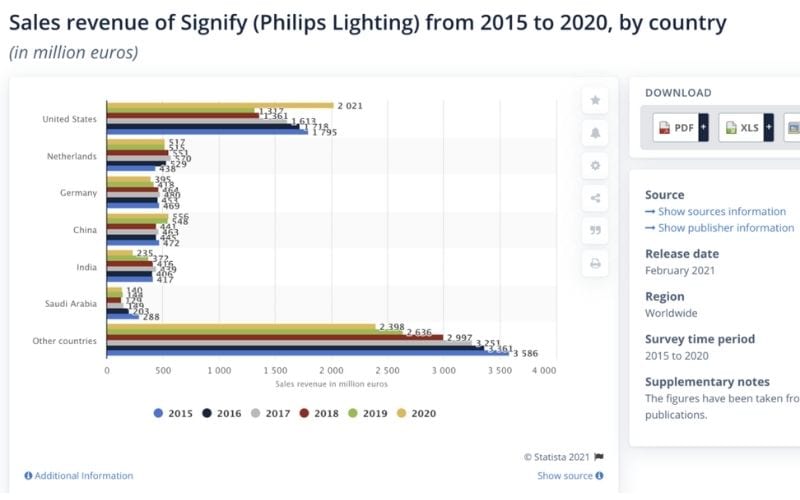
Source: Statista
Historical organic share: 72.8%, making search a major growth channel for Philips Hue
The source-era traffic analysis estimated that more than 72.8% of Philips Hue visits came from organic search. The author interpreted this as evidence that SEO was central to the site's DTC growth model.
That finding is particularly relevant to Chinese brands entering overseas markets.
The source argues that many established brands in Europe and North America follow this sequence:
Build a defensible search presence first, then expand paid and social acquisition.
An SEO-led strategy may take longer to gain momentum, but it can offer several advantages:
- More controllable and sustainable acquisition costs;
- Stronger user trust;
- Content assets that can accumulate value and support more stable visibility.
By contrast, many companies favour rapid growth through advertising and short-term campaigns. This can create an early spike, but the traffic often falls quickly when spending stops, limiting stability and compounding value.
For a company that wants to build an international brand and lead a niche, the source argues that SEO should be part of the growth foundation rather than a minor supporting channel.
Earlier investment and learning can help a brand build a more durable organic advantage.
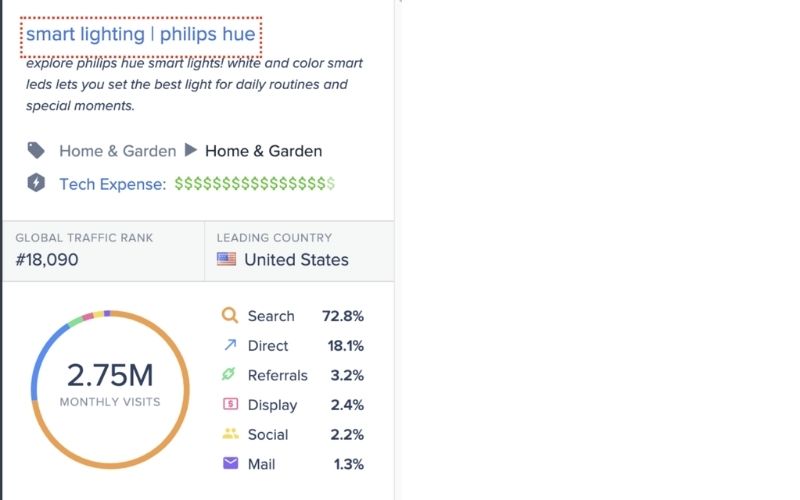
Historical SimilarTech analysis
Historical SEO Snapshot
Domain Rating: 80
Referring domains: 13,000
Estimated organic traffic: 5,810,000 in the source-era Ahrefs snapshot
Ranking keywords: 121,000
Total pages: 5,620, including 205 pages on the US site in the source snapshot
2. Content Analysis
Blog Analysis
The source divides Philips Hue's content approach into two parts: blog content and product-page architecture.
It begins with the blog.
At the time of the review, the blog contained only 28 articles, and the author considered the overall execution weak:
- Focused topics: almost every article addressed smart lighting, so the direction was coherent.
- Limited depth: the source estimated that many articles contained only a little over 100 words and lacked enough substance to compete for demanding queries.
- Weak search optimisation: the author found little evidence of a keyword strategy or deliberate structure and observed little search traffic to the articles.
The topics were relevant, but the source concluded that the brand had not invested enough depth for the blog to contribute materially to SEO.
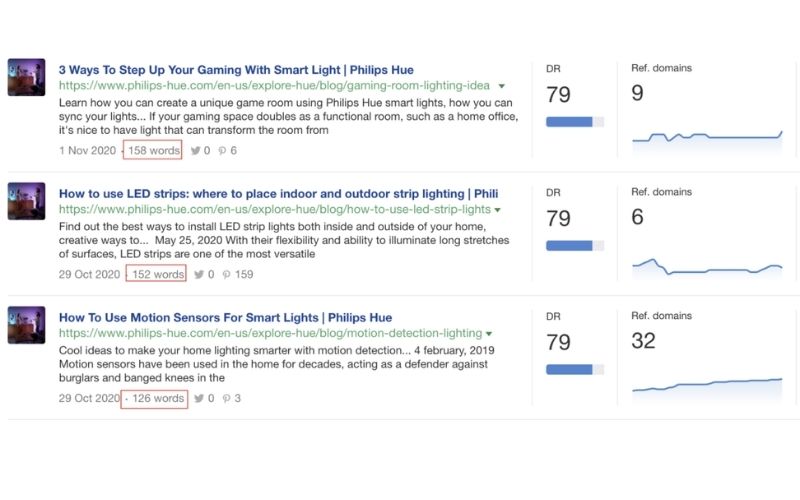
Philips Hue article length in the source review
By contrast, the source considered Philips Hue's category and product pages exceptionally strong in both user experience and search fundamentals, offering useful ideas for ecommerce brands.
The product presentation made the benefits of smart lighting tangible and showed how it could make a home more convenient and welcoming.
The following sections identify the specific elements the source considered useful.
Category-Page Analysis
Menu Categories
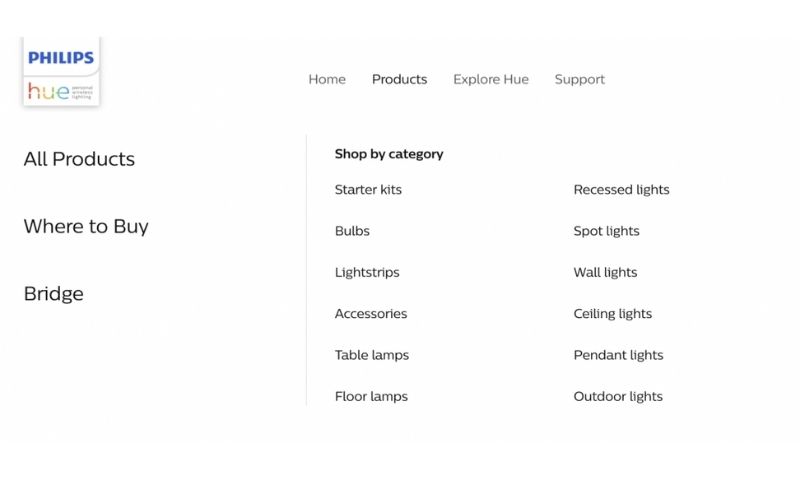
The navigation organised products around use cases such as bedroom, outdoor and ambient lighting. This helped visitors find suitable products quickly and reflected a detailed understanding of customer needs.
Product Category Pages
Several details stood out on individual category pages:
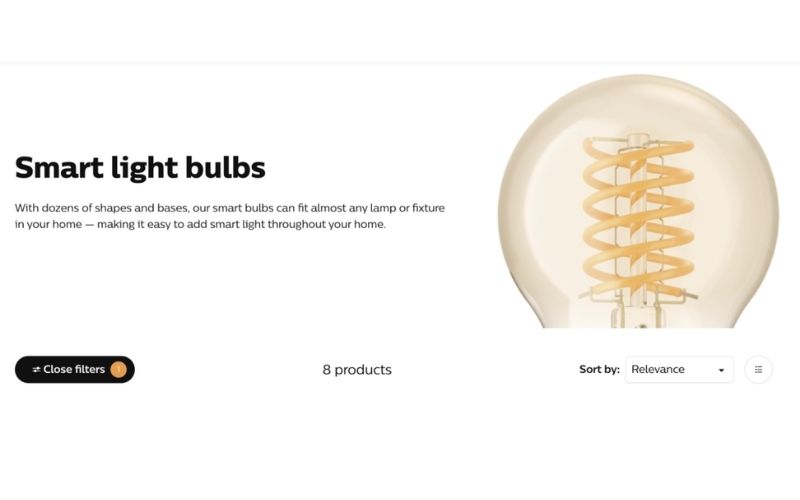
- Introductory copy: a short explanation at the top supported orientation and described what the category offered.
Philips Hue category page above the fold
- Sidebar filters
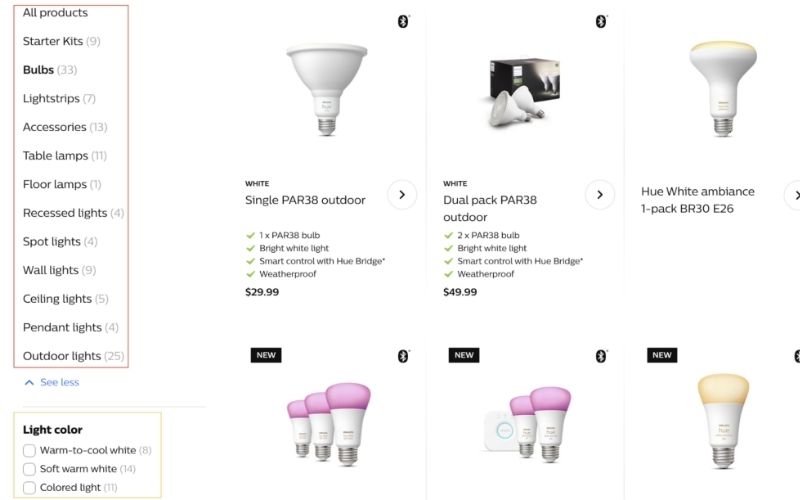
The source notes that default WordPress filters often expose only product attributes, like the area highlighted in yellow in the screenshot.
Adding category choices, like those highlighted in red, can help visitors move between related product groups.
Smart-lighting customers may want to compare more than one product type.
Category shortcuts allow them to move to related products as they browse.
Philips Hue product category page
- Product-category thumbnails
A concise heading explains the use case.
A bullet list presents key specifications for quick scanning.
The Bluetooth mark on the main image answers an important connectivity question.
The source considered these details carefully executed.
An image-led FAQ answers common questions about smart bulbs.
Supporting articles help visitors understand the product and category and enrich the internal-link network.
The source presents this as a useful reference for product-category design and on-page SEO.
Product-Page Analysis
The source believes the product team invested substantial time in refining these pages.
Instead of one generic template, many pages adapt the presentation to a distinct use case and place the product in an appealing setting.
Smaller sellers with fewer design and engineering resources can study these patterns selectively rather than copying them without validation.
Philips Hue product page
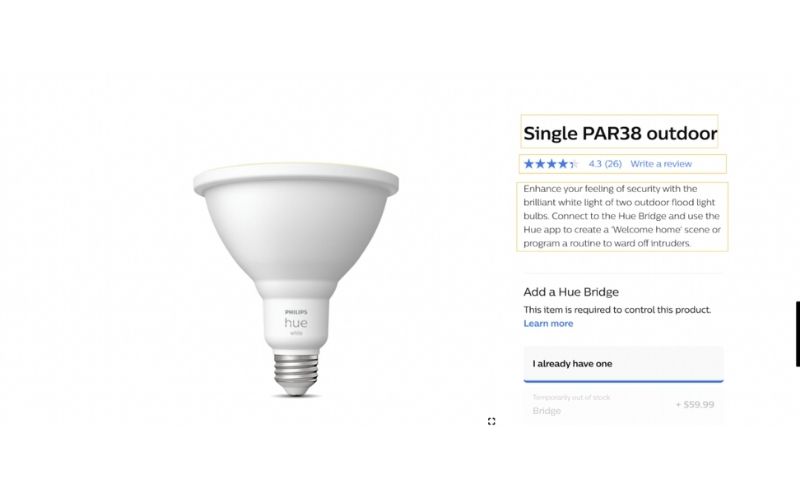
A concise title communicates the use case, quantity, shape and model.
Ratings provide social proof.
The highlighted section gives a short use-case description and important notes.
The most important information appears early.
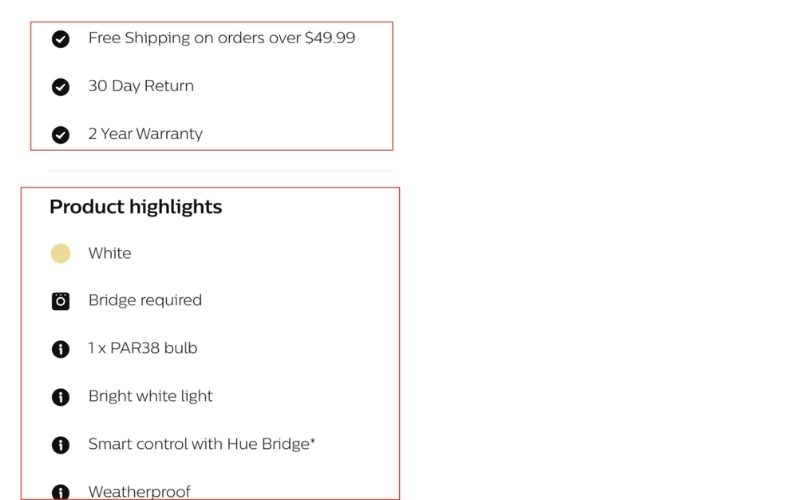
Philips Hue product page
Warranty information and product benefits appear prominently, supporting trust and conversion.
Because specifications matter for electronics, the page provides a direct jump to technical details so visitors do not have to search or leave.
If product choice depends on particular specifications or features, provide a clear route to that information.
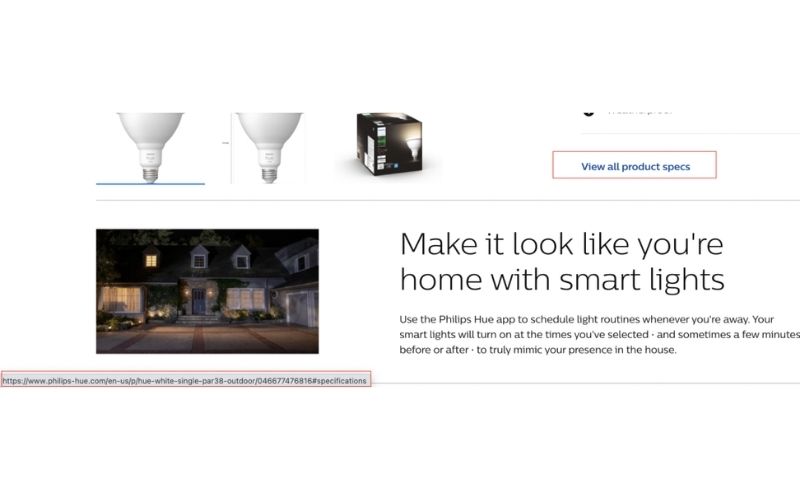
Philips Hue product page
Note: the source found the mobile experience particularly effective and suggests studying it when technical resources allow.
Supporting use-case articles and voice-control information were also well executed and attracted substantial traffic in the source review.
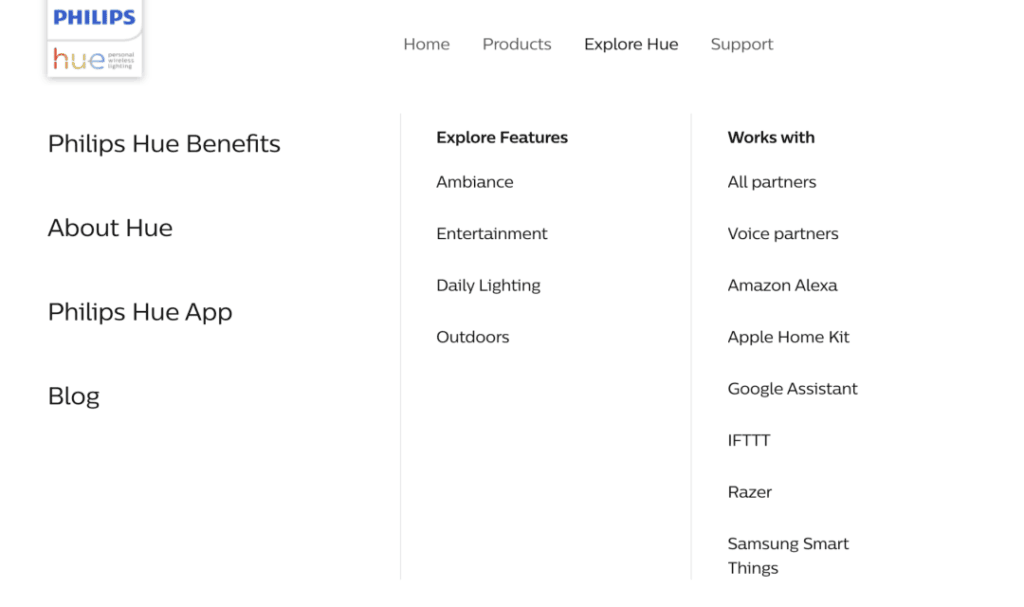
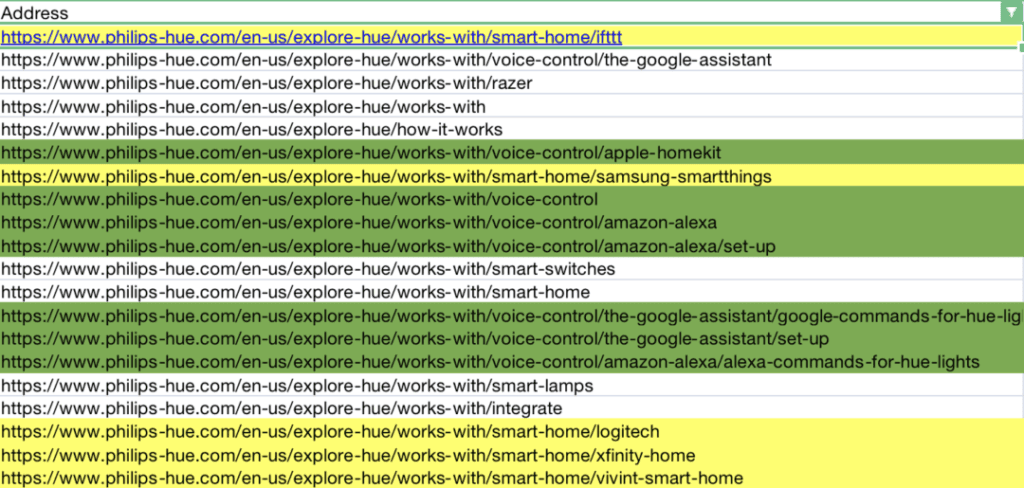
Philips Hue supporting use-case content
3. Backlink Analysis
Backlinks are often a strength for an established brand. Product coverage and public relations can earn mentions from authoritative sites.
As a prominent smart-lighting brand, Philips Hue is frequently mentioned when publishers discuss the category or recommend products.
The source therefore observed a strong profile without evidence that the brand needed to pursue every link manually.
It describes this as an advanced outcome of brand-led, organic link growth.
The historical profile provides an ambitious benchmark, although current figures may differ.
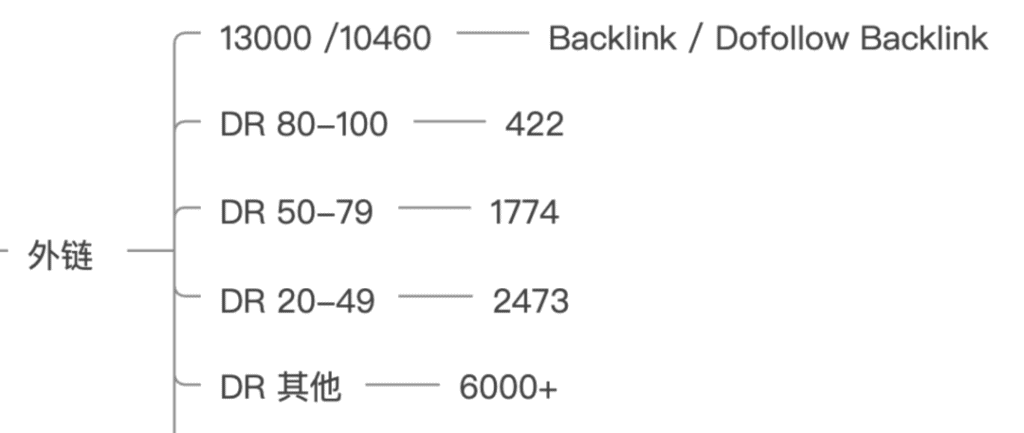
Philips Hue backlink profile in the source snapshot
The source states that its Ahrefs comparison did not count nofollow links as passing ranking credit.
It therefore focused on dofollow referring domains.
The historical dataset contained 10,460 dofollow domains out of roughly 13,000 referring domains, a share above 80%.
The author notes that this was much higher than for many brands in the comparison set.
The strongest bands were dofollow domains with Domain Ratings of 80–100 and 50–79.
The source considered the potential value of these links exceptionally high.
It estimated that a dofollow placement from a DR 80–100 domain could cost more than US$1,000 in a commercial market and noted that such links were rarely available to buy.
It also estimated an average above US$300 for DR 50–79 links.
On those assumptions, the author valued the profile at close to US$1 million. These are source-era estimates, not a current market valuation; the author suggested earned-media outreach as a more attainable route.
How Can a Smaller Brand Build Links at This Scale?
Invest seriously in content that helps and influences the audience.
Useful content can continue attracting links over time, unlike a one-off influencer campaign whose effect may end when the campaign stops.
Strong content may therefore support both traffic and authority.
4. E-A-T
The source uses Google's earlier E-A-T framing.
In simple terms, it means demonstrating credible expertise in the category.
The article connects that credibility mainly with strong, relevant links and expert content, ideally written or reviewed by recognised specialists.
Philips Hue had dofollow links from major organisations and platforms including Google, Apple and Amazon in the source dataset.
The author believed the site's content did not explicitly implement every E-A-T convention.
However, the scale and reputation of the brand supplied strong trust signals in the author's assessment.
Smaller sellers cannot rely on brand recognition at this scale. They should show who created or reviewed the content and cite supporting sources.
5. Social Media
The three social accounts shown in the source were not unusually large for a brand of this scale.
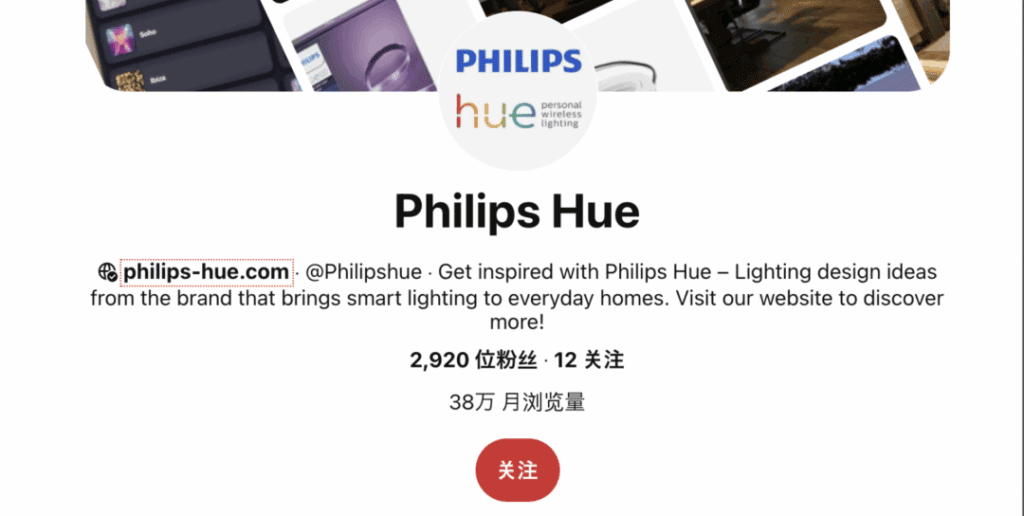
Historical Philips Hue Pinterest account
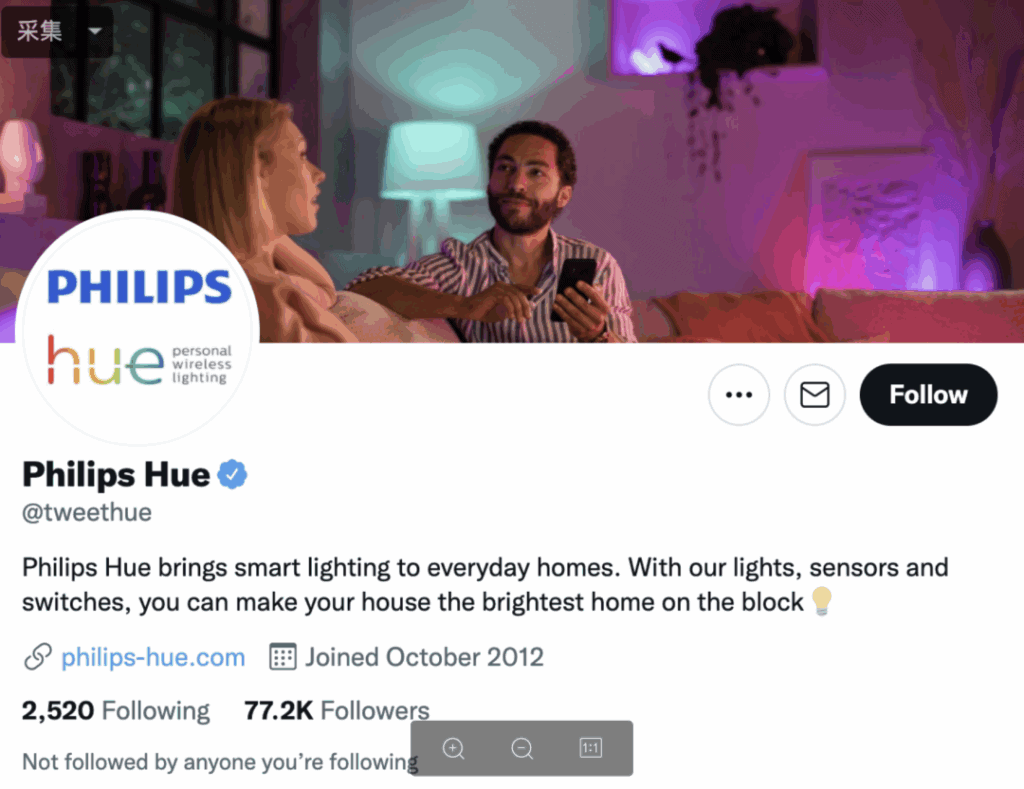
Historical Philips Hue Twitter account
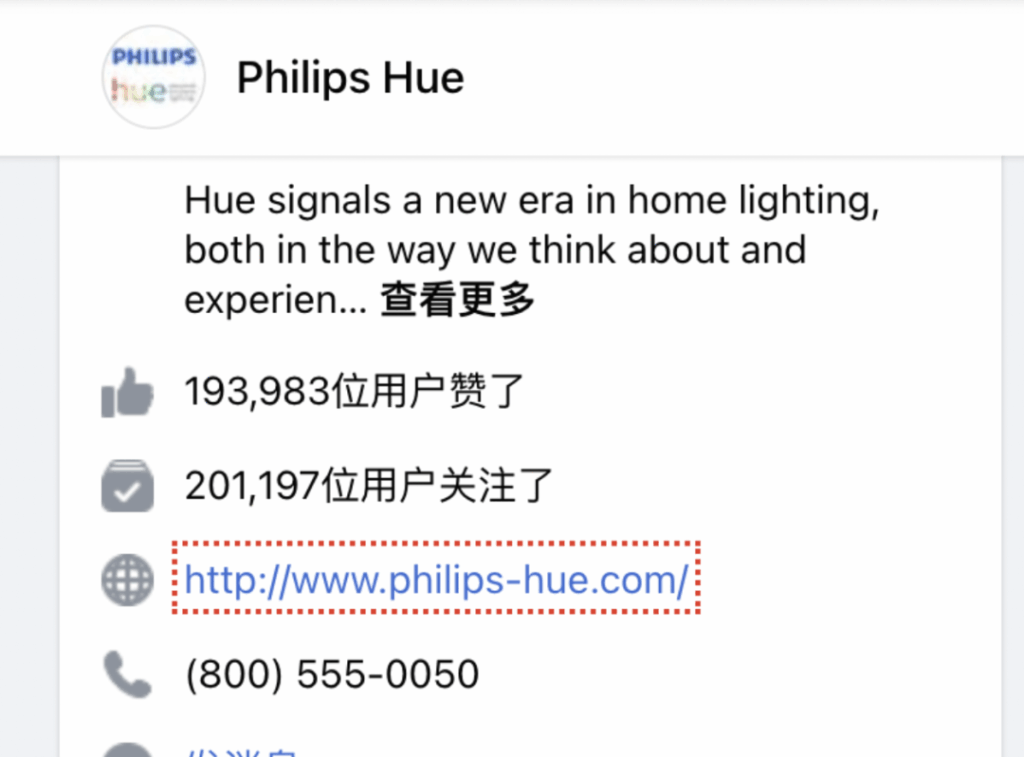
Historical Philips Hue Facebook account
At that time, the brand appeared most active on Facebook and Twitter.
The author believed the company's existing recognition reduced the need to invest heavily in every social channel.
A newer brand may need to share new articles and products consistently on the channels its audience actually uses.
Relevant sharing controls can make useful content easier for visitors to distribute.
A well-moderated community forum may be another option when it suits the audience and resources.
6. Technical SEO
Visitors cannot see most technical SEO work, but it is critical for a large ecommerce site.
An ecommerce site with numerous technical errors will struggle to make its strongest pages consistently accessible and indexable.
The source believed Philips Hue used a custom implementation with relatively clean code and few crawlable parameter URLs.
For example, a filtered URL such as https://domain.com/product-category/?filter_color=black can become indexable when faceted navigation is not controlled deliberately.
You might point out that Amazon has many parameterised URLs and still ranks strongly.
Amazon's extraordinary authority and link profile make it a poor technical benchmark for a smaller site.
The source recommended crawling WooCommerce sites for filter URLs and controlling them in bulk. Current implementations should be validated carefully: noindex, canonical, crawl controls and internal-link handling have different effects, and nofollow should not be applied mechanically.
The source frames site equity as finite and argues that excessive low-value URLs can disperse internal links and crawl attention, particularly when thin pages attract no independent demand or links.
That can make it harder for strong pages to receive clear internal support.
7. Why Traffic Rose So Quickly
The source found an important clue in the history of Philips Hue: an earlier site used the Meethue domain.
According to the historical tracking in the article, Philips Hue did not build all organic visibility from zero. A sitewide 301 migration from Meethue transferred much of the earlier site's history and link signals to the new domain.
When a traffic chart shows an overnight increase of hundreds of thousands of visits, it is worth checking whether a migration or 301 redirect was involved.
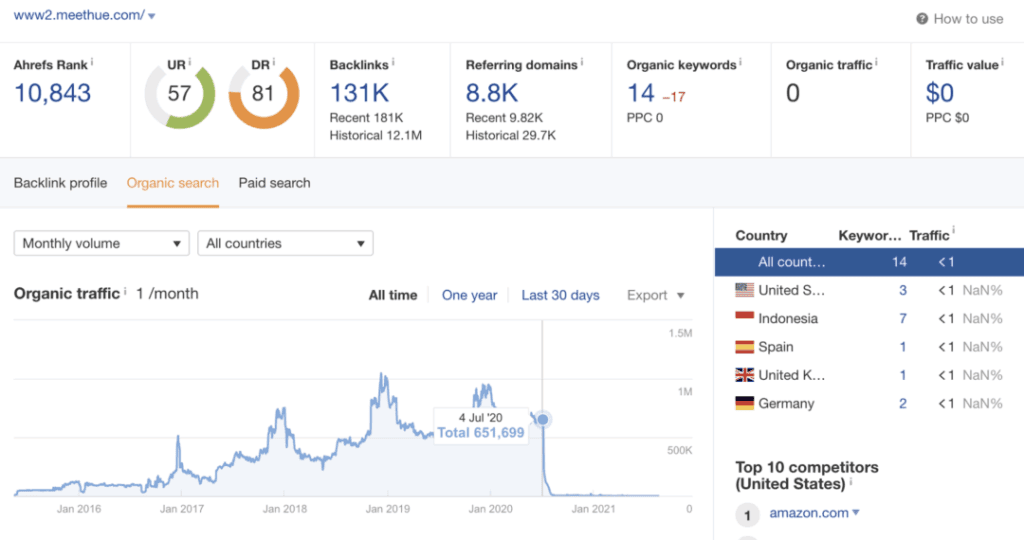
The earlier Meethue site
The Philips Hue curve appears below:
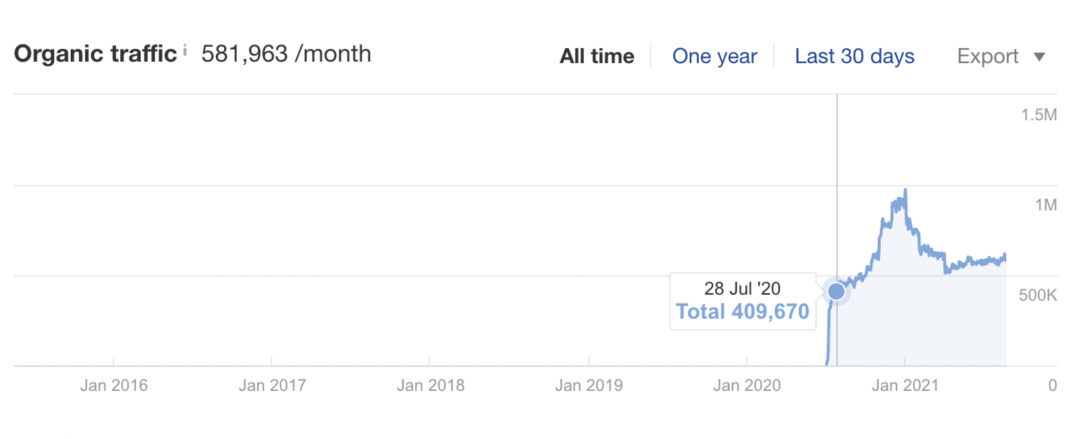
The later Philips Hue site
A properly implemented 301 migration is a standard white-hat practice for a domain change or brand restructure. It is not equivalent to manufacturing links or using a grey-hat shortcut.
However, a 301 migration is not traffic arbitrage. Weak content, confused architecture or poor mapping can still cause substantial losses after a move.
The case is therefore useful for businesses consolidating domains or rebranding.
Final Thoughts
The Philips Hue case supports a broader point: durable brand traffic is built through long-term, systematic investment rather than a short-lived trick.
For any business that wants to build brand influence, SEO requires:
- Long-term content development;
- Rigorous technical architecture;
- Disciplined link acquisition;
- Continuous improvement to the user experience.
More importantly, the team must agree that careful foundations can make later progress faster.
The source closes with a warning for teams operating brand sites:
Avoid black-hat and grey-hat tactics. They may work briefly, but discovery can erase rankings, damage the wider brand and threaten the business.
White-hat SEO may start slowly and require substantial work, but it is designed to build a durable asset. Careful progress takes longer, yet it can last much longer.