On this pageTable of contents+
- 1. How to Choose a Search Strategy: Locate the Business in This Triangle
- 1) Time: Do You Need an Immediate Response or a Compounding Asset?
- 2) Budget: Are You Renting Attention or Building an Asset?
- 3) Competition: Coordination Can Cover More of the Results Page
- 4) SEO vs PPC: Source-Era Comparison Data for 2024–2025
- Summary
- 2. The Difference Is Not Simply “SEO Is Slow and Ads Are Fast”
- 1) The Audience's State of Mind
- 2) The Conversion Path
- 3) The Content Format
- 4) The Investment Model
- 5) Coordination: Build a Portfolio, Not a Channel Contest
- 3. How to Build a Coordinated Search Strategy
- 1) Four Common Coordination Patterns
- Pattern 1: Test Queries With PPC Before Committing SEO Resources
- Pattern 2: Use SEO to Build Understanding and PPC to Capture Later Intent
- Pattern 3: Adapt Strong SEO Content Into a PPC Landing Experience
- Pattern 4: Use Both SEO and PPC for a Core Commercial Query
- 2) Which Combination Fits? A Quick Decision Table
- 3) Why Coordination Works: Search Behaviour Moves Across Touchpoints
- Final Thoughts

When teams plan search acquisition, the question they ask most often is:
“Which is better, SEO or advertising?”
In practice, the channel is often not the underlying problem. The strategy may not fit the objective, the timing may be reversed or resources may be allocated to the wrong stage of demand.
For example:
• expecting immediate volume from a slow SEO programme; • using broad educational content for a high-intent sales objective; • relying only on expensive ads when the budget cannot sustain them.
These are common consequences of a search strategy that does not match the job.
This guide focuses on two decisions:
1. Which approach should the business prioritise now? 2. How can SEO and PPC work together so that investment in one channel supports the other?
If you are setting a search budget or are dissatisfied with current performance, the framework can help you identify avoidable waste.
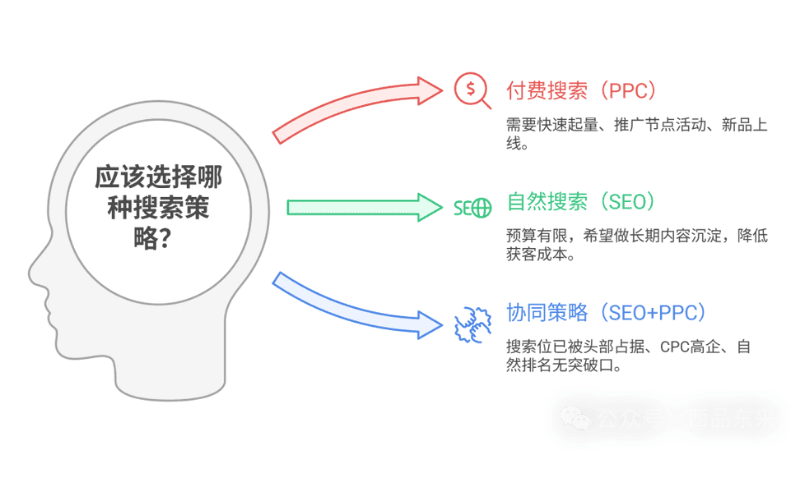
1. How to Choose a Search Strategy: Locate the Business in This Triangle
Brands often begin with “Does SEO or advertising work better?”
The more useful question is which approach fits the business at this particular stage.
To reduce wasted time and spend, assess the business across a simple triangle: time, budget and competition.
1) Time: Do You Need an Immediate Response or a Compounding Asset?
The source team's project experience suggests the following pattern:
Across the source team's projects, PPC campaigns could often be launched and begin collecting useful click data within about 48 hours. That made them suitable for short promotional windows and product launches. SEO commonly required three to six months or longer to show material results. These are source-era operating ranges, not guarantees.
If a new offer launches today and needs its first wave of qualified search traffic within seven days, SEO alone is unlikely to meet the deadline.
If the business has a runway of at least three to six months and can sustain useful content and site improvements, SEO may later provide continuing traffic without a charge for each organic click.
2) Budget: Are You Renting Attention or Building an Asset?
A common mistake is to compare only the first visible cost.
- PPC return can be measured quickly, but auction prices fluctuate. In the source team's 2024–2025 observations, clicks on some competitive commercial queries exceeded US$8; current costs vary by market, match type, quality and competition.
- SEO requires labour, expertise and time. A page that earns durable visibility does not incur a platform fee for each organic click, but it still needs maintenance and there is no permanent ranking guarantee.
The source reports long-term returns of 5–12 times investment for several mature SEO programmes it tracked.
That internal range is not a universal ceiling for PPC or a forecast for another business. Compare both channels using the same attribution window, costs and contribution margin.
The important question is not simply how to spend less, but which investment buys temporary demand and which builds a reusable search asset.
3) Competition: Coordination Can Cover More of the Results Page
Search results have limited prominent positions, and visibility is distributed unevenly.
The source cites a 2024–2025 industry estimate that more than 54% of organic clicks went to the top three positions. The exact share varies by query, device, result features and dataset.
In the source team's advertising accounts, ads received more than 60% of measured clicks for some high-commercial-intent query sets. This is an internal observation, not a general Google benchmark.
SEO alone may struggle to gain immediate visibility in a competitive result set. PPC alone can face rising acquisition costs or a conversion ceiling if the landing experience and brand demand are weak.
That is why more teams use a coordinated model:
PPC provides rapid, measurable visibility near the front of the campaign.
SEO develops discoverable content and brand trust over a longer period.
4) SEO vs PPC: Source-Era Comparison Data for 2024–2025
The following table preserves the key ranges in the Chinese source so readers can see the proposed trade-offs. Treat every number as a historical benchmark to validate against current account data.
| Dimension | Organic Search (SEO) | Paid Search (PPC) |
| Time to Initial Impact | The source uses an average range of 3–6 months. | Ads can begin collecting clicks within 24–48 hours after launch and approval. |
| Return on Investment | The source reports 5–12 times long-term ROI for selected mature projects. | The source uses an approximate average of two times for paid campaigns. |
| Click Cost | No platform fee is charged per organic click, although content, technical work and maintenance have real costs. | The source observed common CPCs around US$4–5 and US$8–9 in highly competitive sets. |
| Stability | Established rankings can continue to drive traffic, but they can still change. | Traffic from a campaign normally stops when spend or delivery stops. |
| Click Concentration | The source cites more than 54% of organic clicks for the top three positions. | The source observed more than 60% ad click share for selected commercial terms. |
| Best-Fit Uses | Content assets, brand education and longer-term acquisition. | Fast exposure, demand capture, testing and time-sensitive campaigns. |
| Opportunity to Work Together | Organic content can inform landing pages and develop a reusable search asset. | Paid campaigns can test queries, offers and conversion paths while adding results-page visibility. |
* The figures above come from public 2024–2025 industry trends cited by the Chinese source and performance observed in the source team's own projects. They are not absolute values for every brand. Current market, measurement and account data must determine any forecast.
Summary
When time, cost and competition are considered together:
- For a promotion that must create demand and sales immediately, PPC is usually the faster test and distribution channel.
- For brand education and lower long-run dependence on paid clicks, SEO can be the primary long-term investment.
- In many real situations, the two channels can cover different stages of the journey more effectively together than either can alone.
2. The Difference Is Not Simply “SEO Is Slow and Ads Are Fast”
“One is slow and one is fast” or “one is free and one costs money” is the first impression many people have of SEO and PPC.
That binary view can lead to poor decisions.
The more important difference is the path each channel creates.
Across its brand work, the source team treated SEO and PPC as two different growth models.
They can reach people at different stages, play different roles, require different content and lead to different conversion paths.
The following five perspectives make those differences easier to understand.
1) The Audience's State of Mind
• SEO often reaches people who are exploring, comparing and forming an opinion. • PPC can capture people who express a more immediate commercial intent and need a credible destination.
This is why SEO often supports education, comparison and brand familiarity.
PPC can address a short-lived query opportunity and move a ready prospect towards the next action.
2) The Conversion Path
SEO often develops a relationship over several interactions.
Content, repeat searches and brand recognition may gradually support a purchase decision rather than closing it in one visit.
PPC is usually more direct.
An ad click can come from a user with stronger intent, but the person may still be comparing options and is not automatically ready to pay.
The landing page must establish relevance, trust and a clear next step quickly. “Three seconds” is a useful reminder about attention, not a universal conversion rule.
3) The Content Format
SEO content often answers “Why should I trust this source?”
A PPC landing page often answers “Why should I take this action now?”
In practice:
• SEO content behaves like a rational adviser, with organised and complete information. • PPC creative and landing content behave more like a focused sales conversation, highlighting the offer, benefit and immediate problem.
An educational SEO page may perform poorly as an ad landing page if it does not help a high-intent visitor make a decision.
4) The Investment Model
SEO is not free; its distinctive value is that useful content and technical improvements can become reusable assets.
A well-designed content structure can keep supporting discovery, subject to ongoing competition, maintenance and ranking changes.
PPC is usually priced by clicks, impressions or outcomes. It can produce results quickly, and delivery usually falls when the budget stops.
It is useful for time-sensitive opportunities and can also support a long-term acquisition programme when the unit economics remain healthy.
Both channels can create traffic, but they allocate cost, risk and learning differently.
5) Coordination: Build a Portfolio, Not a Channel Contest
The question is not always which channel to choose, but how the two should divide the work.
The source observed more high-growth brands building a coordinated path:
| SEO | PPC |
| Build trust and a reusable search asset | Capture active demand and prompt the next action |
| Extend the journey with a connected content set | Test query intent, offers and conversion destinations |
| Reduce long-term reliance on paid acquisition | Reach high-intent users and support time-sensitive campaigns |
One way to see it is that SEO builds the road while PPC puts traffic on selected routes.
A search strategy is not all-or-nothing. Long-term content foundations can make short-term campaigns more credible, while paid data can improve the next organic investment.
3. How to Build a Coordinated Search Strategy
Rather than choosing a side, design the channels so that each can improve the other's decisions and outcomes.
The goal is a coordinated search strategy:
a system that educates and captures demand, improves long-term acquisition economics and still provides a lever for short-term conversions.
1) Four Common Coordination Patterns
The following patterns are among the most practical combinations in the source team's work. Choose the one that matches the current constraint.
Pattern 1: Test Queries With PPC Before Committing SEO Resources
Method: use a controlled paid budget to test real click-through and conversion behaviour for selected queries.
Use the results to give SEO prioritisation first-party evidence and reduce the risk of building content for the wrong audience or intent.
Result: focus long-term content investment on queries that show both a useful search task and plausible commercial value.
Pattern 2: Use SEO to Build Understanding and PPC to Capture Later Intent
SEO can serve early questions such as “What is XX?” and “How do I choose XX?”
PPC can address later actions such as “XX price” or “recommended XX”, where a user may be closer to a decision.
Together they can support a journey such as learn → remember → search → buy.
Pattern 3: Adapt Strong SEO Content Into a PPC Landing Experience
Conditions: the page has a complete structure, fast loading, useful evidence and clear trust signals.
Potential result: relevant content may improve the landing experience, support conversion and sometimes lower paid-media costs.
Caution: comparison, review and solution pages often adapt more naturally than broad educational explainers. Test the page rather than assuming reuse will work.
Pattern 4: Use Both SEO and PPC for a Core Commercial Query
Typical case: a high-intent query such as “recommended mite vacuum” or “skincare for sensitive skin”.
Method: run an eligible ad while continuing to earn an organic position, so the brand may appear in more than one part of the results page.
Potential result: broader visibility can improve recognition and click opportunities, but lift must be measured with incrementality and conversion data rather than assumed.
2) Which Combination Fits? A Quick Decision Table
| Business Condition | Suggested Starting Mix |
| Cold start with little search awareness | Prioritise PPC for rapid learning and begin SEO foundations in parallel. |
| Existing SEO traffic but weak commercial conversion | Use PPC to test high-intent offers and close gaps in the journey. |
| Limited budget and a goal to reduce long-term CAC | Prioritise durable SEO work while preserving a small PPC testing window. |
| Useful content assets but weak conversion rates | Improve the organic experience and test adapted PPC landing pages. |
| Highly competitive market with limited first-page visibility | Use PPC for near-term coverage while SEO develops a longer-term competitive position. |
3) Why Coordination Works: Search Behaviour Moves Across Touchpoints
Search journeys are rarely linear. People move between channels, repeat queries and gather information in fragments.
A user may read an SEO page about “What is XX?”, encounter the brand on social media three days later and eventually purchase after searching an ad-led query such as “recommended XX”.
SEO and PPC therefore should not operate as isolated systems. Their data, messages and destination pages should connect.
Coordination does not merely add another channel. It turns one click into a sequence of useful encounters and gives a conversion the context built by earlier touchpoints.
Brands that make this model work tend to share three practices:
1. Teams select queries around the customer's decision journey rather than departmental ownership. 2. They design content around the conversion path, not traffic alone. 3. They share evidence and landing experiences across advertising and SEO.
Final Thoughts
The real question is whether the business has built a search-growth structure that can compound over time while still responding to short-term opportunities.
SEO is like land on which the brand can build content assets and trust.
PPC is a route to active demand and faster testing.
Mature search programmes do not have to bet everything on one channel. They design the underlying system so that the channels reinforce each other.
If you remember one point, make it this:
Search growth is a systems problem, not merely a contest for traffic.
The strongest advantage comes from a sound structure, clear economics and continuous learning—not budget alone.