
On this pageTable of contents+
- 1. A Credible GEO Case Needs a Complete Chain of Evidence
- What Does a Pre-GEO Baseline Report Look Like?
- 2. Seven Core Metrics for a GEO Case
- Level 1: Does AI Know the Brand?
- Level 2: Is AI Willing to Recommend the Brand?
- How Do You Assess Positive Mention Rate?
- Level 3: Did Users Take Action?
- 3. Three Common Ways GEO Cases Are Misrepresented
- Type 1: Fabricated or Distorted Data
- Type 2: Claiming Someone Else's Result
- Type 3: Misattributed Causation
- 4. How to Verify a GEO Case Yourself in Three Minutes
- Step 1: Test the Prompts on an AI Platform
- Step 2: Check Whether the Data Can Be Traced
- Step 3: Cross-Check Traffic
- 5. Six Questions to Ask a GEO Provider
- 6. What a GEO Case Can and Cannot Prove
- 7. Frequently Asked Questions
- Q1: Is a Screenshot of an AI Answer Enough to Validate a GEO Case?
- Q2: How Long Does It Usually Take to See a GEO Result?
- Q3: How Does GEO Case Validation Differ for B2B and B2C?
- Q4: Can a Company Without an SEO Foundation Do GEO?
- Q5: Is "We Signed an NDA and Cannot Disclose Anything" a Credible Answer?
- Q6: How Can a Small-Budget Company Validate a Provider at Low Cost?
- Final Thoughts

To judge whether a GEO success story is credible, do not look only at how impressive it sounds, and never rely on a single screenshot of an AI answer. A useful case must be verifiable and reviewable, and it must explain where the result came from.
Companies buying GEO services are often attracted by claims that AI recommended a brand, the AI citation rate increased or a case performed well. These statements do not prove success. AI answers fluctuate, testing conditions affect results and reporting definitions can be manipulated. Without a period, platform, sample, baseline and attribution method, a case provides a weak basis for a decision.
Instead of presenting more success stories, this article gives you a framework for evaluating them. You can use it to decide quickly whether a provider's GEO case contains useful evidence or belongs only in a presentation.
1. A Credible GEO Case Needs a Complete Chain of Evidence

Seven elements in the evidence chain for a GEO case
A credible GEO case should explain at least seven points:
- Which AI platform was tested: ChatGPT, Perplexity, Doubao and Google AI Overviews work differently.
- Which prompts were tested: real user questions, not questions selected to produce attractive results.
- The pre-optimization baseline: how often the brand appeared, whether the official website was cited and how frequently competitors appeared.
- The observation period: one screenshot is meaningless; examine a trend of at least four to eight weeks.
- Which metrics changed? Did the brand appear more often? Were more references positive? Did citations or AI referral traffic increase?
- Whether the change can be attributed reasonably: did GEO produce the growth, or did concurrent brand advertising or PR contribute?
- Whether the work produced a real business result: visits, enquiries, demos or CRM leads.
Prompts are what users ask AI. A GEO test should not use only one. Cover the full journey: start with "how should I choose?", move to "is A or B better?", and end with "which brand suits a small home?"
AI referral traffic means visits from an AI platform, such as a user clicking through from ChatGPT to the official website. This metric shows whether AI visibility has produced actual traffic.
An attribution boundary defines which growth can reasonably be associated with GEO and which cannot. Without it, organic SEO growth, brand advertising and PR traffic can all be repackaged as GEO results.
What Does a Pre-GEO Baseline Report Look Like?
"Baseline" may sound technical, yet many providers cannot explain it. A reasonable baseline looks approximately like this:
| Baseline dimension | Acceptable standard |
| Sample size | 50 to 100 prompts, not 10 and not 1,000 |
| Number of platforms | At least three major AI platforms, such as ChatGPT, Perplexity, Doubao or Gemini |
| Test period | Two consecutive weeks, with each prompt tested at least once a day |
| Total sample | 50 prompts × 3 platforms × 14 days ≈ 2,100 tests |
| Baseline data | How often the brand appeared, the share of prompts that named it, cited sources, how often competitors appeared and where the answer placed the brand |
For example, a water-filter brand's baseline report covers 60 relevant prompts on three platforms over 14 consecutive days. The brand appeared 17 times, for a mention rate of 0.67%; nine mentions were positive, the official website was cited once and the primary competitor appeared 143 times. Only with this starting point can the team make a meaningful post-optimization comparison.
If a provider says only that the brand "hardly appeared before optimization," that is a sales line, not a baseline.
In its GEO services, GlobalBrandsDigital begins with industry-relevant prompts that have strong commercial intent and sit late in the purchasing journey. For an outdoor-camping client, for example, we monitor "recommended family camping tents" and "which four-person tent brand should I choose?" rather than "what is camping?" These prompts mirror real purchases, so the results are easier to connect to sales.
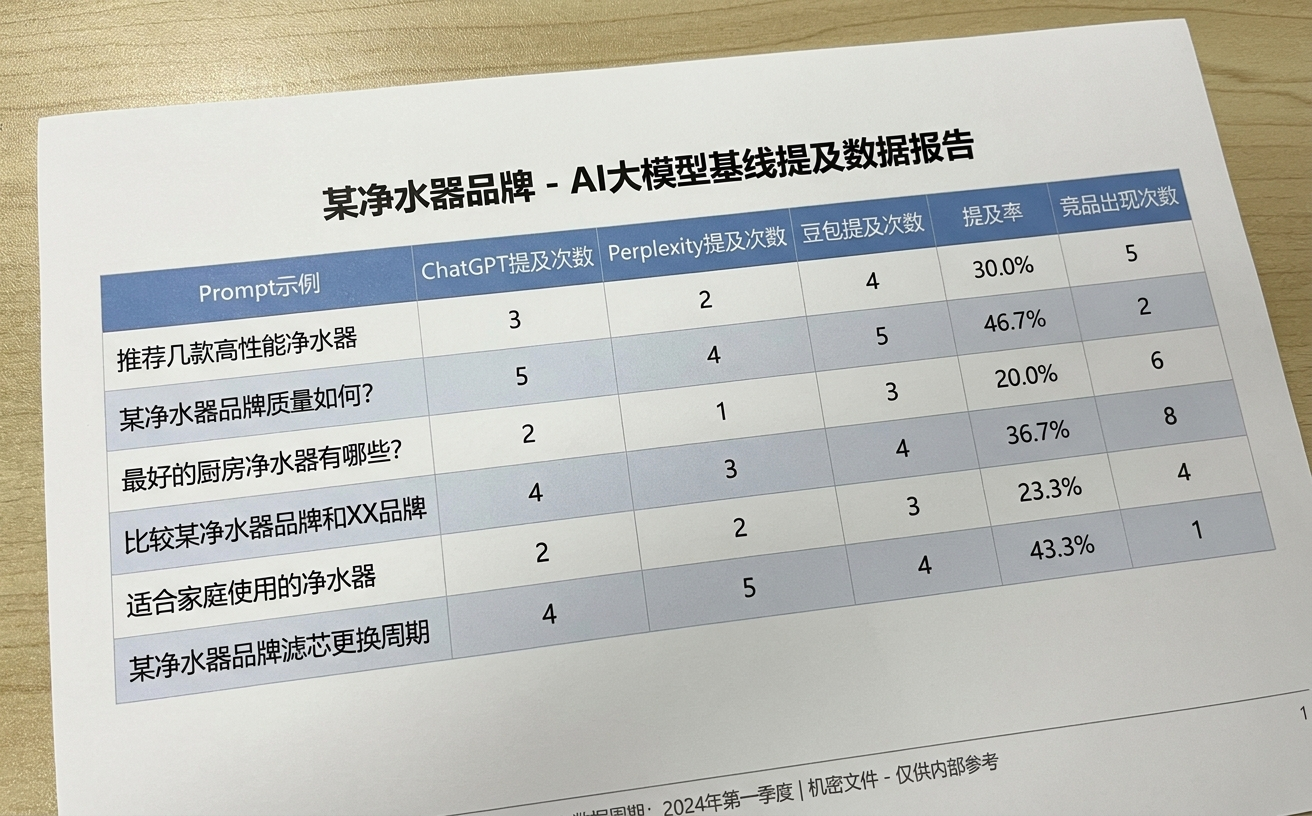
Example data from a pre-optimization GEO baseline report
2. Seven Core Metrics for a GEO Case
The metrics that reveal whether GEO is working fall into three levels.
Level 1: Does AI Know the Brand?
Brand mention rate: the percentage of target prompts in which AI mentions the brand. For example, it may appear in five of 100 answers before optimization and 22 afterward.
Accuracy of the brand description: does AI describe the brand correctly, or does it introduce incorrect information?
If AI cannot even explain what the brand is, recommendations and citations are unlikely to be stable.
Level 2: Is AI Willing to Recommend the Brand?
Positive mention rate: does AI describe the brand as a positive recommendation, mention it neutrally or issue a negative warning such as "avoid this type of brand"? An appearance can have opposite value depending on its sentiment.
Citation rate: does the AI answer cite the official website, blog, product page or industry content? A citation matters more than a mention. It shows that AI is beginning to use material from the brand.
Answer position: does the brand appear near the beginning or at the end of a list? Is it a primary recommendation or a passing mention?
How Do You Assess Positive Mention Rate?
Look at the adjectives and verbs used when the AI answer describes the brand:
| Mention type | Common wording |
| Positive | "recommended," "suitable," "well reviewed," "good value" or "worth considering" |
| Neutral | "also available," "another option" or "the market also includes" |
| Negative | "avoid," "not recommended," "users have reported problems" or "use caution" |
For a small sample, people can label the answers manually. For a large sample, AI-assisted labeling may be more practical. The important requirement is a defined classification rule; do not accept a provider's unsupported claim that every mention was positive.
Level 3: Did Users Take Action?
AI referral traffic: visits delivered by AI platforms.
Leads and conversions: for a B2B company, form submissions, demo bookings and CRM sales leads are the final outcome.
Change in competitor appearance rate: within the same prompts, is the brand gaining visibility relative to competitors?
A case that shows only level-one data is an awareness case. A case that reaches level three is a commercial case.
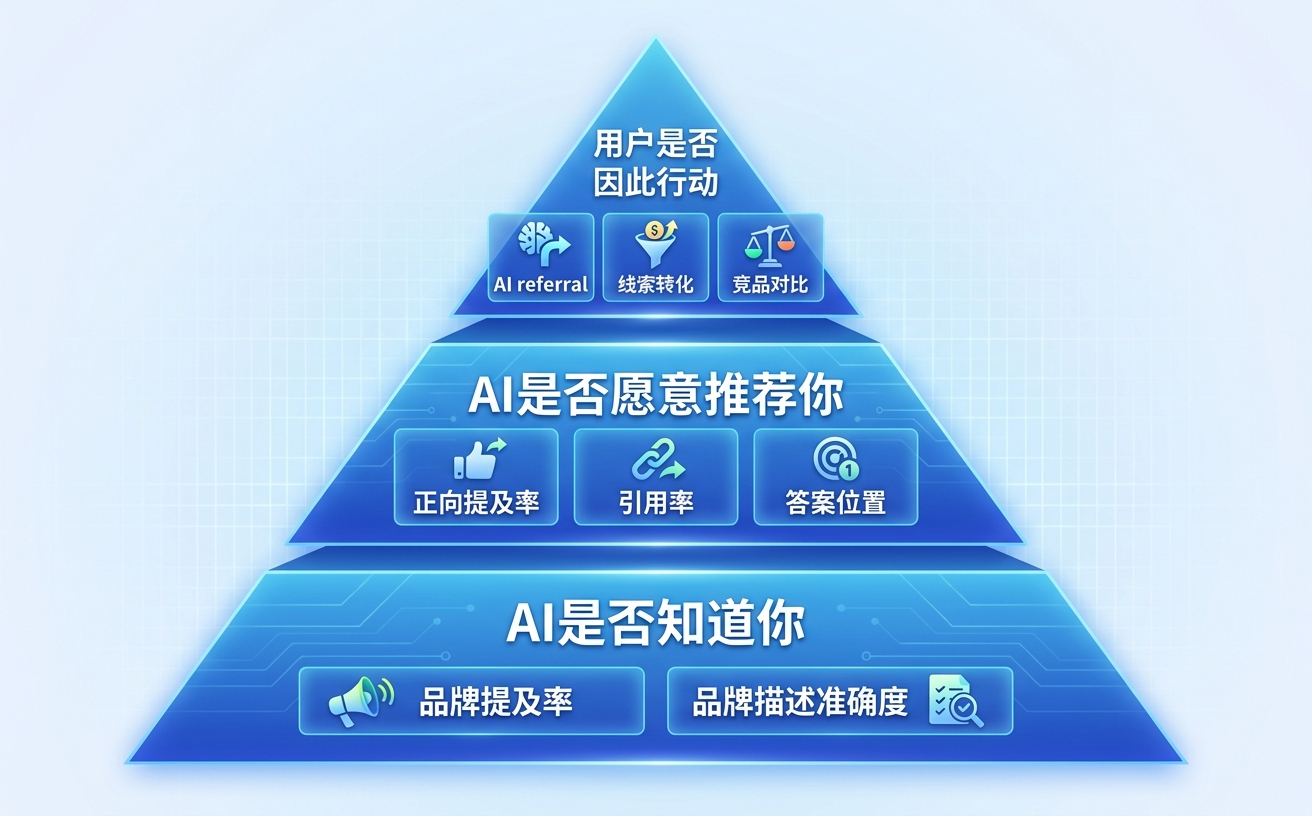
Three-level pyramid for evaluating GEO outcomes
3. Three Common Ways GEO Cases Are Misrepresented
Type 1: Fabricated or Distorted Data
The most common tactic is to invent or exaggerate percentages: "AI citation rate increased by 300%" or "brand mention rate grew by 500%."
The larger the percentage and the less clear the starting point, the more cautious you should be. A 300% increase sounds impressive, but a rise from one appearance to four is also 300%. Always ask for the base number.
A subtler variation is cherry-picking successful samples. A provider may test 100 questions, show the three successes and hide the other 97 failures.
Type 2: Claiming Someone Else's Result
A provider takes a publicly reported GEO result for a brand and presents the brand as its own client.
To identify this, search the brand name from the case in Google. Check for third-party media coverage and see whether the reported service provider is the one making the claim.
Type 3: Misattributed Causation
This is the most difficult type to detect. The client's traffic did increase and the data is real, but GEO was not the reason. The brand may have run advertising or a KOL partnership at the same time, or benefited from an industry trend. The provider then claims all the credit.
Ask for traffic sources to be separated and examine the contribution from AI referrals rather than total traffic.
Misrepresentation is common partly because the GEO industry does not yet have an official, authoritative tool comparable to Google Search Console. AI answers are also a black box, giving a provider the convenient excuse that an algorithm change made the result impossible to reproduce. Buyers who are unfamiliar with generative AI can also be distracted by terms such as RAG and vector retrieval.
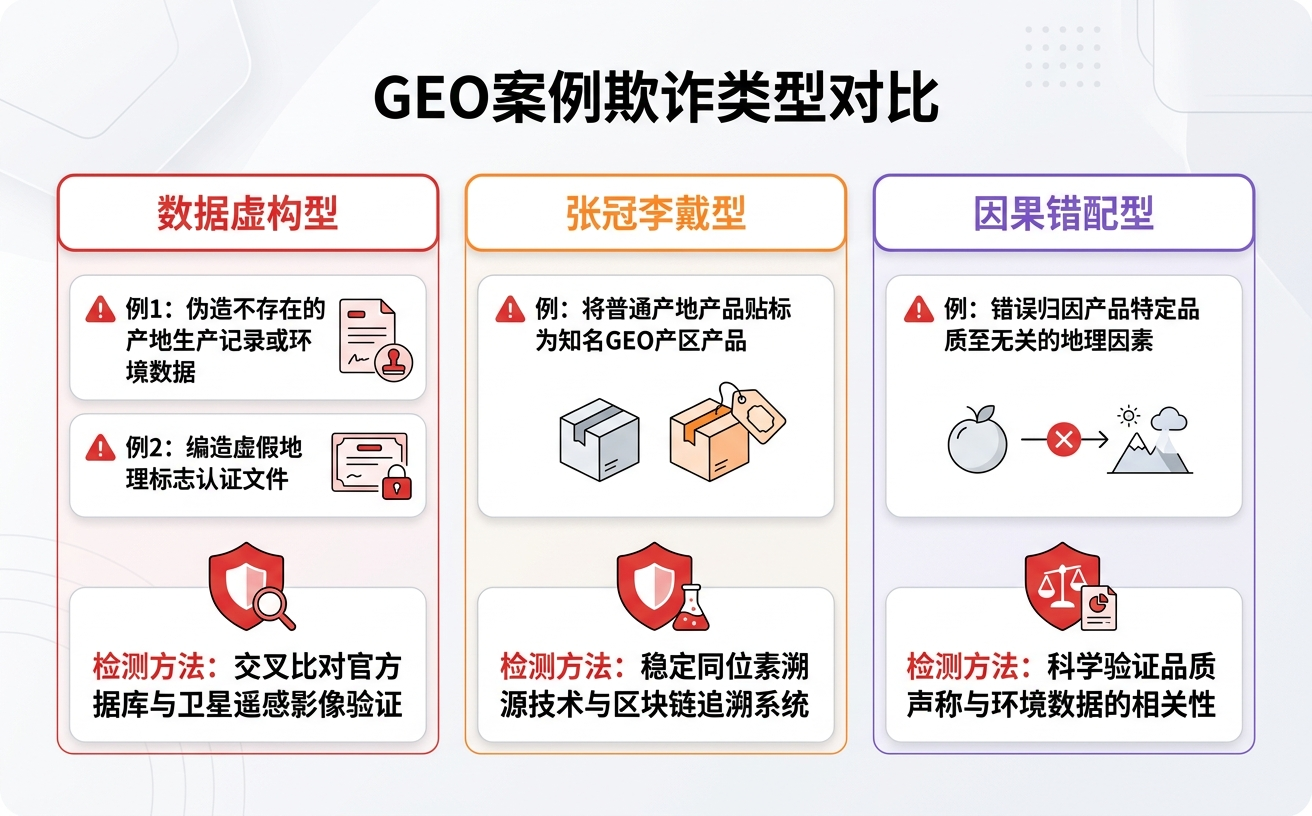
Three types of misleading GEO case and how to identify them
4. How to Verify a GEO Case Yourself in Three Minutes
You can complete an initial three-step check without a paid tool.
Step 1: Test the Prompts on an AI Platform
Copy the prompts from the case into ChatGPT, Perplexity or Doubao and run them yourself. Check three things: did the brand appear, where did it appear and which website was cited?
If the answer cites only the brand's official website, the result carries limited weight because AI already tends to cite an official site. More valuable citations come from independent reviews, professional media and Q&A communities.
But what if the AI answer changes every time?
Use a small sample with repeated testing for a rough check:
- Select three to five primary prompts.
- Express each prompt in two or three ways, such as "cleanser recommendations for sensitive skin," "what facial cleanser should sensitive skin use?" and "which cleanser brand is good for sensitive skin?"
- Test each version three times.
- Each prompt will then have six to nine test results.
As a rough standard, if the brand appears at least three times in six to nine tests, the case has some observable basis. If it appears fewer than twice, the claim may be more presentation than substance.
This method is not rigorous, but it is sufficient for screening a provider before purchase. Accurate measurement requires a professional monitoring tool.
Step 2: Check Whether the Data Can Be Traced
Ask the provider for original dashboard screenshots that include timestamps and URLs, not just charts in a presentation. Ask which monitoring tool was used. Third-party platforms such as AthenaHQ, Profound and Otterly can provide relatively independent data. If the provider says it uses an internal system, ask whether clients can log in and view live data. A service that permits only a monthly report is effectively a black box.
A credible provider commonly uses third-party and in-house platforms together:
| Monitoring method | Purpose | Limitation |
| Third-party platform | Provides broad industry measurement with a fixed prompt set and template, relatively independent data, and cross-brand comparisons of overall visibility | Can be customized only slightly and may not reflect how a specific company works |
| In-house platform | Provides business-specific depth through custom prompts, grouping by scenario and tracking changes in competitors' recommendation rates for relevant prompts | In-house data may be biased if it is not cross-checked |
Comparing both sources makes the results more independent and more useful to the company. Each source has blind spots when used alone.
GlobalBrandsDigital built its GEO tracker because third-party tools cannot be tailored far enough. People ask very different things when buying home appliances, pet food, industrial machines or SaaS. A company can add its own prompts and group them by the early, comparison and final stages of a purchase. It can also track how often AI names or recommends each competitor for those prompts.
Even when an in-house platform is used, we recommend cross-checking the results with a third-party tool.
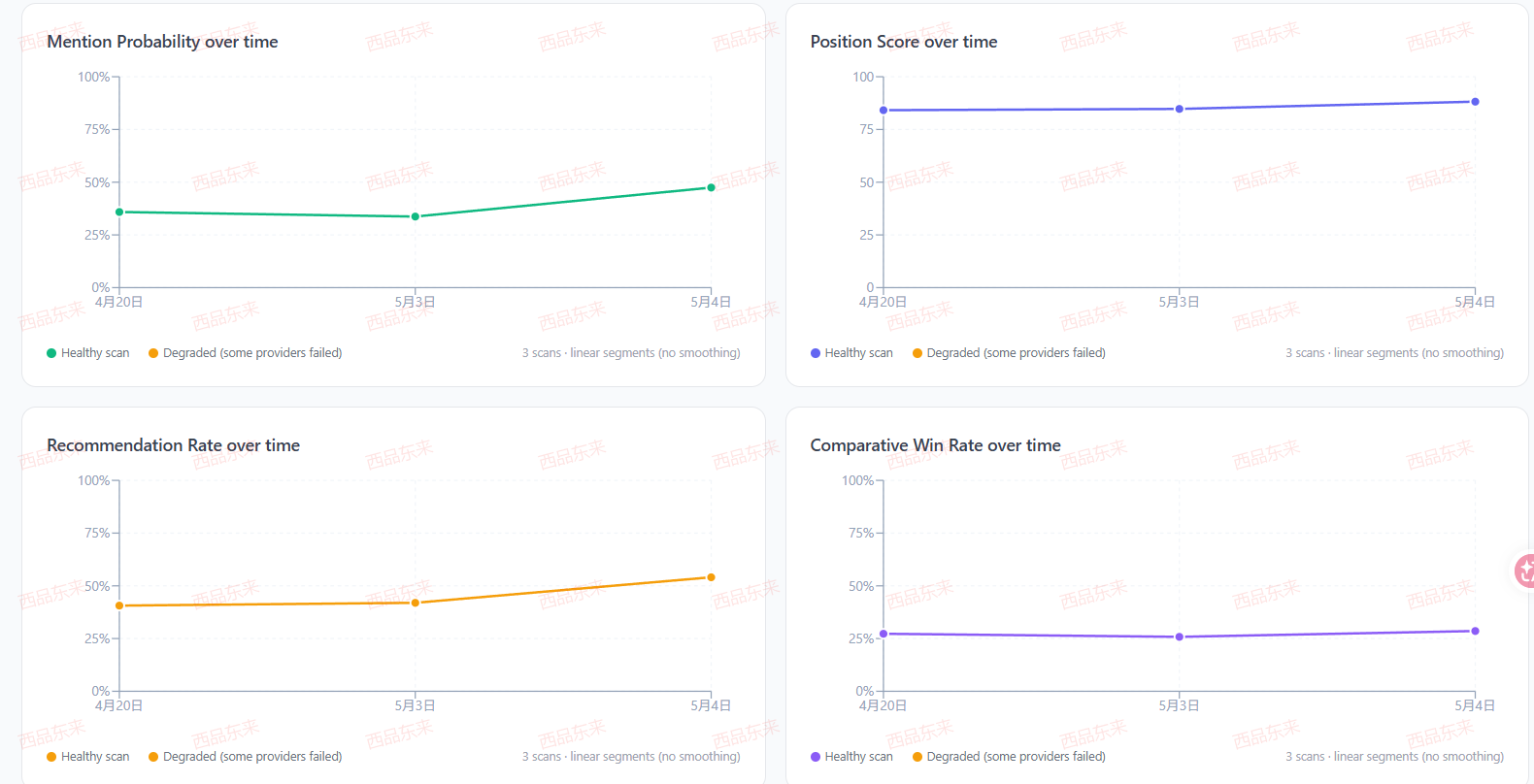
Data dashboard in GlobalBrandsDigital's GEO tracking platform
Step 3: Cross-Check Traffic
Use the free version of Similarweb or Ahrefs to examine the client's website traffic curve and see whether the timing aligns. If a case says optimization began in the fourth quarter and traffic doubled three months later, check whether the data from Q4 through the following Q1 shows that change.
At a deeper level, look for a material increase in the share of traffic from AI referrals. If overall traffic increased but AI traffic did not, the increase cannot reasonably be attributed to GEO.
5. Six Questions to Ask a GEO Provider
Take this checklist into the sales conversation. A provider that can answer these questions has done much of the work needed to establish credibility; one that cannot has revealed an important limitation.
| Question to ask | What a credible answer looks like | Warning sign |
| What industry and company size did the client represent? | Outdoor products, with annual revenue of 80 million | "We cannot disclose that" |
| How were the prompts selected? | From the customer decision journey, including comparison and decision prompts | Only questions likely to show the brand were selected |
| What was the pre-optimization baseline? | Specific mention-rate data and a competitor comparison | "The brand hardly appeared before" |
| Which tool measured the citation rate? | A combination of third-party and in-house platforms | "It is our internal system and we cannot show it" |
| Is this client still renewing the service? | The client has renewed for two years | An evasive answer |
| Can the same method be reproduced in my industry? | A clear explanation of what can and cannot be done | "It will work 100%" |
The final question is the most important. Do not trust a provider that promises the result can be reproduced with complete certainty. GEO outcomes depend on industry competition, the brand's starting position and the depth of its content assets. There is no 100% guarantee.
6. What a GEO Case Can and Cannot Prove
A GEO case can show whether an optimization direction is effective. If one set of prompts improves for several consecutive weeks, brand mentions rise, official content earns citations and the gap with competitors narrows, the method has some evidential value.
A GEO case can also show whether more AI answers include the brand. More frequent appearances in industry prompts, product comparisons and supplier shortlists indicate that AI is beginning to include the brand in its answers.
It cannot prove that the brand will be recommended every time. AI answers are not fixed pages; they change with time, location and context. No case can guarantee the same result for every future search.
Nor can a case by itself prove that GEO increased sales. The product, its price, the website, the sales team and market demand all affect revenue. GEO can influence how people discover and research a brand, but it cannot be assigned every outcome.
A provider that guarantees AI recommendations or a specific number of leads is either unprofessional or dishonest.
7. Frequently Asked Questions
Q1: Is a Screenshot of an AI Answer Enough to Validate a GEO Case?
No. A screenshot proves only that the brand appeared once. It cannot demonstrate long-term stability or prove that the result produced a visit, lead or conversion.
Q2: How Long Does It Usually Take to See a GEO Result?
Changes in citation rate may appear in two to three months. A conversion effect may take six months or longer. A promise of results in two weeks generally implies low-quality, high-volume content that may cause harm over time.
Q3: How Does GEO Case Validation Differ for B2B and B2C?
B2B validation needs to examine the search paths of several roles across the decision process. B2C can focus on prompts tied to consumer situations.
B2C prompts concentrate on the final stage before purchase: "which is better?", "how should I choose?" and "which brand suits this need?" The team can judge progress by how often the brand appears and whether people buy soon afterward.
B2B requires layered tests. A technical team may ask about "CRM system comparison" or "enterprise SaaS architecture." Buyers may ask for "recommended suppliers for this industry" or "enterprise pricing models." An executive assessing risk may ask "is this supplier reliable?" or "what are the alternatives?" Different people own each layer, and GEO needs to make the brand visible across them.
B2B sales also require a longer view. Moving from an AI mention to an enquiry and signed contract may take three to six months. The review should consider how AI helped at every stage, not merely whether AI delivered a lead directly.
Q4: Can a Company Without an SEO Foundation Do GEO?
It can begin with a diagnostic, but should not move directly into a large GEO program. GEO depends on content, technical access, brand information and external signals. Without an SEO foundation, the company usually needs to improve official-site content and crawlability first.
Q5: Is "We Signed an NDA and Cannot Disclose Anything" a Credible Answer?
An NDA protects a client's identity, not every data dimension. A credible provider can describe a client as a top-three ecommerce brand or a skincare brand with GMV in the billion range instead of using the vague phrase "a well-known brand."
Q6: How Can a Small-Budget Company Validate a Provider at Low Cost?
Ask for a small pilot lasting one to two weeks. Select three to five important prompts and see whether the provider can produce an observable change in citation rate during the pilot. If the result is promising, consider a longer agreement.
Final Thoughts
A credible GEO success story explains the platform, prompts, baseline, time period, metrics and attribution boundary. A single attractive AI screenshot used to secure a contract is packaging, not a case.
For an international company, GEO is not about chasing one screenshot of an AI recommendation. Its value lies in building a measurable, reviewable system for continuous optimization and growth.
If you are choosing a GEO provider or want to see how ChatGPT, Perplexity, Google AI Overviews, Doubao and other platforms portray your brand, begin with a GEO audit. GlobalBrandsDigital can find prompts with strong buying intent, record the starting point, compare how often AI recommends each competitor and decide which pages and sources to improve first.
Understand the present position before deciding whether to invest. Validate the direction before discussing long-term growth. That is a more dependable way to work on GEO.